

Balance Foundry Mobility Guide
Thoracic mobility exercises help you move your upper back through controlled rotation and extension instead of forcing motion through the neck or lower back. A short routine can be useful before strength training, after long periods of sitting, or as part of a broader mobility session.
The thoracic spine is the middle and upper portion of your back between the neck and lower back. It contributes to rotation, extension, posture, breathing mechanics, and overhead movement.
When that area feels stiff, people often compensate somewhere else. The lower back may arch more during overhead movement, the neck may rotate farther than intended, or the shoulders may struggle to move cleanly.
The goal of thoracic mobility training is not to force your spine into a dramatic stretch. It is to practice controlled movement through a comfortable range and help your upper back contribute more effectively to everyday movement and exercise.
What Is Thoracic Mobility?
Thoracic mobility refers to how well the middle and upper portion of your spine can move through rotation, extension, and smaller amounts of flexion and side bending.
In practical terms, good thoracic movement helps when you rotate to reach behind you, extend your upper back during overhead movements, maintain a comfortable upright position, or move your shoulders without excessive compensation from the lower back.
Mobility is not the same thing as simply being flexible. Flexibility usually refers to how much a muscle can lengthen, while mobility includes your ability to actively control a joint or body region through a useful range of motion.
If that distinction is new to you, our mobility vs. flexibility guide explains the difference in more detail.
Why Thoracic Mobility Matters
Rotation
Your upper back contributes significantly to turning and reaching. Better controlled rotation can make everyday movement feel less restricted.
Overhead Movement
Thoracic extension works together with shoulder motion. If the upper back stays rigid, the lower back may compensate by arching more.
Strength Training
Squats, presses, rows, carries, and many other exercises rely on the trunk maintaining a useful position while the limbs move around it.
Daily Posture Changes
Long periods of sitting can make the upper back feel stiff. Mobility work gives you an opportunity to move through ranges you may not use much during the day.
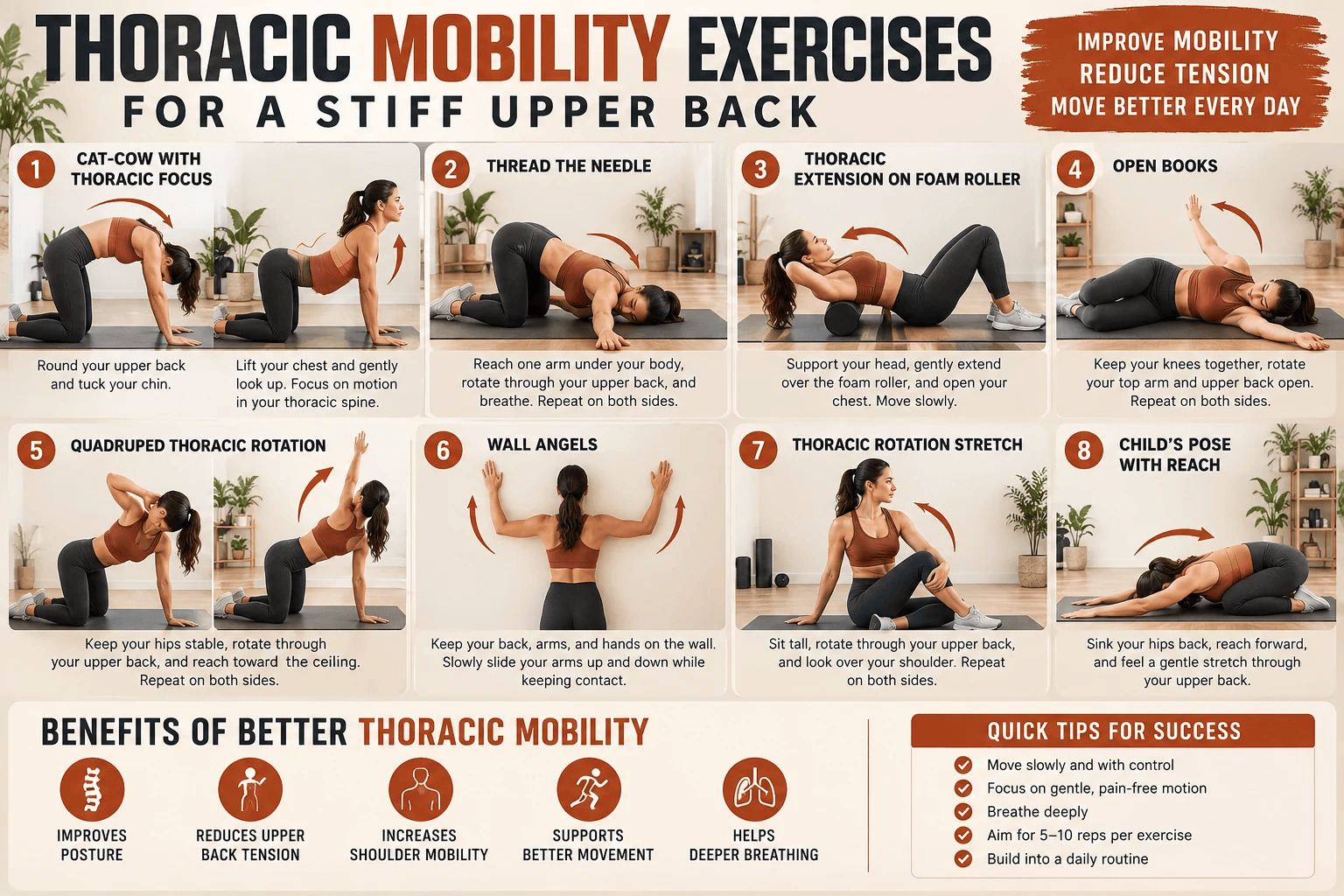
8 Thoracic Mobility Exercises
Cat-Cow With a Thoracic Focus
Start on your hands and knees with your hands below your shoulders and knees below your hips.
- Slowly round your upper back and let your head follow naturally.
- Reverse the movement by lifting your chest and gently extending the upper back.
- Keep the movement smooth rather than forcing a large arch through the lower back.
- Repeat for 6 to 10 controlled repetitions.
Think about spreading the shoulder blades apart as you round and gently drawing them back together as you extend.
Thread the Needle
This exercise combines thoracic rotation with a gentle reach through the upper back.
- Begin on your hands and knees.
- Slide one arm underneath your body toward the opposite side.
- Allow your upper back to rotate while keeping your hips relatively stable.
- Return to the starting position.
- Perform 5 to 8 repetitions per side.
The motion should come mostly from the upper back rather than from shifting the hips dramatically to one side.
Thoracic Extension Over a Foam Roller
A foam roller can provide support while you practice upper-back extension.
- Sit on the floor with your knees bent.
- Place the roller horizontally behind your upper back.
- Support your head lightly with your hands.
- Gently extend your upper back over the roller.
- Return to neutral and repeat 5 to 8 times.
Avoid turning this into a large lower-back arch. The goal is controlled movement through the upper back.
Open Book Rotation
Open books are one of the simplest ways to isolate upper-back rotation while the lower body stays relatively quiet.
- Lie on your side with your hips and knees bent.
- Stack your hands in front of you.
- Rotate the top arm open toward the opposite side.
- Follow the hand with your eyes and upper body.
- Return slowly and repeat 5 to 8 times per side.
Keep your knees together so the rotation comes primarily from the upper back.
Quadruped Thoracic Rotation
This exercise adds active rotation while challenging you to keep the hips stable.
- Begin on your hands and knees.
- Place one hand lightly behind your head.
- Rotate your elbow down toward the opposite wrist.
- Then rotate the elbow upward toward the ceiling.
- Perform 5 to 8 repetitions on each side.
Move only as far as you can without shifting your entire body sideways.
Wall Angels
Wall angels combine upper-back positioning with shoulder movement and can reveal whether you are compensating through the lower back.
- Stand with your back near a wall.
- Bring your arms into a comfortable bent-elbow position.
- Slide the arms slowly upward.
- Keep the ribs from flaring forward.
- Lower with control and repeat 6 to 10 times.
You do not need to force your hands or elbows flat against the wall if doing so changes your posture or causes discomfort.
Seated Thoracic Rotation
A seated rotation is easy to perform at home, at work, or during a warm-up.
- Sit tall with both feet supported.
- Cross your arms lightly or place your hands across your chest.
- Rotate your chest to one side without forcing the movement.
- Return to center and rotate the other way.
- Perform 5 to 8 repetitions per side.
Keep your hips facing forward so the motion does not simply come from turning the pelvis.
Child’s Pose With Reach
This variation combines a gentle upper-back stretch with a reaching motion.
- Begin on your hands and knees.
- Sit your hips back toward your heels.
- Reach both arms forward.
- For more emphasis on one side, walk both hands slightly to the opposite side.
- Hold 20 to 30 seconds while breathing normally.
Use a range that feels comfortable for your knees, hips, shoulders, and spine.
A Simple 8-Minute Thoracic Mobility Routine
You do not need to perform every exercise every day. A short routine with a few well-controlled movements can be enough.
| Exercise | Volume | Main Focus |
|---|---|---|
| Cat-Cow | 8 reps | Flexion and extension |
| Thread the Needle | 6 reps per side | Rotation |
| Foam Roller Extension | 6 reps | Extension |
| Open Books | 6 reps per side | Rotation |
| Wall Angels | 8 reps | Upper back + shoulders |
Move slowly enough that you can tell where the motion is coming from. If the routine turns into fast bouncing or large compensations, reduce the range and slow down.
Common Thoracic Mobility Mistakes
1. Forcing Rotation
More range is not automatically better. If you have to jerk or bounce into a position, the range is probably too aggressive.
2. Arching the Lower Back
Thoracic extension drills can easily become lumbar-extension drills. Keep the ribs controlled and focus on moving the upper back.
3. Moving the Hips Instead of the Upper Back
Rotation drills become less specific when the pelvis turns with every repetition. Keeping the hips relatively stable helps place more emphasis on the thoracic spine.
4. Ignoring the Shoulders
Thoracic and shoulder movement often work together. A stiff upper back can affect overhead mechanics, but limited shoulder motion can also make the upper back appear more restricted than it really is.
5. Treating Mobility Like a Max-Effort Stretch
Mobility training should emphasize control. You should be able to breathe normally and move into and out of the position without feeling trapped or forced.
When Should You Do Thoracic Mobility Exercises?
These movements can fit into several parts of your day:
- Before training: Use a few dynamic repetitions before pressing, pulling, or overhead work.
- After sitting: A short rotation-and-extension routine can break up long periods at a desk.
- During mobility sessions: Combine thoracic work with hips, ankles, feet, and shoulders.
- On recovery days: Keep the intensity low and focus on comfortable motion.
If your main goal is a daily routine, our full-body mobility routine already includes upper-back rotation along with ankle, hip, and shoulder work.
How to Progress Thoracic Mobility
Progress does not have to mean stretching farther. Better control is often a more useful goal.
- Slow each repetition down.
- Pause briefly at the end of your comfortable range.
- Improve breathing control while holding a position.
- Reduce compensation from the hips or lower back.
- Add light resistance only after you can control the basic movement.
You can also pair thoracic mobility with shoulder work. Our upcoming shoulder mobility exercises guide focuses specifically on overhead movement and shoulder range of motion.
Frequently Asked Questions
What are the best thoracic mobility exercises?
Useful options include open books, thread the needle, quadruped thoracic rotations, foam roller thoracic extensions, wall angels, and controlled seated rotations. The best choice depends on which movement feels most limited.
How often should I do thoracic mobility exercises?
Light mobility work can often be performed several times per week or even daily if the movements remain comfortable and do not create soreness or irritation.
How long does it take to improve thoracic mobility?
There is no universal timeline. Some people notice a temporary improvement in movement after a short warm-up, while lasting changes usually depend on repeated practice, strength, activity level, and individual anatomy.
Can thoracic mobility help overhead movement?
Thoracic extension contributes to many overhead positions, but shoulder mobility and individual anatomy also matter. Upper-back mobility is one part of the overall movement.
Can a foam roller improve thoracic mobility?
A foam roller can provide support for thoracic-extension drills, but it is not required. Controlled rotation and extension exercises can also be performed without equipment.
Why does my lower back move during thoracic exercises?
Your body naturally looks for motion wherever it can find it. If the upper back is not moving much, the lower back or hips may compensate. Reducing the range and slowing down can help you isolate the intended movement.
Final Takeaway
Thoracic mobility is less about chasing a dramatic stretch and more about restoring useful, controlled movement through the upper back.
Start with rotation and extension drills you can perform comfortably, keep the hips and lower back from doing all the work, and build consistency before adding more difficult variations.
Review the 8 Exercises Visit the Mobility HubContinue Building Your Mobility
Thoracic mobility works best as part of a broader approach to movement. Continue with these Balance Foundry guides:
- 10-Minute Full-Body Mobility Routine — combine upper-back work with ankles, hips, and shoulders.
- Mobility vs. Flexibility — understand the difference between active control and passive range.
- Hip Mobility Exercises — build lower-body movement for squatting, walking, and hiking.
- Ankle Dorsiflexion Exercises — improve controlled forward ankle movement.
- Foot Mobility Exercises — work on foot and toe movement from the ground up.
- Shoulder Mobility Exercises — pair upper-back mobility with better overhead movement.
Browse all movement guides in the Balance Foundry Mobility Hub.
Leave a Reply