

Balance Foundry Mobility Guide
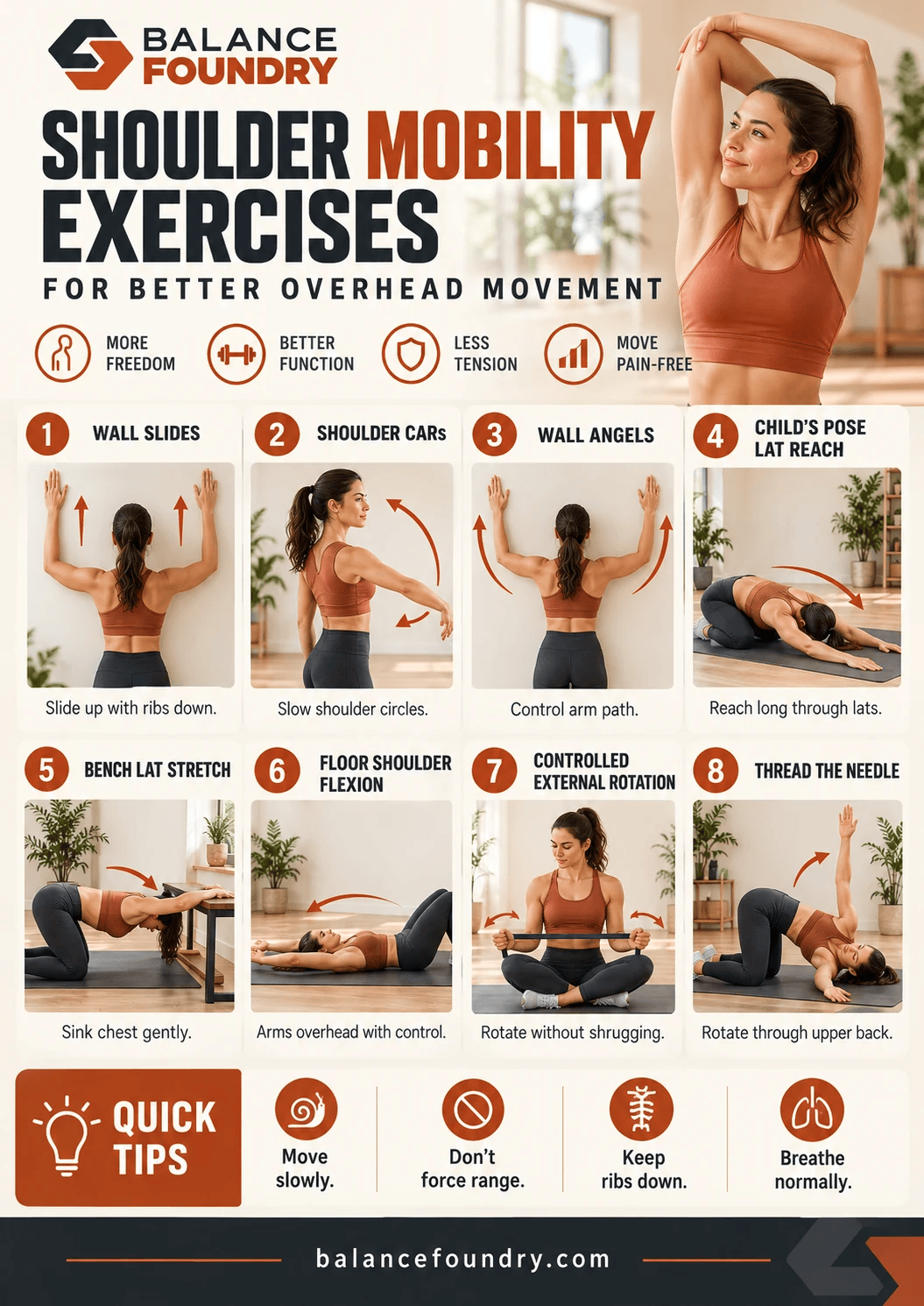
Shoulder mobility exercises can help you improve overhead movement by combining shoulder flexion, rotation, upper-back movement, and controlled range of motion. The goal is not to force your arms higher—it is to move more smoothly without shrugging, flaring the ribs, or compensating through the lower back.
Good overhead movement is not only about the shoulder joint. Your shoulder blades, upper back, ribs, and trunk position all influence how easily your arms can move overhead.
That is why shoulder mobility often improves more when you combine several types of movement instead of relying on a single stretch.
If your upper back is also stiff, start with our thoracic mobility exercises because thoracic extension and rotation can directly affect how comfortable overhead movement feels.
What Is Shoulder Mobility?
Shoulder mobility is your ability to move the shoulder joint and shoulder blade through useful ranges of motion with control.
That includes movements such as:
- raising your arms overhead,
- rotating the upper arm inward and outward,
- moving the shoulder blade upward and around the rib cage,
- reaching behind or across the body,
- maintaining trunk position while the arm moves.
Shoulder mobility is different from simply being flexible. A person may be able to stretch into a large range but still struggle to actively control that range.
Our mobility vs. flexibility guide explains that distinction in more detail.
Why Shoulder Mobility Matters for Overhead Movement
Overhead Strength
Presses, carries, pull-ups, and many upper-body exercises require the arms to move overhead while the trunk remains controlled.
Shoulder Blade Movement
The shoulder blade needs to rotate and move around the rib cage as the arm rises. Restricted scapular motion can make overhead movement feel awkward.
Upper-Back Position
Thoracic extension contributes to overhead positioning. A stiff upper back may encourage the lower back to arch instead.
Daily Reaching
Putting something on a high shelf, reaching overhead, and many household tasks rely on comfortable shoulder range of motion.
8 Shoulder Mobility Exercises
Wall Slides
Wall slides are a simple way to practice overhead movement while controlling the ribs and shoulder blades.
- Stand with your back near a wall.
- Bring your arms into a comfortable bent-elbow position.
- Slide your arms upward slowly.
- Keep your ribs from flaring forward.
- Lower with control and repeat 6 to 10 times.
Do not force your wrists or elbows flat against the wall if that causes your lower back to arch.
Shoulder CARs
Controlled articular rotations, or CARs, move the shoulder through a large controlled circle.
- Stand tall with one arm at your side.
- Slowly raise the arm forward and overhead.
- Rotate the arm as needed to continue the circle behind you.
- Return to the starting position.
- Perform 3 to 5 slow circles per side.
Keep the movement slow enough that you can control your trunk rather than twisting to create extra range.
Wall Angels
Wall angels combine shoulder movement with upper-back positioning.
- Stand with your back near a wall.
- Bend the elbows to about 90 degrees.
- Slide the arms upward while keeping the ribs controlled.
- Move only through a comfortable range.
- Repeat 6 to 10 times.
If your hands or elbows lift away from the wall, that is not automatically a problem. Prioritize smooth movement over forcing contact.
Child’s Pose Lat Reach
This variation can help you explore overhead shoulder flexion while the floor supports your body.
- Begin on your hands and knees.
- Sit your hips back toward your heels.
- Reach your arms forward.
- For more emphasis on one side, walk the hands slightly to the opposite side.
- Hold 20 to 30 seconds while breathing normally.
Bench Lat Stretch
A bench, chair, or countertop can support the arms while you move the chest downward between the shoulders.
- Kneel or stand in front of a stable surface.
- Place your hands or elbows on the surface.
- Shift your hips back and lower your chest gently.
- Keep the ribs controlled rather than forcing the lower back to arch.
- Hold 20 to 30 seconds.
Floor Shoulder Flexion
Lying on the floor makes it easier to notice when the lower back starts to compensate for limited shoulder movement.
- Lie on your back with knees bent.
- Start with your arms pointing toward the ceiling.
- Slowly lower the arms overhead.
- Keep the ribs from lifting excessively.
- Return to the start and repeat 6 to 10 times.
Controlled External Rotation
External rotation drills help train shoulder control rather than only overhead flexion.
- Keep your elbows close to your sides.
- Bend the elbows to about 90 degrees.
- Rotate the forearms outward slowly.
- Keep the shoulders relaxed instead of shrugging.
- Return with control and repeat 8 to 12 times.
You can perform this without resistance or add a light resistance band once the movement feels comfortable.
Thread the Needle
Thread the needle is primarily a thoracic rotation exercise, but it pairs well with shoulder mobility because upper-back movement affects overhead mechanics.
- Begin on your hands and knees.
- Reach one arm underneath your body.
- Rotate through the upper back.
- Return and rotate the arm upward if comfortable.
- Perform 5 to 8 repetitions per side.
For more upper-back work, see our full thoracic mobility guide.
A Simple 8-Minute Shoulder Mobility Routine
| Exercise | Volume | Main Focus |
|---|---|---|
| Shoulder CARs | 3 circles per side | Controlled shoulder rotation |
| Wall Slides | 8 reps | Overhead flexion |
| Thread the Needle | 6 reps per side | Thoracic rotation |
| Bench Lat Stretch | 20–30 sec | Overhead range |
| Controlled External Rotation | 10 reps | Rotator control |
This routine can work well before upper-body training or as a short movement session during the day.
Common Shoulder Mobility Mistakes
1. Flaring the Ribs
If the ribs lift sharply as the arms go overhead, you may be creating extra range through the lower back instead of the shoulder and upper back.
2. Shrugging Toward the Ears
Some upward movement of the shoulder blade is normal, but excessive shrugging can make the movement feel tense and uncontrolled.
3. Forcing Range
Mobility work should not become a contest to reach farther. Use the range you can control today and build from there.
4. Ignoring Thoracic Mobility
Limited upper-back extension can affect how easily the arms move overhead. Shoulder and thoracic mobility should often be trained together.
5. Only Stretching Passively
Passive stretching can be useful, but active drills such as shoulder CARs and wall slides help you practice controlling the range you have.
When Should You Do Shoulder Mobility Exercises?
- Before upper-body workouts: Use dynamic drills such as CARs and wall slides.
- After long periods of sitting: Add light overhead and rotation work.
- During mobility sessions: Combine shoulders with thoracic, hip, and ankle work.
- On recovery days: Keep the intensity low and use comfortable ranges.
Shoulder mobility work can also fit into a morning or evening movement routine, especially if you spend a lot of time working at a desk.
How to Progress Shoulder Mobility
Better shoulder mobility is not always about reaching farther. Progress can also mean:
- moving more slowly,
- keeping the ribs under better control,
- reducing shrugging,
- improving left-to-right consistency,
- adding light resistance while maintaining form.
If your main limitation is overhead range, work on both shoulder flexion and thoracic extension rather than assuming the shoulder joint is the only restriction.
Frequently Asked Questions
What are the best shoulder mobility exercises?
Useful options include wall slides, shoulder CARs, wall angels, floor shoulder flexion, lat stretches, external-rotation drills, and upper-back rotation work.
How often should I do shoulder mobility exercises?
Light mobility work can often be performed several times per week or daily if the movements remain comfortable and do not irritate the shoulder.
Can shoulder mobility improve overhead pressing?
Better shoulder and thoracic movement can make overhead positioning easier, but strength, technique, anatomy, and training experience also matter.
Why does my back arch when I raise my arms overhead?
Your body may be compensating for limited shoulder flexion, limited thoracic extension, or both. Reducing the range and keeping the ribs controlled can help you identify where the motion is coming from.
Should I stretch my shoulders before lifting?
Dynamic mobility drills are often a better fit before training than long, intense passive stretches. The best warm-up depends on the workout and your individual needs.
Do I need equipment for shoulder mobility?
No. Most shoulder mobility drills can be done with a wall, floor, bench, or countertop. A light resistance band can be added later for controlled rotation work.
Final Takeaway
Shoulder mobility is not just about getting your arms higher. It is about moving overhead with better control while the shoulder blades, upper back, ribs, and trunk work together.
Start with simple drills, keep the movement slow, and avoid forcing range you cannot control.
Review the 8 Exercises Visit the Mobility HubContinue Building Your Mobility
Shoulder mobility works best as part of a broader movement plan. Continue with these Balance Foundry guides:
- Thoracic Mobility Exercises — improve upper-back rotation and extension.
- 10-Minute Full-Body Mobility Routine — combine shoulder work with ankles, hips, and spine.
- Mobility vs. Flexibility — understand active control versus passive range.
- Hip Mobility Exercises — improve lower-body movement for squatting, walking, and hiking.
- Ankle Dorsiflexion Exercises — build controlled ankle movement.
- Foot Mobility Exercises — work on foot and toe motion from the ground up.
Browse all movement guides in the Balance Foundry Mobility Hub.
Leave a Reply