
Balance Foundry Mobility Guide
Ankle dorsiflexion exercises work best when they combine active movement, calf flexibility and strength. The goal is not simply to push the knee farther forward. It is to build usable ankle range while keeping the heel planted, the foot controlled and the movement comfortable.
Ankle dorsiflexion is the motion that brings the top of your foot toward your shin. In weight-bearing movement, it occurs when the shin travels forward over a planted foot. You use it while walking, descending stairs, squatting, running, hiking downhill and landing from a jump.
When dorsiflexion feels restricted, the body may compensate by lifting the heel, turning the foot outward, collapsing the arch or shifting motion to the knee, hip or trunk. Those signs do not prove that your calf is simply “tight.” Joint tolerance, strength, swelling, previous injury and individual anatomy can also influence the motion.

What Is Ankle Dorsiflexion?
Dorsiflexion occurs at the ankle as the foot moves toward the shin. In an open-chain exercise such as an ankle pump, the foot moves while the leg stays relatively still. In a closed-chain movement such as a squat or lunge, the foot stays planted while the shin moves forward.
Both versions matter. Open-chain exercises help you practice actively lifting the foot. Weight-bearing exercises help you use dorsiflexion in positions that resemble walking, stairs and squatting.
The calf muscles and Achilles tendon can influence available range, but they are not the only factors. The gastrocnemius crosses both the knee and ankle, so a straight-knee stretch emphasizes it more strongly. The soleus does not cross the knee, so bending the knee shifts the stretch lower in the calf.
Check Your Starting Point With the Knee-to-Wall Test
The knee-to-wall test, also called the weight-bearing lunge test, gives you a repeatable way to observe ankle dorsiflexion. It is not a medical diagnosis and there is no universal score that every person must reach.
Face a Wall
Place one foot flat on the floor with the second toe pointing generally toward the wall. Use a staggered stance so the other foot helps you balance.
Move the Knee Forward
Guide the knee toward the wall without lifting the heel or collapsing the arch. Let the knee travel in line with the middle toes.
Adjust the Distance
Move the foot backward until you find the farthest distance where the knee can still touch the wall with clean form.
Measure and Compare
Measure from the tip of the big toe to the wall. Compare sides and retest under similar conditions every two to four weeks rather than after every session.
Do not create extra distance by spinning the toes outward or allowing the heel to float. Quality matters more than the number.
9 Ankle Dorsiflexion Exercises
1. Seated Ankle Pumps
This is a gentle way to move the ankle actively before weight-bearing drills.
- Sit tall with the lower leg supported or the heel resting lightly on the floor.
- Pull the toes and forefoot toward the shin.
- Pause briefly, then point the foot away under control.
Perform 10 to 20 smooth repetitions. Move through a comfortable range without forcing either end position.
2. Banded Dorsiflexion
This exercise strengthens the muscles on the front of the lower leg, including the tibialis anterior.
- Anchor a light resistance band in front of you and loop it over the forefoot.
- Begin with the ankle gently pointed.
- Pull the toes toward the shin while keeping the knee and heel still.
- Return slowly instead of letting the band snap the foot forward.
Start with two sets of 10 repetitions. Use enough resistance to feel the front of the shin working without cramping or losing control.
3. Knee-to-Wall Rocks
This turns the knee-to-wall test into a controlled mobility exercise.
- Set up with the working foot flat and the toes facing the wall.
- Move the knee forward until it lightly touches the wall.
- Keep the heel planted and the arch controlled.
- Return to the starting position slowly.
Perform 8 to 12 repetitions per side. Move the foot closer if you cannot maintain a clean heel-down position.
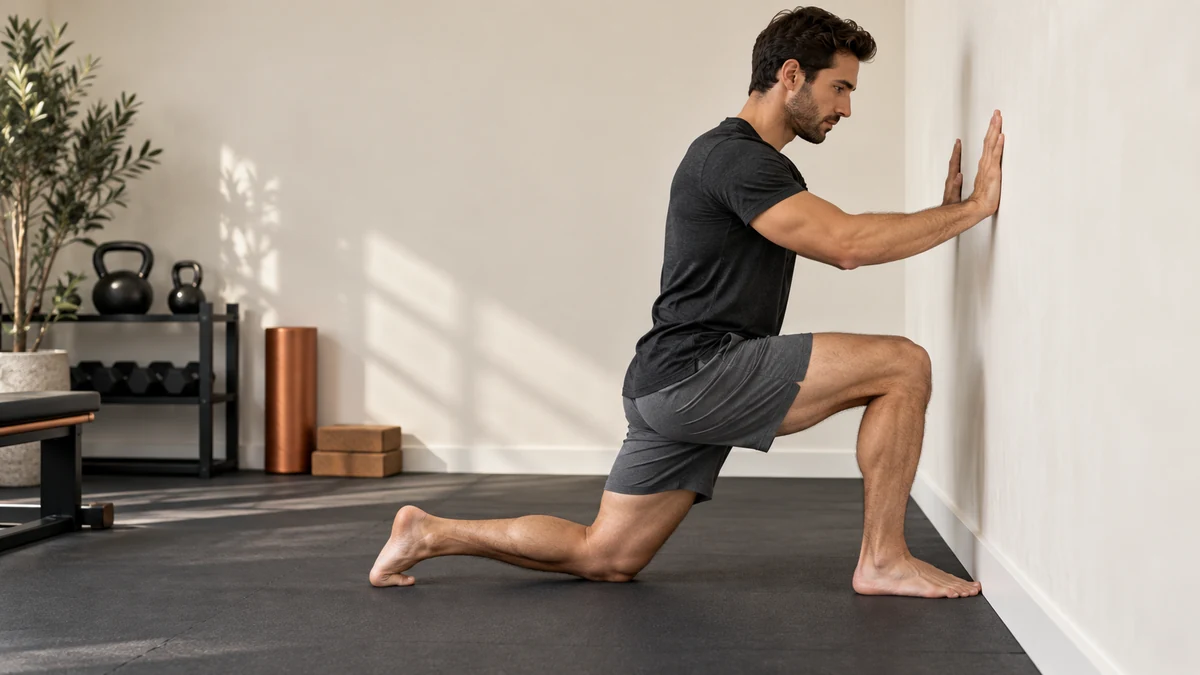
4. Half-Kneeling Knee Drive
The half-kneeling position reduces the balance demand and lets you focus on one ankle.
- Kneel with the working foot in front and flat on the floor.
- Keep the front heel heavy and the foot facing forward.
- Shift the pelvis forward as the knee travels over the toes.
- Pause, then move back without twisting the foot.
Complete 8 to 10 repetitions per side. Place padding under the down knee if needed.
5. Straight-Knee Calf Stretch
A straighter knee places more emphasis on the gastrocnemius.
- Stand facing a wall with the working leg behind you.
- Keep the back heel down and the foot pointing forward.
- Lean forward until you feel a comfortable stretch through the upper calf.
Hold for 20 to 30 seconds and repeat two or three times. You can also perform this stretch on a stable slant board for a more consistent angle.
6. Bent-Knee Soleus Stretch
Bending the knee shifts more emphasis toward the soleus, which can be especially relevant to the ankle position used in squats and stair descent.
- Stand with the working foot securely planted.
- Bend the knee forward while keeping the heel down.
- Maintain even pressure across the heel and forefoot.
- Stop when you feel a stretch through the lower calf.
Hold for 20 to 30 seconds. If you feel a sharp block or pinch at the front of the ankle, reduce the range rather than pushing harder.
For detailed slant-board variations of both calf stretches, see our guide to using a slant board for ankle mobility.
7. Wall-Supported Tibialis Raise
Tibialis raises strengthen active dorsiflexion and require no resistance band.
- Stand with your back against a wall and your feet a short distance forward.
- Keep the heels planted.
- Lift the toes and forefeet toward the shins.
- Lower slowly without rocking the body.
Begin with two sets of 10 to 15 repetitions. Move the feet farther from the wall to increase the challenge gradually.
8. Heel Walk
Heel walks train the muscles that lift the forefoot while adding a simple coordination challenge.
- Stand near a wall or rail if you need balance support.
- Lift the forefeet while keeping the heels in contact with the floor.
- Take short, controlled steps without leaning backward excessively.
Begin with 10 to 20 total steps. Stop if the front of the shin cramps or you cannot keep the toes elevated.
9. Split-Squat Ankle Drive
This progression combines dorsiflexion with lower-body control.
- Take a split stance and hold a stable support.
- Keep the front foot fully planted.
- Lower slightly as the front knee travels forward over the toes.
- Push through the whole front foot to return.
Perform 6 to 10 controlled repetitions per side. Use a shallow range first and increase depth only when the heel, arch and knee remain controlled.
A Simple 10-Minute Ankle Dorsiflexion Routine
| Exercise | Starting Dose | Purpose |
|---|---|---|
| Seated ankle pumps | 15 repetitions | Active warm-up |
| Knee-to-wall rocks | 2 × 8 per side | Weight-bearing mobility |
| Straight-knee calf stretch | 2 × 20 seconds | Gastrocnemius flexibility |
| Bent-knee soleus stretch | 2 × 20 seconds | Soleus flexibility |
| Tibialis raises | 2 × 12 repetitions | Active dorsiflexion strength |
Try the routine two to four times per week. It can also serve as a warm-up before squats, balance work or hiking. If the ankles feel more irritated later that day or the following morning, reduce the range, volume or frequency.
How to Progress Ankle Dorsiflexion Work
Progress One Variable
- Add two controlled repetitions
- Add five seconds to a stretch
- Increase the forward knee travel slightly
- Use a little more band resistance
- Reduce hand support
Keep the Current Level If
- The heel repeatedly lifts
- The foot turns outward
- The arch collapses
- The knee path becomes inconsistent
- You feel pinching or instability
Do not increase range, resistance and training volume at the same time. Small changes make it easier to identify what your ankle tolerates.
Common Ankle Dorsiflexion Exercise Mistakes
Turning the Foot Outward
Toe-out can make the knee appear to travel farther while routing around the intended ankle motion. Keep the foot near your natural forward-facing position and reduce the range if needed.
Letting the Heel Lift
A floating heel changes a weight-bearing dorsiflexion drill. Shorten the movement until you can keep the heel grounded.
Forcing a Front-of-Ankle Pinch
A calf stretch should feel different from a sharp block or pinch at the front of the ankle. Do not push harder into pinching. Persistent symptoms may need professional assessment.
Only Stretching
Static stretching may help increase range, but you also need to use and control that range. Combine stretches with active ankle movement, knee-over-toe drills and dorsiflexion strengthening.
Testing Too Often
Immediate changes after warming up do not always represent lasting progress. Retest the knee-to-wall movement every two to four weeks under similar conditions.
Frequently Asked Questions
How long does it take to improve ankle dorsiflexion?
It varies with the cause of the restriction, training consistency and individual anatomy. Some people notice short-term changes after warming up, but meaningful, repeatable improvement generally requires consistent practice over several weeks.
Can I do ankle dorsiflexion exercises every day?
Gentle ankle pumps and comfortable mobility work may be tolerated daily, but strengthening and more intense stretching require recovery. Begin with two to four sessions per week and adjust based on soreness and symptoms.
What is the best exercise for ankle dorsiflexion?
There is no single best exercise for every restriction. Knee-to-wall rocks are useful for weight-bearing practice, calf stretches address flexibility and tibialis raises strengthen active dorsiflexion. A combination is usually more complete.
Should my knee go over my toes?
Forward knee travel is normal during walking, stairs, lunges and squats. During mobility drills, allow the knee to move forward in line with the toes while keeping the heel down and staying within a comfortable range.
Can a slant board improve ankle dorsiflexion?
A slant board provides a consistent angle for straight- and bent-knee calf stretches and supported ankle rocks. It can be useful when calf flexibility and movement tolerance contribute to the restriction, but it will not address every possible cause.
Why does the front of my ankle pinch?
Pinching can have several causes and cannot be diagnosed from an exercise response alone. Reduce the range and avoid repeatedly forcing the position. Seek professional assessment if the sensation persists, worsens or follows an injury.
Final Takeaway
Useful ankle dorsiflexion is not just about stretching the calf. It requires a combination of available range, strength and control. Begin with gentle active motion, add straight- and bent-knee mobility work, then reinforce the range with tibialis raises or heel walks.
Keep the heel down, the foot quiet and the knee tracking forward. Progress one variable at a time and stop forcing the movement if you feel sharp pain or joint pinching. For equipment-assisted options, explore our guide to using a slant board for ankle mobility or browse the Balance Foundry Mobility Hub.
Explore Slant Board Mobility Visit the Mobility Hub
Sources
- American Academy of Orthopaedic Surgeons: Foot and Ankle Conditioning Program
- Radford et al.: Does stretching increase ankle dorsiflexion range of motion?
- Young et al.: Interventions for increasing ankle joint dorsiflexion
- Terada et al.: Therapeutic interventions for increasing ankle dorsiflexion after ankle sprain
Leave a Reply