
Balance Foundry Mobility Guide
A slant board makes ankle mobility work simple and repeatable. The goal is not to force the heel downward or chase the steepest angle. It is to create a controlled position where the ankle, calf and foot can gradually tolerate more useful range.
Using a slant board for ankle mobility can help you work on calf flexibility and ankle dorsiflexion—the motion that brings your shin toward the top of your foot. You use that motion when walking downhill, descending stairs, squatting, hiking and allowing the knee to travel forward over the foot.
The board is useful because it holds the foot at a consistent angle. That makes the stretch easier to repeat than hanging your heel from a step, and adjustable models let you begin gently. However, ankle mobility is not only about stretching the calf. Joint tolerance, foot position, strength and control all influence how well you use the range you have.
What Does Ankle Mobility Actually Mean?
The ankle moves in several ways, but dorsiflexion is usually the focus of mobility work. In weight-bearing movement, dorsiflexion occurs as the shin moves forward over a planted foot. If that motion feels limited, you may notice the heel lifting early, the foot turning outward, the arch collapsing, or the body shifting to avoid the restricted side.
Those observations do not automatically prove that the calf is “tight.” A recent injury, ankle swelling, joint irritation, pain, fear of loading or structural differences may also limit motion. Stretching is most appropriate when the restriction feels like a tolerable pull through the calf or Achilles region—not a sharp pinch in the front of the ankle.
Research reviews have found that calf stretching can produce small improvements in ankle dorsiflexion. The practical takeaway is to use stretching consistently, then reinforce the available range with controlled movement and strength rather than expecting one long session to permanently change the ankle.
Check Your Starting Point With the Knee-to-Wall Test
The weight-bearing lunge, often called the knee-to-wall test, is a practical way to monitor ankle dorsiflexion. It is not a medical diagnosis, and there is no single perfect score for every body or activity. Its value is consistency.
- Face a wall in a staggered stance with the test foot flat.
- Point the second toe generally toward the wall.
- Drive the knee forward until it lightly touches the wall without the heel lifting.
- Move the foot back until you find the farthest repeatable distance that still allows a clean touch.
- Measure from the tip of the big toe to the wall and compare sides.
Retest under the same conditions every two to four weeks, not after every set. A small day-to-day change may reflect warm-up, fatigue or measurement variation rather than a true mobility gain.
How to Set Up a Slant Board for Ankle Mobility
Choose the lowest incline
Begin with a shallow angle that creates mild-to-moderate tension. A steeper board is not automatically more effective, especially if it causes the feet to rotate, the knees to lock hard or the body to lean backward.
Place it on a stable surface
Use a flat, dry floor. The board should not slide, rock or flex unexpectedly. Keep a wall, rail or sturdy countertop nearby for light balance support.
Set the whole forefoot on the platform
Place the heel toward the low edge and the toes toward the high edge. Keep even pressure across the base of the big toe, base of the little toe and heel—the foot’s basic tripod.
Use a controlled dose
A strong stretch is not required. Start with 20 to 30 seconds or 6 to 10 slow repetitions, then reassess how the ankle feels during normal walking.
If you need an adjustable board, the StrongTek wooden slant board offers a broad platform, while the StrongTek portable model is easier to store or carry. Compare more options in our best adjustable slant boards guide.
5 Ways to Use a Slant Board for Ankle Mobility
1. Straight-Knee Calf Stretch
This version emphasizes the gastrocnemius, the larger superficial calf muscle that crosses the knee and ankle.
- Stand on the board with both heels down and feet pointing forward.
- Keep the knees straight but not forcefully locked.
- Stand tall or lean the whole body slightly forward from the ankles.
- Hold a gentle calf stretch for 20 to 30 seconds while breathing normally.
Complete two or three holds. If one side is more limited, use a staggered stance and shift slightly more weight to that leg without twisting the pelvis.
2. Bent-Knee Soleus Stretch
Bending the knee changes the emphasis toward the soleus, a deeper calf muscle that does not cross the knee. This position often feels particularly relevant to the forward-shin movement used in squats, stairs and hiking descents.
- Stand securely on the board and hold a stable support.
- Bend both knees a few inches while keeping both heels heavy.
- Keep the torso tall and allow the knees to travel forward in line with the toes.
- Pause for 20 to 30 seconds without bouncing.
If you feel a pinch at the front of the ankle rather than a stretch through the lower calf, reduce the angle and range. Repeated pinching deserves assessment rather than more aggressive stretching.
3. Supported Knee-Over-Toe Rock
This drill turns the stretch into a controlled movement. It can help you practice using dorsiflexion while the heel remains planted.
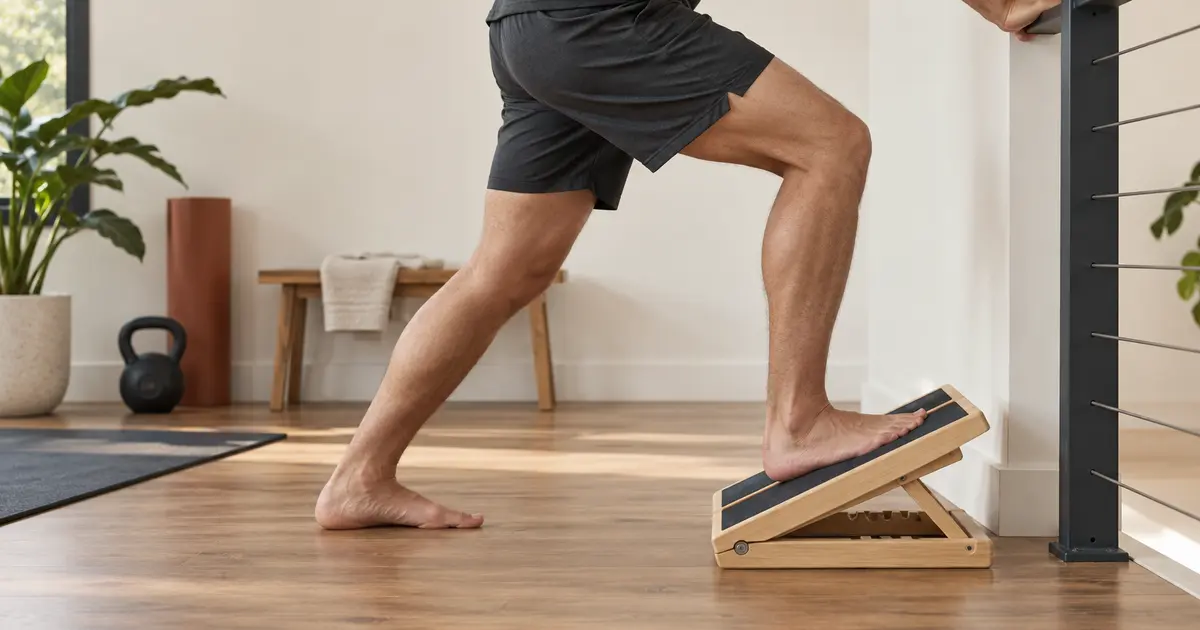
- Use a staggered stance with the working foot on the board.
- Hold a wall or sturdy support.
- Slowly guide the knee forward over the middle toes.
- Pause briefly, then return without letting the arch collapse.
Perform 6 to 10 smooth repetitions per side. The goal is a clean path, not maximum forward travel.
4. Split-Stance Ankle Mobilization
Use this when you want to isolate one ankle while controlling how much body weight enters the position.
- Place the front foot on the board and step the other foot behind you.
- Keep the front heel planted and the back heel relaxed.
- Shift the pelvis forward as the front knee bends.
- Return to the start under control.
Complete 8 slow repetitions on each side. Increase the forward shift before increasing the board angle.
5. Slow Calf Raise With a Controlled Lower
Mobility is more useful when you can control it. This drill strengthens the calf through the board’s available range.
- Stand with both feet on the board and hold stable support.
- Rise onto the balls of the feet without rolling the ankles outward.
- Pause at the top, then lower slowly until the heels return to the comfortable stretch position.
- Stop before pain, loss of balance or an uncontrolled drop.
Begin with 6 to 10 two-leg repetitions. This is a strength drill, not a reason to force the heel lower than your current comfortable range.
A Simple 8-Minute Slant-Board Ankle Routine
| Exercise | Starting dose | Main focus |
|---|---|---|
| Straight-knee calf stretch | 2 × 20–30 seconds | Gastrocnemius flexibility |
| Bent-knee soleus stretch | 2 × 20–30 seconds | Lower-calf flexibility |
| Supported knee-over-toe rock | 1–2 × 8 each side | Controlled dorsiflexion |
| Slow two-leg calf raise | 1–2 × 8 | Strength through range |
Try this routine two to four times per week. It may also work as a warm-up before squats, hiking or lower-body training, but keep pre-workout static holds moderate so the ankles feel ready rather than fatigued. If the routine consistently leaves you sorer the next day, reduce the angle, volume or frequency.
How to Progress Without Forcing the Ankle
Progress one variable
- Add a few seconds to the hold
- Add one or two controlled repetitions
- Shift slightly more weight to one side
- Increase the board angle one setting
Stay at the current level if
- The heel repeatedly lifts
- The foot turns outward
- The arch collapses to find range
- You cannot control the return
Do not change angle, duration and loading at the same time. A good progression looks almost boring: small increases, clean repetitions and no need to fight the position.
Common Slant-Board Ankle Mobility Mistakes
Starting too steep
Aggressive angles often create compensation rather than better dorsiflexion. Use the lowest setting that produces a clear, tolerable stretch.
Letting the heel float
If the heel loses contact during a knee-over-toe drill, you are no longer practicing the same weight-bearing ankle motion. Reduce the range until you can keep the foot grounded.
Turning the feet outward
Toe-out can make the movement appear larger while routing around the intended restriction. Keep the foot close to your normal forward-facing position unless a clinician has instructed otherwise.
Stretching into a hard front-of-ankle pinch
A muscular pull through the calf is different from a sharp block or pinch at the front of the joint. Back off if you feel pinching, instability, numbness or sharp pain.
Only stretching
Passive range is one part of mobility. Combine it with slow knee-over-toe motion and calf raises so your nervous system and muscles learn to control the position.
Frequently Asked Questions
What angle should I use for ankle mobility?
Start at the lowest setting that creates a mild-to-moderate calf stretch while you can keep the heel down and foot controlled. There is no universal best angle; your position quality matters more than the number.
How long should I stand on a slant board?
For mobility work, begin with 20- to 30-second holds for two or three rounds. Longer is not automatically better. Use short, repeatable doses that do not create pain or prolonged soreness.
Should my knees be straight or bent?
Use both. A straighter knee emphasizes the gastrocnemius, while a bent knee shifts more emphasis toward the soleus. Both can contribute to useful ankle dorsiflexion.
Can I use a slant board every day?
Some people tolerate gentle daily mobility, but more is not always necessary. Two to four sessions weekly is a sensible starting point. Adjust based on symptoms, training load and recovery.
Can a slant board fix limited ankle mobility?
It can help when calf flexibility and tolerance are part of the limitation, but not every restriction has the same cause. Persistent pinching, swelling or major side-to-side differences may require assessment from a qualified healthcare professional.
Is a slant board useful before squats?
Yes, gentle stretches and controlled ankle rocks can be part of a squat warm-up. A slant board can also elevate the heels during squats, but that changes the exercise rather than permanently correcting ankle mobility. See our slant boards for squats guide for that use.
Final Takeaway
A slant board gives you a stable way to practice ankle dorsiflexion, but the best results come from combining gentle stretching with controlled movement and strength. Start low, keep the heel planted, track the knee over the toes and progress only when the position remains clean. For more ideas, visit the Slant Board Hub or explore our complete list of slant board exercises.
Compare Adjustable Slant Boards Explore the Mobility Hub
Sources
- American Academy of Orthopaedic Surgeons: Foot and Ankle Conditioning Program
- Radford et al.: Does stretching increase ankle dorsiflexion range of motion?
- Terada et al.: Therapeutic interventions for increasing ankle dorsiflexion after ankle sprain
- Smith et al.: Weight-bearing lunge measurement of ankle dorsiflexion
Leave a Reply