
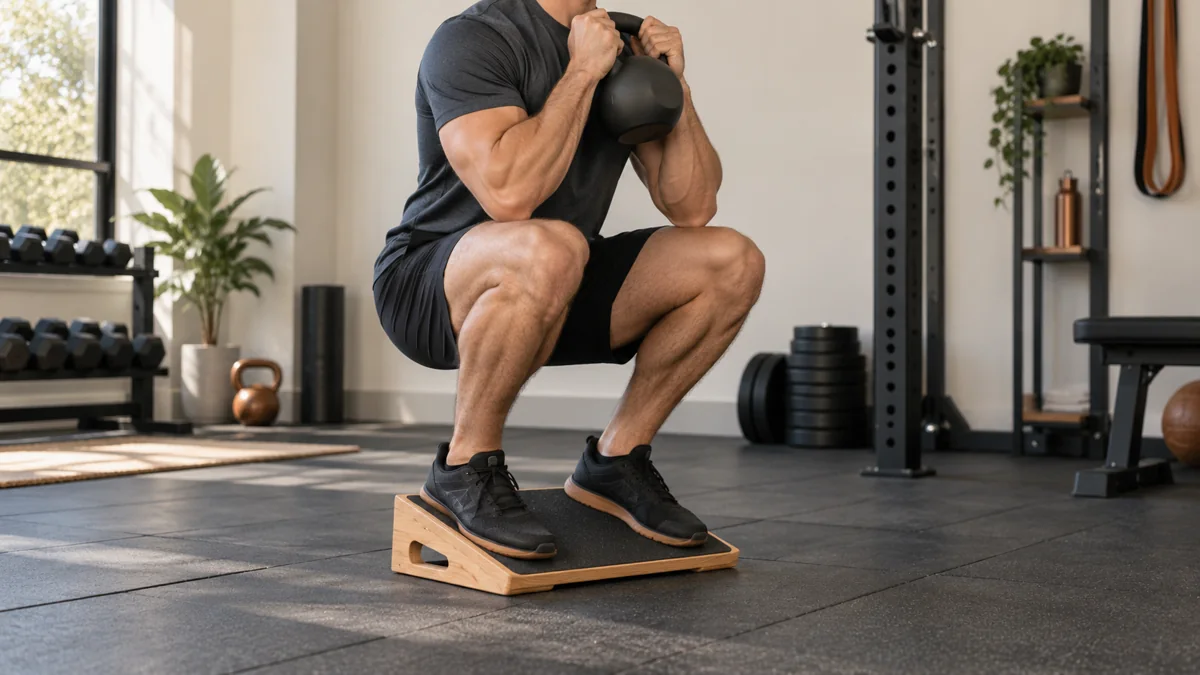
Find the Right Heel Elevation Without Sacrificing Stability
A good slant board for squats should feel planted under load, fit your preferred stance, and provide enough heel elevation to help you squat comfortably—not force you into someone else’s position.
Heel-elevated squats can make it easier to keep the torso upright and reach depth when ankle dorsiflexion is limited. They can also shift the exercise toward the quadriceps. But the best setup depends on more than angle alone: platform width, surface grip, construction, and whether you use a narrow or wide stance all matter.
After comparing adjustable boards, fixed wedges, and two-platform designs, the StrongTek Extra-Large Wooden Slant Board is our best overall pick. Its broad wooden platform and five settings make it the most adaptable option for home training. Lifters who prioritize stance freedom may prefer independent wedges, while the extra-wide Wolf Wedge is the simplest grab-and-go choice.
StrongTek Extra-Large Wooden Slant Board
Best for buyers who want one stable, full-width platform with several angle choices for squats, calf work, and general mobility.
Best Slant Boards for Squats at a Glance
| Product | Best for | Format | Angle | Why it stands out | Amazon |
|---|---|---|---|---|---|
| StrongTek Extra-Large Wooden Slant Board | Best overall | Single full-width board | 5 settings, 15°–35° | Broad platform and adjustable progression | View |
| Wolf Squat Wedge Block | Simple wide platform | Single EVA wedge | Fixed 15° | 27-inch width without adjustment hardware | View |
| Premium Weight-Lifting Slant Boards, Set of 2 | Stance freedom | Independent wedges | Fixed 25° | Each foot can be positioned independently | View |
| EXURA Adjustable Wide Slant Board | Adjustable split platforms | Two steel platforms | 4 levels | Combines stance freedom with adjustment | View |
Listings, variants, dimensions, capacities, sellers, and availability can change. Confirm the current Amazon listing before ordering.
How We Chose These Squat Slant Boards
This is a research-based buyer’s guide. Balance Foundry has not physically tested every product listed. We compared manufacturer and retailer information, platform layout, available angles, stance flexibility, surface grip, materials, portability, and suitability for heel-elevated squat variations. Read our full Review Methodology.
For squatting, we gave more weight to usable standing area and stable foot placement than to stretch-specific extras such as toe bars. We also selected different platform formats because a full-width board and independent wedges solve different problems.
Detailed Slant Board Reviews
1. StrongTek Extra-Large Wooden Slant Board
The StrongTek XL is the best all-around choice for home exercisers who want a traditional full-width board and the ability to experiment with heel height.
The five-position design is its main advantage. A lower setting can be easier for first-time heel-elevated squats, while higher settings provide room to explore deeper elevation for light squat variations and mobility work. Its anti-slip surface and broad platform are more reassuring than balancing each foot on a small block.
The tradeoff is stance width: both feet must fit on one board. It is also bulkier than foam wedges and less convenient to carry to a commercial gym.
Pros
- Five usable incline settings
- Large, continuous standing surface
- Useful beyond squats for calf and ankle work
Cons
- Stance is limited by board width
- Heavier and less portable than EVA
- More moving parts than a fixed wedge
2. Wolf Squat Wedge Block
The Wolf Wedge is for lifters who want a broad, uncomplicated heel lift without hinges, supports, or separate pieces to align.
The 27-inch listed width offers more lateral room than many conventional calf-stretch boards. The fixed 15-degree incline is moderate, making it a sensible starting point for goblet squats, bodyweight squats, and technique practice. Because it is EVA, it should be easier to move and store than a large wooden or steel design.
A fixed angle is convenient but removes progression options. EVA also feels different from rigid wood or steel, so buyers who want the firmest possible platform under heavier loading may prefer another design.
Pros
- Wide one-piece platform
- No adjustment mechanism
- Lightweight and easy to move
Cons
- Only one incline angle
- EVA may compress more than rigid platforms
- Not as compact as two small wedges
4. EXURA Adjustable Wide Slant Board
The EXURA combines two independent foot platforms with four adjustment levels, making it the most configurable squat-focused design in this group.
The separate platforms let users choose their stance width, while the multiple levels provide more control over heel elevation than fixed blocks. That combination is particularly useful when more than one person will use the equipment or when you want to compare squat positions gradually.
The listing describes a 900-pound capacity, but that should be treated as a manufacturer claim rather than an independent test result. This format also has more setup steps than a one-piece wedge, so both sides must be locked at matching heights and placed symmetrically.
Pros
- Adjustable heel elevation
- Independent stance positioning
- Rigid metal construction
Cons
- More setup than a fixed wedge
- Both platforms must be matched carefully
- Likely less convenient for travel
Why Use a Slant Board for Squats?
Work Around Limited Ankle Range
Elevating the heels reduces how much ankle dorsiflexion is needed to reach a given squat depth. That can make an upright squat feel more accessible while you continue working on ankle mobility separately.
Emphasize the Quadriceps
A heel lift often allows more forward knee travel and a more upright torso, which can increase the quadriceps’ role in movements such as cyclist squats and heel-elevated goblet squats.
Practice Consistent Positioning
A purpose-built wedge gives both heels a repeatable elevation. That is generally more stable and easier to reproduce than improvising with loose weight plates.
How to Choose a Slant Board for Squats
Start With a Manageable Angle
More elevation is not automatically better. A moderate angle is usually easier to control and more versatile. Adjustable models let you begin low and increase only when the position feels stable and useful.
Match the Platform to Your Stance
A one-piece board is quick to set up, but your entire stance must fit on it. Independent wedges are better for wide stances or lifters who turn their toes out, provided both pieces are positioned evenly.
Favor Grip and Floor Contact
Look for a textured standing surface and non-slip contact beneath the product. A high capacity rating means little if the wedge can slide on your floor.
Consider Rigidity Under Load
Wood and steel generally provide a firmer feel. EVA is lighter and simpler but may compress. Match the material to the exercises and loads you actually plan to use.
Check Usable Foot Area
Overall dimensions do not always equal usable standing room. Make sure the sloped surface supports your heel and enough of the foot to feel secure in your intended shoes.
How to Squat Safely on a Slant Board
- Place the board or wedges on a clean, dry, level, non-slip surface.
- If adjustable, confirm every support is fully seated. For two platforms, use matching angles and symmetrical spacing.
- Begin with bodyweight or a light counterbalanced load before progressing.
- Center each heel on the incline and keep the entire setup from rocking or sliding.
- Use a stance that allows the knees to track naturally in line with the toes.
- Control the descent and stop at the deepest position you can maintain without pain or loss of balance.
- Step off before changing the angle or moving the equipment.
If your main goal is calf stretching or ankle-mobility drills rather than squatting, see our broader guide to the best adjustable slant boards.
Frequently Asked Questions
What angle is best for a squat slant board?
There is no universal best angle. A moderate incline around 10–20 degrees is a practical starting range for many users, while steeper wedges create a more pronounced heel lift. Choose the lowest elevation that helps you reach the intended position with control.
Are slant boards good for squats?
They can be useful for heel-elevated squat variations, especially when the goal is a more upright torso, greater knee travel, or additional quadriceps emphasis. They should complement—not replace—appropriate strength, technique, and mobility work.
Is a single board or two wedges better?
A single board is faster to align and provides one continuous platform. Two wedges allow more control over stance width and toe angle. The better option depends on your squat stance and how much setup flexibility you value.
Can I lift heavy weights on a slant board?
Only if the product is intended for loaded exercise, is undamaged, sits securely on the floor, and has adequate verified capacity for the user plus the external load. Capacity numbers on retail listings are manufacturer claims, so use conservative judgment.
Are slant boards better than weight plates under the heels?
A dedicated wedge generally offers a broader, more consistent, and purpose-built surface. Plates can shift, create awkward edges, and vary in height. Whatever you use must be stable before adding load.
Can heel-elevated squats fix ankle mobility?
No. Heel elevation can reduce the ankle range required during the squat, but it does not by itself restore mobility. Use it as a training option while addressing mobility limitations separately when appropriate.
Our Final Recommendation
Choose the StrongTek Extra-Large Wooden Slant Board if you want the most versatile one-piece platform. Pick the Wolf Wedge for simple, moderate elevation; the two-piece 25-degree set for maximum stance freedom; or the EXURA when both stance width and angle adjustment matter.
Continue exploring the Slant Boards Hub, compare the best adjustable models, or visit our growing Mobility Hub.
Leave a Reply