
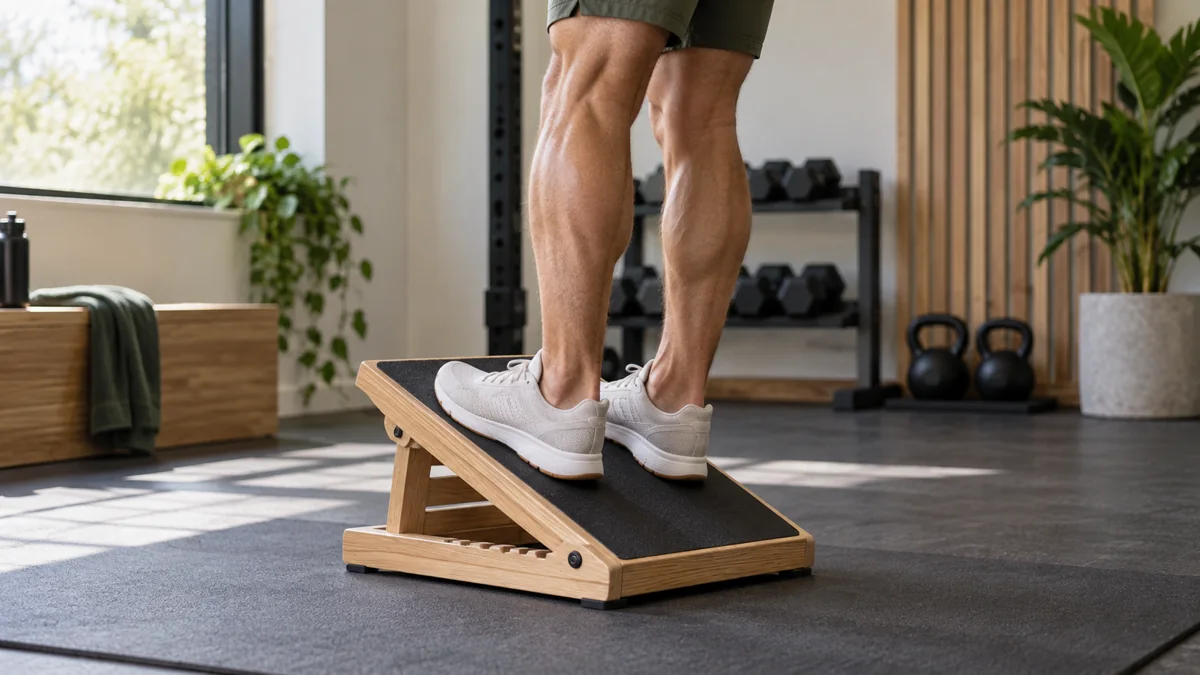
The best adjustable slant board should offer useful incline settings, secure foot contact, and enough platform space for the way you plan to train. We compared four distinct designs for calf stretching, ankle mobility, portability, squats, and wide-stance exercise.
The StrongTek Extra-Large Wooden Slant Board is our best overall adjustable slant board because it combines five moderate incline settings with a roomy wooden platform and a straightforward support system. It is the most balanced choice here for stretching, mobility work, and general home use.
That does not make it the automatic choice for everyone. The Yes4All model adds a toe-stretcher bar for users focused mainly on calf work. StrongTek’s ABS board is lighter and easier to move. The EXURA uses two wide steel platforms for people who want more stance freedom during squats and other two-foot exercises.
StrongTek Extra-Large Wooden Slant Board
Choose it if you want one traditional adjustable board with five useful settings and more standing room than a compact travel design.
Best Adjustable Slant Boards at a Glance
| Product | Best for | Construction | Adjustment | Standout feature | Amazon |
|---|---|---|---|---|---|
| StrongTek Extra-Large Wooden Slant Board | Best overall | Wood platform | 5 angles | Roomy, traditional full-foot design | View |
| Yes4All Professional Wooden Slant Board | Calf stretching | Wood with toe bar | 5 positions | Front bar supports stretch-focused positioning | View |
| StrongTek Portable ABS Slant Board | Portability | ABS plastic | 5 angles | Approximately 3.7-pound design | View |
| EXURA Adjustable Wide Slant Board | Wide-stance training | Two steel platforms | 4 levels | Independent platforms for stance flexibility | View |
Product listings, variants, specifications, sellers, and availability can change. Confirm the current Amazon listing before ordering.
How We Chose These Adjustable Slant Boards
This is a research-based buyer’s guide. Balance Foundry did not physically test every board listed here. We compared current manufacturer and retailer information, design, adjustment range, platform format, surface grip, portability, and the job each board is best equipped to perform. Learn more in our Review Methodology.
Multiple settings should create meaningful progression rather than duplicate nearly identical positions.
Surface texture, heel support, platform edges, and usable standing room affect confidence.
The selected angle should seat securely and remain predictable during its intended movement.
Single-foot stretching, wide squats, and two-foot exercises require different shapes and dimensions.
Weight, folded size, handles, and storage affect whether a board is convenient enough to use regularly.
Every pick needed a distinct reason to choose it over the other adjustable options.
Detailed Adjustable Slant Board Reviews
1. StrongTek Extra-Large Wooden Slant Board
The StrongTek XL is the most versatile conventional adjustable slant board in this group, making it the easiest recommendation for buyers who want one board for stretching and general mobility work.
Five positions allow the incline to increase in manageable steps. StrongTek lists 15, 20, 25, 30, and 35 degrees for its traditional wooden model. That range is more suitable for progressive stretching than a board that begins at a steep fixed angle.
The large wooden platform is the main reason to choose this version over a compact portable board. More standing room can help users with larger feet and anyone who wants additional margin around the shoe. The rigid platform also gives it the familiar feel associated with clinic-style incline boards.
The tradeoff is portability. A larger wooden board occupies more storage space and is less convenient to carry than a plastic model. Amazon listings may also group multiple StrongTek sizes or surface variants, so confirm the selected size before checkout.
- Five moderate incline settings
- Roomier platform than compact models
- Rigid wooden construction
- Side handle supports moving and storage
- Bulkier than a travel board
- Not as wide as a dedicated two-foot squat platform
- Wood should be stored in a dry location
2. Yes4All Professional Wooden Slant Board with Toe Bar
The Yes4All model adds a raised toe-stretcher bar to a five-position wooden platform, giving it a more stretch-specific design than the other boards in this guide.
The front bar gives the forefoot a defined point of contact. That can be useful for buyers who want a dedicated station for supported calf stretching rather than a completely open exercise platform.
Five positions allow the user to begin at a manageable setting and increase the incline as comfort and range improve. The wooden structure also avoids the softer feel of foam wedges and the hollow feel some users associate with lightweight plastic.
The toe bar is also the limitation. It may interfere with heel-elevated squats or other movements that benefit from an uninterrupted surface. Choose this model for stretch-focused use, not because the bar automatically makes it more versatile.
- Five incline positions
- Toe bar supports stretch-focused positioning
- Anti-slip standing surface
- Rigid wooden format
- Toe bar can interfere with some exercises
- More specialized than a flat platform
- Less convenient to transport than plastic
3. StrongTek Portable ABS Slant Board
StrongTek’s ABS model trades the look and footprint of a wooden board for lighter handling, making it the most practical choice for travel, office use, or frequent storage.
The current listing describes five adjustable positions, a non-slip surface, and a lightweight 3.7-pound design. That combination makes more sense than a heavy board when the equipment will move between home, work, and a gym.
Plastic construction can also tolerate routine handling without the same concern about chipped finish or moisture exposure as unfinished wood. A heel support helps establish foot position at steeper inclines.
Portability comes with compromises. A compact platform provides less room around the foot, and the angle information shown across current listing sections is not fully consistent. Confirm the active variant and its current angle settings before purchasing.
- Lightweight and easy to move
- Five adjustable positions
- Non-slip standing surface
- Better suited to travel and frequent storage
- Smaller standing area than an XL board
- Plastic feel will not appeal to everyone
- Listing angle details should be verified
4. EXURA Adjustable Wide Slant Board
The EXURA stands apart by using two independent steel platforms, giving users more freedom to change stance width and foot position during two-foot exercises.
Separate platforms can be positioned for narrow, standard, or wider stances rather than forcing both feet onto one fixed-width board. That makes the design better suited to heel-elevated squats and other symmetrical lower-body exercises.
Steel construction provides a rigid feel and supports the listing’s heavy-duty positioning. Four adjustment levels also provide more versatility than fixed squat wedges while preserving a stance-friendly format.
This is the least portable option in the group. Two metal platforms require more setup and storage space, and both pieces must be positioned evenly before use. The advertised 900-pound capacity is a manufacturer claim and should not be treated as independent proof of safety for heavily loaded exercise.
- Independent platforms allow stance adjustment
- Rigid steel construction
- Four incline levels
- More exercise-oriented than narrow stretch boards
- Heavier and less portable
- Requires careful two-piece alignment
- More equipment than casual stretching requires
How to Choose an Adjustable Slant Board
Start with your primary use
Stretching, ankle-mobility work, and heel-elevated squats do not require the same platform. A full-foot wooden board works well for supported stretches. Two independent platforms are more flexible for squat stance. A compact plastic board makes sense when storage and transport matter most.
Look at the lowest setting first
The steepest angle attracts attention, but the lowest usable position often determines whether a board is beginner-friendly. Starting too steep can turn a controlled stretch into an uncomfortable position. More settings are helpful only when the range contains angles you can use.
Measure the usable platform
Compare your shoe length and intended foot position with the actual standing surface—not only the board’s outside dimensions. Heel stops, toe bars, hinges, and borders can reduce usable space.
Consider how the angle locks in place
Traditional wooden boards often use a rear support seated in grooves. Plastic boards may use notches or molded supports. Steel platforms use hinged braces. Whatever the system, it should be fully seated on both sides before weight is applied.
Do not shop by weight capacity alone
A large capacity number does not tell you how stable a board feels, how much space it provides, or whether it suits dynamic exercise. Platform design, floor contact, grip, and secure adjustment matter just as much.
Plan for storage
The board that remains accessible is more likely to be used. Measure the intended storage area and consider whether weight, handles, folded height, or separate pieces will make daily use inconvenient.
Adjustable Slant Board Setup and Safety
- Place the board on a flat, stable, dry surface with adequate traction.
- Begin at the lowest practical incline and make sure every support point is fully seated.
- Use a wall, rail, countertop, or sturdy object for balance while learning the position.
- Step onto the board carefully instead of jumping or dropping weight onto it.
- Keep the knee and foot aligned comfortably and avoid forcing a painful range.
- Step off before changing the angle. Never adjust the board while standing on it.
- Inspect the platform, hinges, braces, fasteners, grip material, and floor contact before use.
Adjustable Slant Board FAQ
What angle should a beginner use?
Begin with the lowest setting that creates a mild, controlled position without pain or loss of balance. Many traditional boards begin near 15 degrees, but the appropriate angle depends on the person and the movement.
Is an adjustable slant board better than a fixed wedge?
It is more versatile for progressive stretching and mobility work. A fixed wedge can be faster and simpler for repeatable heel-elevated squats. The better design depends on the primary use.
Can I use an adjustable slant board for squats?
Some boards support bodyweight or lightly loaded squat variations, but platform width, stability, adjustment security, and manufacturer instructions matter. A wide two-platform design is generally more stance-friendly than a narrow stretching board.
Is wood, plastic, or steel best?
Wood offers a rigid traditional platform, plastic reduces weight, and steel supports wide heavy-duty designs. Construction material matters less than whether the full design fits your use, space, and comfort.
Should both feet be on the slant board?
That depends on the exercise and platform. Some stretches use one foot at a time, while squat variations use both feet. Follow the board manufacturer’s instructions and use support when necessary.
How often should I check the adjustment system?
Check it before every session. Make sure supports are seated evenly and inspect for loose hardware, cracks, bending, worn grip, or other damage.
Which Adjustable Slant Board Should You Buy?
Choose the StrongTek Extra-Large Wooden Slant Board for the most balanced combination of platform space and progressive adjustment. Pick the Yes4All when calf stretching is the priority, the StrongTek ABS when portability matters most, or the EXURA when you want independent steel platforms for two-foot training.
Leave a Reply