
Movement Foundations
Mobility and flexibility overlap, but they are not interchangeable. Flexibility gives you access to range; mobility helps you actively control and use that range.
Flexibility describes how far a muscle and its surrounding tissues can lengthen. Mobility describes how well you can actively move a joint through an available range with control. Stretching can improve flexibility, while useful mobility also depends on coordination, strength and joint-specific movement.
Mobility training has become a catch-all term for stretching, warmups, joint circles, yoga flows and corrective exercises. That broad use can make the subject more confusing than it needs to be.
The simplest distinction is this: flexibility is about the range that is available, while mobility is about your ability to create and control movement within that range. Both qualities matter, and neither automatically guarantees the other.
You might be flexible enough to pull your leg into a high position with your hands but unable to lift it there under its own power. You might also have enough ankle range for everyday walking but lack the control or strength needed to use that range during a deep squat. Those are different movement problems and may need different solutions.
What is mobility?
Mobility is the ability to actively move a joint through an appropriate range of motion while maintaining control of the surrounding body. Hospital for Special Surgery describes mobility as a joint’s ability to actively move through its intended range. That word actively is important: mobility is something you produce, not simply a position another person or an outside force can place you into.
Useful mobility generally combines several elements:
- Available range of motion: The joint and surrounding tissues must allow the movement.
- Strength: Muscles must create force throughout the range, including near positions that feel unfamiliar.
- Coordination: Your nervous system must organize the movement without unnecessary compensation.
- Stability: Other parts of the body must remain controlled enough for the target joint to move effectively.
- Task-specific control: The range must transfer to the activity you actually want to perform.
For example, ankle mobility during a squat is not just the ability to push the knee forward over the toes. You also need the heel to remain grounded, the foot to maintain useful contact with the floor and the knee to track with reasonable control. Our guide to ankle dorsiflexion exercises focuses on developing that forward ankle motion.
What is flexibility?
Flexibility is commonly used to describe the ability of muscles and other soft tissues to lengthen enough to permit a range of motion. Stretching is the most familiar way to train it.
When you hold a calf stretch against a wall, use a strap to bring your leg toward you or settle into a supported hamstring stretch, an external force helps you access the position. Practiced consistently and at an appropriate intensity, stretching can improve flexibility and joint range of motion.
Flexibility is valuable. It can make certain positions more accessible and may reduce the feeling that tight tissues are blocking movement. But additional passive range is not automatically useful unless you can control it.
You do not need to choose one and reject the other. Stretching and active mobility drills can work together when each addresses a real limitation.
Mobility vs. flexibility: the practical difference
| Question | Flexibility | Mobility |
|---|---|---|
| What does it describe? | How much passive range is available | How much range you can actively use and control |
| Primary emphasis | Muscle and soft-tissue length | Joint motion, strength, coordination and control |
| Common methods | Static, assisted and relaxed stretching | Controlled joint circles, active end-range work, loaded movement and dynamic drills |
| Example | Using your hands to pull your knee toward your chest | Lifting your knee toward your chest without using your hands |
| When it is useful | When tissue tightness limits a needed position | When you need to move through that position during exercise or daily activity |
Imagine lying on your back while someone raises your straight leg. If the leg travels high with assistance, you have passive range available. Now try to lift that same leg without help while keeping the knee straight and the other leg still. The active range will usually be smaller because your muscles must create and control the motion.
The gap between those two positions can offer a clue. A large gap may mean that more stretching is not the only answer; active control and strength within the existing range may deserve greater attention.
Do you need mobility training, stretching or both?
Start with the movement you want to improve instead of assuming that every limitation comes from tight muscles. Your squat, overhead reach, walking stride or ankle position can be influenced by technique, joint structure, strength, balance, previous injury, discomfort and familiarity with the task.
You may need more flexibility when…
A target position is limited even when you are relaxed and supported, and the restriction feels like manageable tissue tension rather than pain or a hard joint block.
You may need more active mobility when…
You can reach the position with assistance but lose it when the support is removed or when the movement becomes loaded.
You may need more strength when…
You can enter the position but cannot hold it, leave it smoothly or maintain control once resistance is added.
You may need assessment when…
Movement produces sharp pain, catching, significant swelling, numbness, instability or a sudden loss of range following an injury.
Mobility is specific
Being mobile in one area does not make you mobile everywhere. A person may have excellent hip rotation but limited ankle dorsiflexion, or mobile shoulders but poor control in an overhead position.
This is why mobility training works best when it is connected to a goal. If your heel rises during a squat, assess the ankle and the squat pattern. If reaching overhead causes your ribs to flare and lower back to arch, examine shoulder and upper-back motion as well as trunk control.
More range is not always better
The goal is not to maximize every joint’s range. The useful target is enough comfortable motion for your chosen activities, supported by appropriate strength and control. Some people naturally have more joint motion than others and may benefit more from stability and strength than from repeatedly pushing farther into end range.
When should you perform mobility work?
Dynamic mobility drills fit naturally into a warmup because they move the joints through gradually increasing ranges without long passive holds. Before lower-body training, that might include ankle rocks, controlled squats and hip rotations. Before an upper-body workout, it might include shoulder circles and thoracic rotations.
Longer relaxed stretches often fit better after training or in a separate flexibility session. That is not an absolute rule, but it is a useful starting framework. Hospital for Special Surgery recommends dynamic movement before activity and notes that static stretching can be used when the body is already warm.
Short mobility sessions can also stand alone. Five to ten focused minutes performed consistently may be more useful than an occasional long session that leaves you excessively sore.
A simple beginner mobility routine
This routine moves through several commonly used joint actions without requiring special equipment. Move slowly, stay within a comfortable range and use a wall or chair when balance support is helpful.
8-minute mobility foundation
Complete one controlled round. Add a second round when appropriate.
- Ankle rocks — 8 repetitions per side: Keep the heel down and guide the knee forward over the middle toes.
- Supported deep-squat shifts — 5 per side: Hold a stable surface, sit into a comfortable squat and shift gently from side to side.
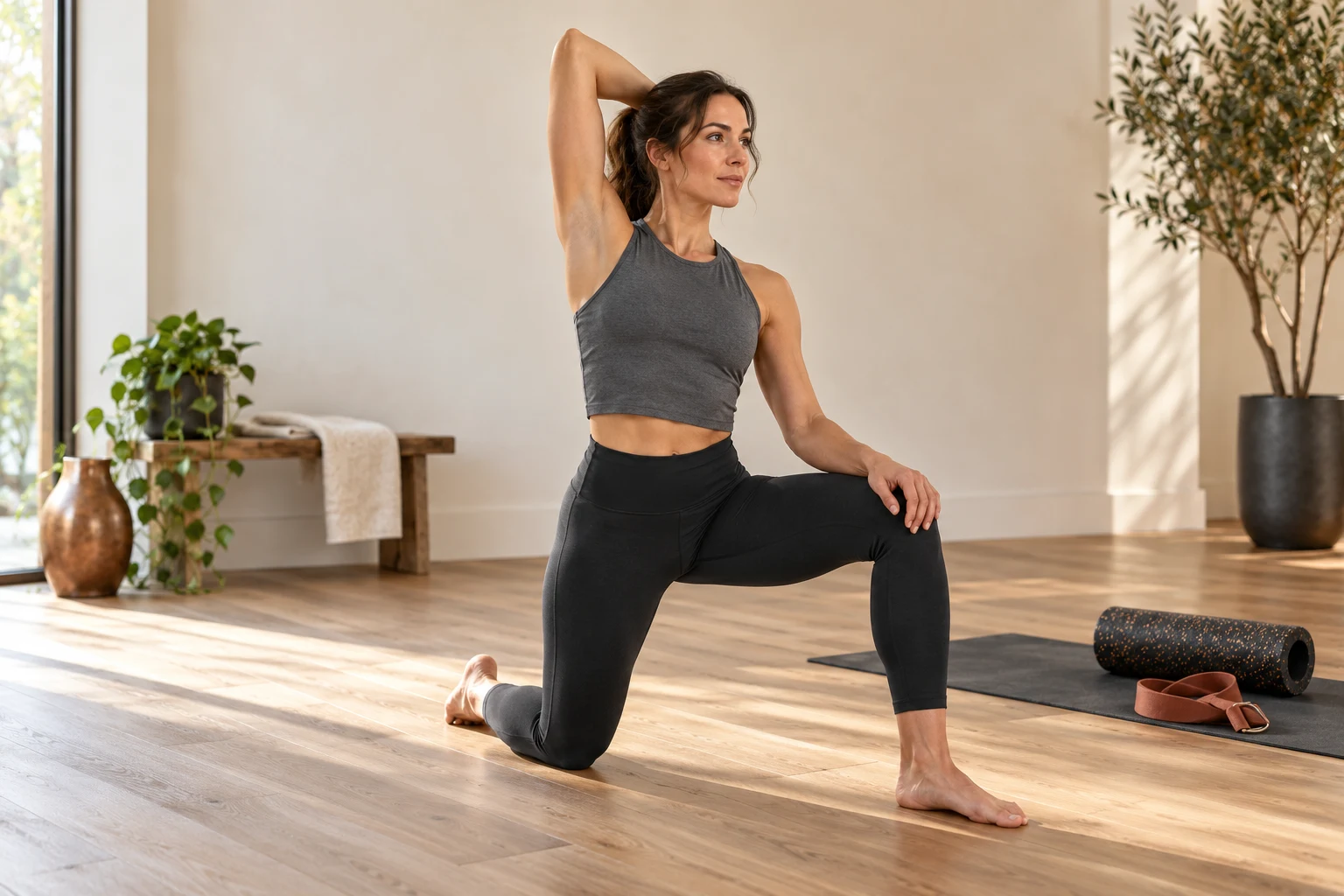
- Half-kneeling hip shifts — 6 per side: Tuck the pelvis slightly and glide forward without arching the lower back.
- 90/90 hip rotations — 6 total: Sit with both knees bent and rotate the legs from one side to the other without forcing the range.
- Quadruped thoracic rotations — 6 per side: From hands and knees, rotate one arm toward the ceiling while keeping the hips controlled.
- Wall slides — 8 repetitions: Slide the arms upward while keeping the movement comfortable and avoiding excessive rib flare.
- Controlled calf raises — 10 repetitions: Rise and lower slowly through the range you can control.
If the ankles are your main restriction, continue with our dedicated ankle dorsiflexion routine. A slant board can also create a repeatable setup for calf stretching and supported ankle work; see how to use a slant board for ankle mobility.
How mobility tools fit into training
Mobility tools can make a position easier to repeat, provide feedback or change the training angle. They are useful when they solve a specific problem, but they are not required for every drill.
- Slant boards provide a consistent incline for calf stretching, ankle work and heel-elevated squat variations.
- Resistance bands can provide assistance, light resistance or directional feedback.
- Foam rollers can be used for temporary soft-tissue work or as a support for certain mobility drills.
- Balance boards challenge active control and coordination rather than simply creating more passive range.
- Stability balls can support positions and introduce controlled instability during trunk, hip and shoulder exercises.
For equipment-specific guidance, visit our slant-board hub, balance-board hub and balance and stability ball hub.
Move within a comfortable range
Mobility training should not require sharp pain, forced joint positions or bouncing aggressively into end range. Stop and seek guidance from a qualified healthcare professional when movement causes sharp pain, catching, significant swelling, numbness, unexplained weakness or instability—especially after an injury or surgery.
Frequently asked questions
Is mobility the same as stretching?
No. Stretching is one method used primarily to improve flexibility and available range. Mobility training generally includes active movement, strength and control through a joint’s range.
Can you be flexible but not mobile?
Yes. You may be able to reach a position with assistance yet lack the strength or coordination to enter and control it actively. Passive flexibility does not guarantee usable mobility.
Can strength training improve mobility?
It can. Exercises performed with appropriate technique through a comfortable, gradually progressing range can strengthen the muscles responsible for controlling that range. Mobility and strength do not have to be trained separately.
Should I stretch before working out?
A dynamic warmup is generally the more practical choice immediately before activity. Longer static stretches can be performed after training or separately. The best approach depends on the activity, your needs and how the stretching affects your performance.
How often should beginners perform mobility exercises?
Short, comfortable sessions can be performed regularly, including as part of a warmup. Start with two to four focused sessions per week or a few minutes most days, then adjust according to your recovery and goals.
How long does it take to improve mobility?
There is no universal timeline. Progress depends on the joint, the reason for the restriction, training consistency, exercise selection and whether the goal requires flexibility, strength, coordination or a combination of them.
Final takeaway
Mobility and flexibility are partners, not rivals. Flexibility helps make range available. Mobility turns that range into controlled movement you can use during training, recreation and everyday tasks.
Instead of stretching everything indiscriminately, identify the position you want to improve. Determine whether the limitation appears to involve available range, active control, strength or technique. Then choose the simplest drill that addresses that need and retest the movement.
Start with the ankles
The ankles influence squatting, walking, stair descent and many balance exercises. Use our step-by-step guide to begin building controlled dorsiflexion.
Explore Ankle Dorsiflexion Exercises
Leave a Reply