
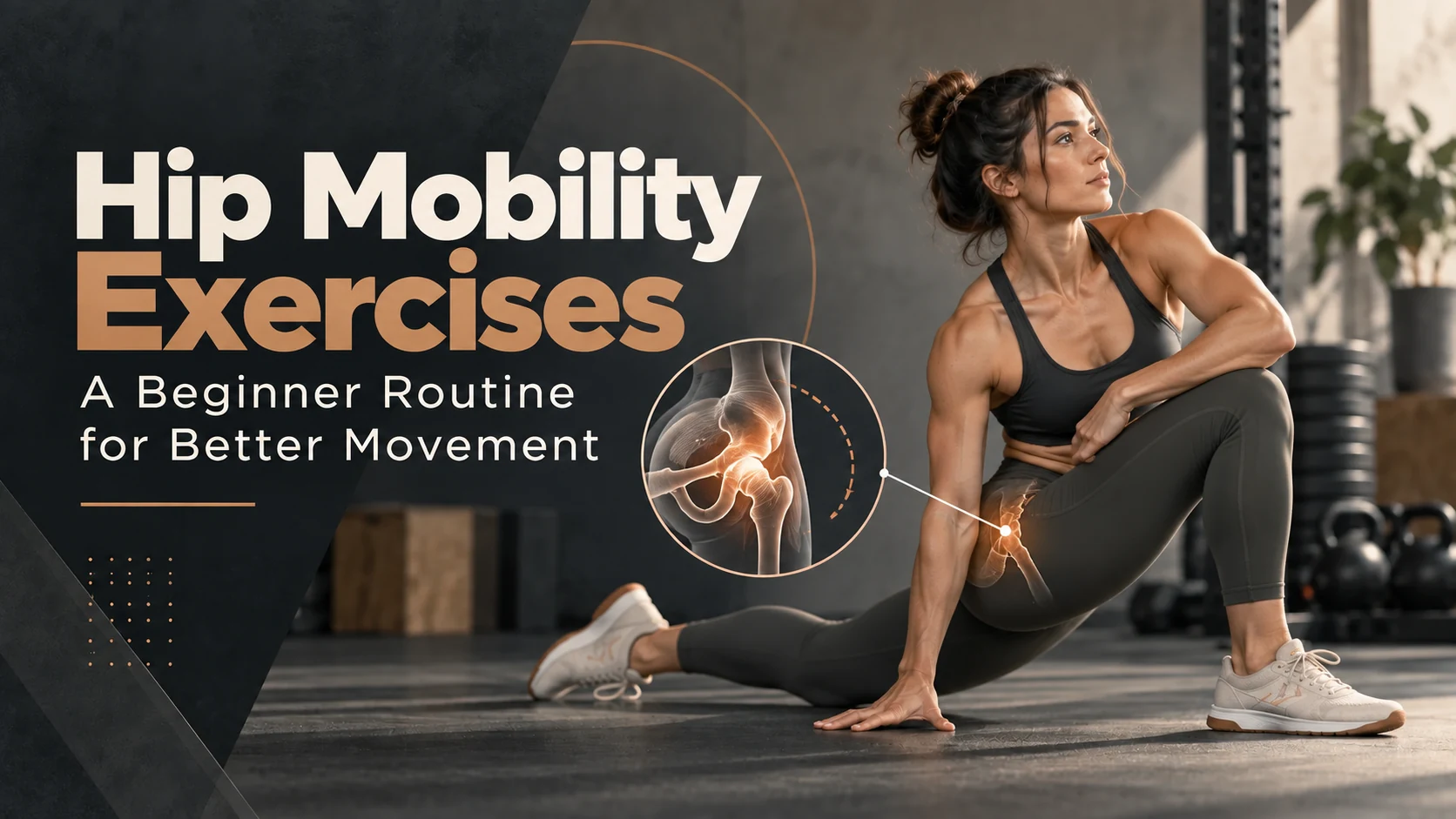
Hip mobility affects far more than your ability to perform a deep squat. Your hips need to flex, extend, rotate, and move from side to side during walking, climbing stairs, hiking, getting up from a chair, lifting, and countless other everyday movements.
When those movements feel restricted, the answer is not necessarily to stretch harder. A better approach is to gradually build comfortable range of motion while learning to control that range.
The beginner hip mobility exercises below target several of the primary ways the hip moves. You do not need specialized equipment, and the complete routine can be finished in roughly 10 to 15 minutes.
What Is Hip Mobility?
Hip mobility describes your ability to move the hip joint through its available range of motion while maintaining control of your pelvis, trunk, and leg.
The hip is capable of movement in several directions, including:
- Flexion: bringing the thigh toward the torso
- Extension: moving the leg behind the body
- Internal rotation: rotating the thigh inward
- External rotation: rotating the thigh outward
- Abduction: moving the leg away from the body’s midline
- Adduction: moving the leg toward the body’s midline
A well-rounded hip mobility routine should therefore include more than one hip-flexor stretch. It should expose the hips to several different positions and directions.
Why Hip Mobility Matters
Your hips sit near the center of your body and help transfer force between your upper and lower body. Restricted or poorly controlled hip motion may change the way you perform movements such as squatting, stepping, hinging, or walking.
Improving hip mobility can be especially useful if you want to:
- Feel more comfortable in a squat
- Move more freely while walking or hiking
- Improve rotational movement
- Make lunges and split-stance movements feel smoother
- Reduce the feeling of stiffness after prolonged sitting
- Prepare your hips for strength training
- Maintain movement options as you get older
The Hips Aren’t Always the Limiting Factor
If your heels lift, your feet turn excessively outward, or you struggle to keep your balance when squatting, hip mobility may only be part of the picture.
Ankle dorsiflexion can also influence squat mechanics. If squatting is your primary goal, combine hip work with our guide to ankle mobility for squats.
7 Beginner Hip Mobility Exercises
Move slowly through each exercise. You should feel mild muscular tension or a controlled stretch, not sharp pain, pinching, or joint discomfort.
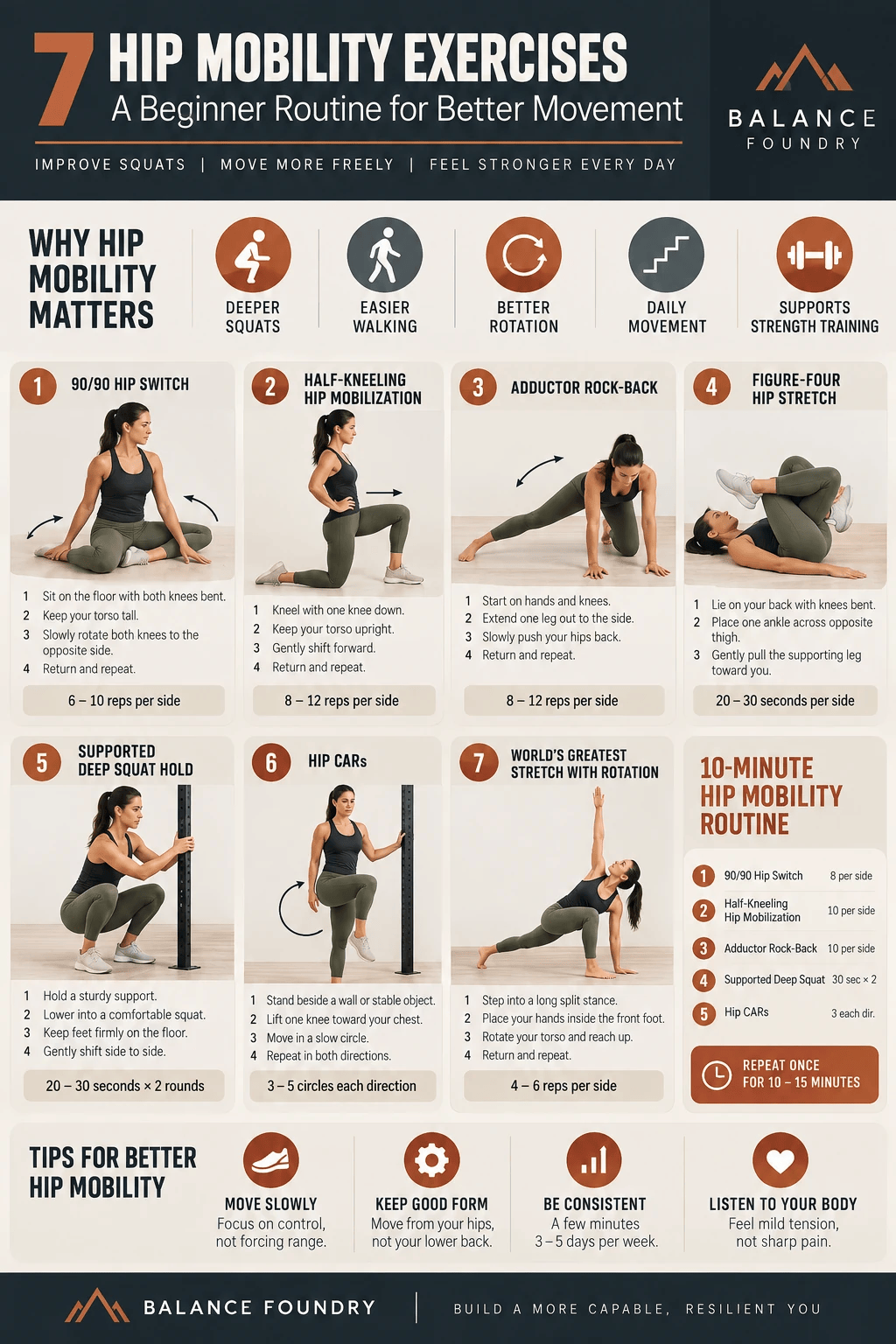
1 90/90 Hip Switch
The 90/90 position is one of the most useful beginner exercises for exploring both internal and external hip rotation.
How to do it:- Sit on the floor with both knees bent.
- Position one leg in front of you and the other toward your side.
- Aim for roughly a 90-degree bend at each knee.
- Keep your torso tall.
- Slowly rotate both knees toward the opposite side.
- Move only as far as you can without forcing the position.
- Return to the starting side and repeat.
Start with: 6 to 10 controlled transitions per side.
2 Half-Kneeling Hip Flexor Mobilization
This exercise focuses primarily on hip extension and the muscles along the front of the hip.
How to do it:- Kneel with one knee on a padded surface.
- Place the opposite foot in front of you.
- Keep your torso upright.
- Gently tuck your pelvis rather than excessively arching your lower back.
- Shift your body forward slightly until you feel a mild stretch through the front of the kneeling-side hip.
- Return and repeat using a slow rocking motion.
Start with: 8 to 12 slow repetitions per side.
3 Adductor Rock-Back
The adductors run along the inside of the thigh and contribute to hip movement and control. This rock-back provides a gentle way to explore that range.
How to do it:- Begin on your hands and knees.
- Extend one leg directly out to the side.
- Keep the foot flat or position the heel down with the toes pointing upward.
- Keep your spine relatively neutral.
- Slowly push your hips backward.
- Stop when you feel comfortable tension along the inside of the extended leg.
- Return to the starting position.
Start with: 8 to 12 repetitions per side.
4 Figure-Four Hip Stretch
The figure-four position targets the back and outside of the hip and is especially useful for people who find floor-based mobility work more comfortable.
How to do it:- Lie on your back with both knees bent.
- Place one ankle across the opposite thigh just above the knee.
- Gently bring the supporting leg toward your torso.
- Keep your head and shoulders relaxed.
- Stop when you feel a comfortable stretch through the hip.
Start with: 20 to 30 seconds per side for 1 to 2 rounds.
5 Supported Deep Squat Hold
A supported squat combines mobility at the hips, knees, ankles, and feet while allowing you to explore the position without worrying as much about balance.
How to do it:- Stand in front of a sturdy post, countertop, railing, or suspension trainer.
- Hold the support with both hands.
- Place your feet around shoulder width apart.
- Slowly lower into a comfortable squat.
- Use your arms only as much as necessary.
- Keep your feet firmly connected to the floor.
- Gently shift your weight from side to side if comfortable.
Start with: 20 to 30 seconds for 2 rounds.
6 Hip CARs
CARs—controlled articular rotations—take the hip through a slow circular movement and challenge you to control the joint through different positions.
How to do it:- Stand beside a wall or sturdy object for support.
- Brace your trunk gently.
- Lift one knee toward your chest.
- Move the knee outward to the side.
- Rotate the thigh so the knee begins moving behind you.
- Return the foot to the floor.
- Reverse the movement.
Start with: 3 to 5 slow circles in each direction per hip.
7 World’s Greatest Stretch With Rotation
This dynamic movement combines hip mobility with trunk rotation and can work well as part of a warm-up before walking, hiking, or strength training.
How to do it:- Begin in a standing position.
- Step one foot forward into a long split stance.
- Place your hands inside the front foot.
- Keep the rear leg extended or lower the rear knee if needed.
- Rotate your torso toward the front leg.
- Reach the same-side arm toward the ceiling.
- Return your hand to the floor and step back.
- Repeat on the opposite side.
Start with: 4 to 6 slow repetitions per side.
A Simple 10-Minute Hip Mobility Routine
You do not need to perform every possible hip mobility exercise during every session. Consistency is usually more practical than trying to complete a long mobility workout once in a while.
Beginner Hip Mobility Routine
| Exercise | Reps / Time | Main Focus |
|---|---|---|
| 90/90 Hip Switch | 8 per side | Hip rotation |
| Half-Kneeling Hip Mobilization | 10 per side | Hip extension |
| Adductor Rock-Back | 10 per side | Inner thigh / lateral mobility |
| Supported Deep Squat | 30 seconds × 2 | Combined lower-body mobility |
| Hip CARs | 3 each direction | Active hip control |
Run through the sequence once to begin. If you enjoy it and have more time, complete a second round.
When Should You Do Hip Mobility Exercises?
There is no single required time of day. Hip mobility work can fit into several parts of your routine.
Before Exercise
Use controlled, dynamic exercises such as hip CARs, 90/90 transitions, adductor rock-backs, and supported squats as part of your warm-up.
After Sitting for Long Periods
A short mobility session can simply provide some movement after your hips have remained in the same position for an extended period.
On Recovery Days
Low-intensity mobility work can be an easy way to stay active without turning every session into a workout.
Before Squatting
Combine hip mobility with ankle mobility if your goal is improving your squat position. The hips and ankles both contribute to how you organize the movement.
Start with our guide to ankle mobility for squats if your heels tend to rise or your ankles feel restricted as you descend.
Mobility vs. Flexibility: What’s the Difference?
The words are often used interchangeably, but they describe slightly different qualities.
Flexibility generally refers to how much a muscle or related tissue can lengthen.
Mobility is broader. It includes joint range of motion as well as your ability to actively control movement through that range.
That is why this routine combines traditional stretch positions with active movements such as 90/90 switches and hip CARs.
How Often Should You Work on Hip Mobility?
For most beginners, short mobility sessions performed consistently are easier to maintain than occasional long sessions.
A practical starting point is:
- 3 to 5 days per week for a short dedicated routine
- 5 to 10 minutes when using mobility as a warm-up
- Gentle movement breaks during days with prolonged sitting
You do not have to turn every session into an intense stretching workout. Many mobility exercises can be performed at a comfortable effort level.
Common Hip Mobility Mistakes
1. Forcing Range of Motion
More range is not automatically better. Work within a position you can control and gradually explore additional movement.
2. Turning Every Mobility Exercise Into a Stretch
Passive stretching can be useful, but active control matters too. Include exercises that require you to move the joint rather than simply holding a position.
3. Moving Through the Lower Back Instead of the Hip
If your pelvis and spine move dramatically during a hip exercise, you may appear to have more hip range than you actually do. Slow down and make the movement smaller.
4. Ignoring the Ankles and Feet
Lower-body movement is interconnected. Limited ankle motion or poor foot control can change the way a squat or lunge feels even when your hips move well.
5. Working Through Pain
Mobility exercises may create mild muscular tension, but sharp pain, significant pinching, or persistent joint discomfort is a reason to stop rather than push deeper.
Frequently Asked Questions About Hip Mobility
How long does it take to improve hip mobility?
There is no universal timeline. Your starting mobility, anatomy, training history, activity level, and consistency all matter. Rather than focusing on a deadline, look for gradual improvements in movement quality and comfort.
Can tight hips affect squats?
Hip range of motion can influence how you squat, but it is only one factor. Ankle mobility, foot position, stance width, balance, limb proportions, and squat technique can also affect your preferred squat depth and position.
Should I stretch my hips every day?
Gentle mobility work can be performed frequently if it feels comfortable, but you do not need an intense stretching session every day. A combination of mobility, strength training, walking, and regular movement is often more practical.
Are 90/90 exercises good for hip mobility?
The 90/90 position can be a useful way to explore hip internal and external rotation. Beginners can use their hands for support and progressively rely less on them as control improves.
Can walking improve hip mobility?
Walking moves the hips repeatedly through flexion and extension and is an excellent general movement habit. However, a dedicated mobility routine can expose the hips to rotational and lateral positions that normal walking does not emphasize as strongly.
Build Mobility You Can Actually Use
You do not need extreme flexibility to move well.
The goal of hip mobility training is to gradually develop comfortable, controlled movement that transfers to activities you actually perform—whether that is squatting, strength training, hiking, walking, working around the house, or simply getting up and down from the floor more comfortably.
Start with a few of these exercises, stay consistent, and pay attention to how your movement changes rather than how far you can force yourself into a stretch.
Continue Building Your Mobility
Hip mobility is only one part of a mobile lower body. If squatting is one of your goals, work from the ground up and address your ankles as well.
Next: Read Ankle Mobility for Squats to learn how ankle dorsiflexion affects squat movement and which exercises can help you work on it.
You can also explore more movement guides in the Balance Foundry Mobility Hub.
Leave a Reply