
Your feet are the first point of contact with the ground during walking, standing, balancing, squatting, and nearly every lower-body movement you perform.
When the toes do not move well, the arch feels weak, or the foot cannot adapt to the floor, the rest of the body may have to compensate. That does not mean every movement problem begins at the feet, but improving foot and toe control can give you a stronger foundation for balance and movement.
The foot mobility exercises below are designed for beginners and focus on toe control, arch activation, ankle movement, and better awareness of how your feet interact with the ground.
Why Foot Mobility Matters
The foot is made up of numerous joints, muscles, tendons, and connective tissues that work together to create both mobility and stability.
Your feet need to be able to adapt to the surface beneath you while also becoming firm enough to push against the ground.
Foot mobility and control can influence:
- Standing balance
- Walking mechanics
- Squat stability
- Single-leg control
- Toe-off during walking
- Arch function
- Ground awareness
Your Feet Are Part of the Mobility Chain
The feet, ankles, knees, and hips work together. If your goal is better squatting or lower-body movement, foot exercises are most useful when combined with ankle and hip mobility rather than treated as a completely separate system.
You may also want to read Ankle Mobility for Squats and Hip Mobility Exercises.
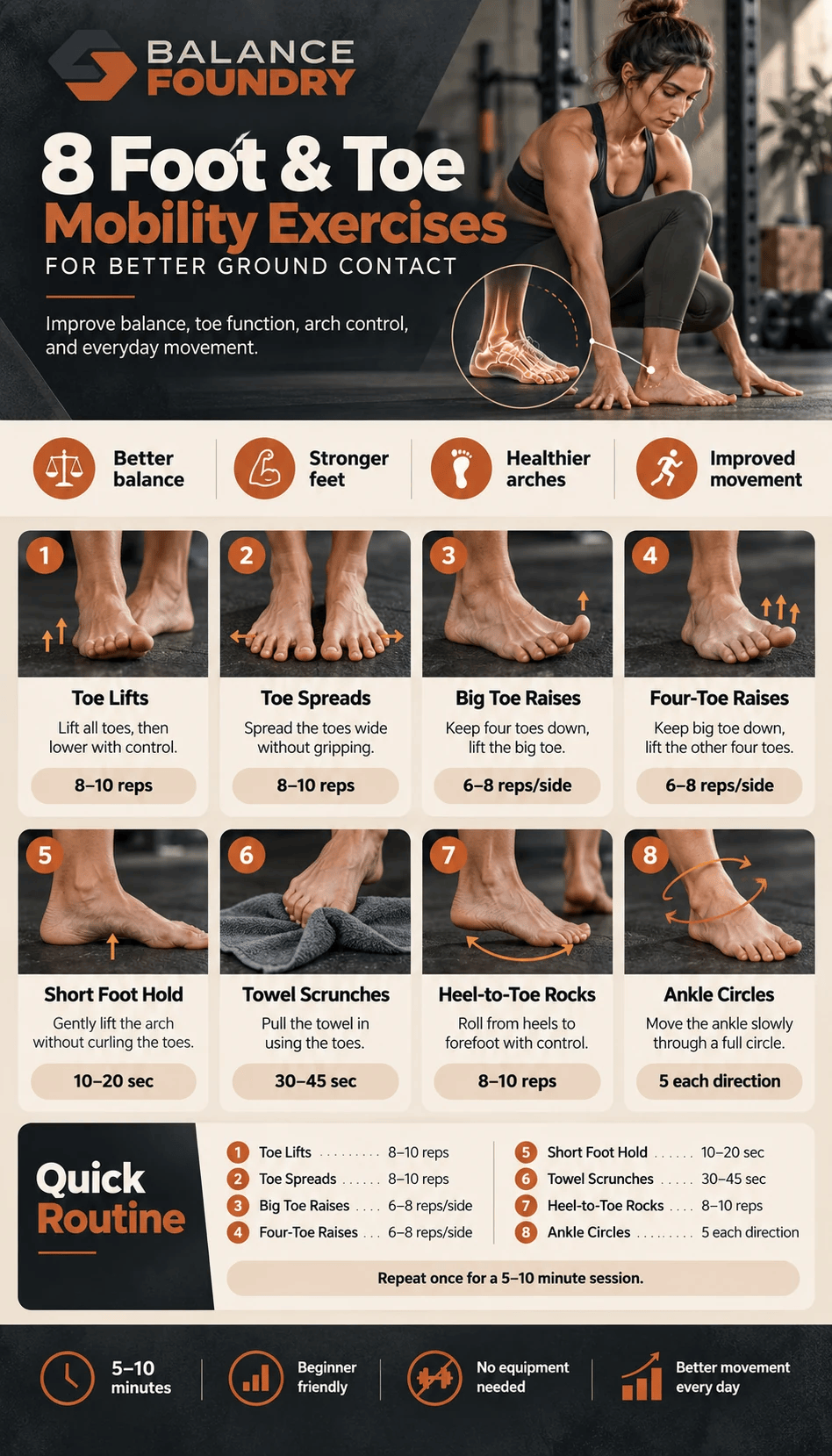
8 Foot and Toe Mobility Exercises
Most of these exercises can be performed barefoot or in socks on a stable surface. Move slowly and focus on control rather than simply completing repetitions.
1 Toe Lifts
Toe lifts are a simple way to begin separating toe movement from the rest of the foot.
How to do it:- Stand or sit with your foot flat on the floor.
- Keep the heel and ball of the foot in contact with the ground.
- Lift all five toes upward.
- Pause briefly.
- Slowly lower the toes back down.
Start with: 8 to 10 repetitions.
2 Toe Spreads
Toe spreads encourage independent toe control and help you explore how well the toes can widen against the floor.
How to do it:- Place the foot flat on the floor.
- Relax the toes.
- Slowly spread the toes apart.
- Hold briefly without gripping the floor.
- Relax and repeat.
Start with: 8 to 10 repetitions.
3 Big Toe Raises
This exercise helps develop independent control of the big toe.
How to do it:- Stand or sit with the entire foot on the floor.
- Keep the four smaller toes pressed lightly into the ground.
- Lift only the big toe.
- Pause.
- Slowly lower it.
Start with: 6 to 8 repetitions per foot.
4 Four-Toe Raises
Now reverse the previous exercise and keep the big toe down while lifting the other four toes.
How to do it:- Place the entire foot flat on the floor.
- Press the big toe lightly into the ground.
- Lift the four smaller toes.
- Pause briefly.
- Lower with control.
Start with: 6 to 8 repetitions per foot.
5 Short Foot Hold
The short foot exercise focuses on gently activating the muscles that support the arch without curling the toes.
How to do it:- Place your foot flat on the ground.
- Keep the heel and base of the big toe in contact with the floor.
- Imagine gently drawing the ball of the foot toward the heel.
- Allow the arch to rise slightly.
- Do not curl or grip with the toes.
- Hold and relax.
Start with: 10 to 20 seconds for 2 to 3 rounds.
6 Towel Scrunches
Towel scrunches challenge toe flexion and can provide an easy introduction to foot strengthening.
How to do it:- Sit in a chair with a small towel on the floor.
- Place your bare foot on the towel.
- Use your toes to pull the towel toward you.
- Relax the toes between pulls.
Start with: 30 to 45 seconds per foot.
7 Heel-to-Toe Rocks
Heel-to-toe rocks move the foot and ankle through a simple weight-shifting pattern similar to parts of the walking cycle.
How to do it:- Stand tall with your feet around hip width.
- Shift your weight toward your heels and gently lift the forefoot.
- Return through the center.
- Shift forward onto the balls of the feet.
- Allow the heels to rise slightly.
- Move back and forth slowly.
Start with: 8 to 10 repetitions.
Hold a wall or stable support if needed.
8 Ankle Circles
Although primarily an ankle movement, ankle circles also allow the foot to move through several different positions.
How to do it:- Sit or stand while holding support.
- Lift one foot slightly off the ground.
- Slowly draw a circle with the foot.
- Use the largest comfortable range you can control.
- Reverse direction.
Start with: 5 circles in each direction per foot.
A Simple 5- to 10-Minute Foot Mobility Routine
You do not need to perform a long foot workout. The exercises can be combined into a short routine that is easy to repeat several times per week.
Beginner Foot Mobility Routine
| Exercise | Reps / Time | Main Focus |
|---|---|---|
| Toe Lifts | 8–10 reps | Toe mobility |
| Toe Spreads | 8–10 reps | Toe control |
| Big Toe Raises | 6–8 reps | Big toe independence |
| Four-Toe Raises | 6–8 reps | Smaller toe control |
| Short Foot Hold | 10–20 sec | Arch control |
| Towel Scrunches | 30–45 sec | Toe strength |
| Heel-to-Toe Rocks | 8–10 reps | Weight transfer |
| Ankle Circles | 5 each direction | Ankle and foot mobility |
Complete the sequence once. If you have more time, repeat it for a second round.
What Is the Foot Tripod?
The foot tripod is a useful concept for understanding ground contact.
Think of three primary contact points:
- The heel
- The base of the big toe
- The base of the little toe
During many standing exercises, the goal is to maintain contact through all three points rather than collapsing entirely toward the inside or outside of the foot.
That does not mean your foot should remain rigid. The foot naturally adapts and moves. The tripod is simply a helpful starting position for learning better ground awareness.
Why Big Toe Mobility Matters
The big toe plays an important role during walking because your body moves over the foot and eventually pushes away from the ground through the forefoot.
If the big toe feels stiff, this part of walking may feel less natural.
Big toe raises and gentle toe mobility exercises can help you practice moving and controlling the big toe independently.
How Foot Mobility Relates to Balance
Your feet constantly receive information from the surface beneath you.
When standing on one leg or reacting to small changes in position, muscles throughout the foot and ankle contribute to maintaining balance.
Improving toe control and foot awareness does not guarantee perfect balance, but it can provide a better base for balance training.
This is also why foot mobility fits naturally with the larger Balance Foundry focus on balance boards, mobility, and stability training.
When Should You Do Foot Mobility Exercises?
Before Balance Training
A few minutes of toe and foot exercises can help you become more aware of your ground contact before performing balance work.
Before Squats or Lower-Body Training
Toe lifts, short foot holds, and ankle movement can be included in a warm-up before squats, lunges, or similar exercises.
After Wearing Shoes All Day
Moving the toes independently can simply give your feet an opportunity to move after spending much of the day inside footwear.
As Part of a Mobility Routine
You can also combine these exercises with our 10-Minute Full-Body Mobility Routine.
Should You Train Barefoot?
You do not need to perform every workout barefoot to improve foot function.
However, performing basic foot mobility exercises barefoot can make it easier to see and feel what your toes and arches are doing.
If you are new to barefoot movement, start with low-intensity activities in a safe environment rather than immediately performing long or high-impact workouts without shoes.
Common Foot Mobility Mistakes
Gripping the Floor Constantly
The toes should be able to relax as well as create force. Constantly clawing at the ground can create unnecessary tension.
Rolling the Foot Outward
When lifting the toes or activating the arch, try to maintain contact at both the base of the big toe and little toe.
Trying to Create a Huge Arch
The short foot exercise should be subtle. You are not trying to pull the foot into an exaggerated shape.
Doing Too Much Too Soon
The small muscles of the feet may fatigue quickly if they are not accustomed to direct exercise. Start with a small amount of work and progress gradually.
Ignoring Pain
Mild muscular effort is normal. Sharp pain, persistent joint discomfort, or worsening symptoms are reasons to stop rather than push through the exercise.
Frequently Asked Questions
How often should I do foot mobility exercises?
A short routine can be performed several times per week. Many of these exercises are low intensity, so frequency can be adjusted based on how your feet feel.
Can foot exercises improve balance?
Foot and ankle control contribute to balance, but balance is a whole-body skill. Foot exercises are best combined with standing balance exercises and progressive balance training.
Why can’t I move my big toe independently?
Many people initially have difficulty moving individual toes. That does not automatically indicate a problem. Practicing slowly can improve your awareness and control over time.
Are towel scrunches good for your feet?
Towel scrunches can be a useful beginner exercise for toe flexion, but they should not be the only foot exercise you perform. Include toe spreading, arch control, and standing movements as well.
Can I do these exercises every day?
Gentle toe and mobility exercises may be performed frequently if they are comfortable. More demanding foot-strengthening exercises may require additional recovery depending on volume and intensity.
Build Better Movement From the Ground Up
Foot mobility does not need to be complicated.
Learning to lift and spread your toes, activate your arch, control your ankle, and maintain better ground contact can give you a stronger foundation for balance and lower-body movement.
Start with a few exercises, move slowly, and focus on improving control rather than forcing your feet into extreme positions.
Continue Building Your Mobility
Your feet are only one part of the lower-body movement system.
Continue with Ankle Mobility for Squats, Hip Mobility Exercises, or the 10-Minute Full-Body Mobility Routine.
You can also explore the full Balance Foundry Mobility Hub for additional mobility guides, exercises, and equipment resources.