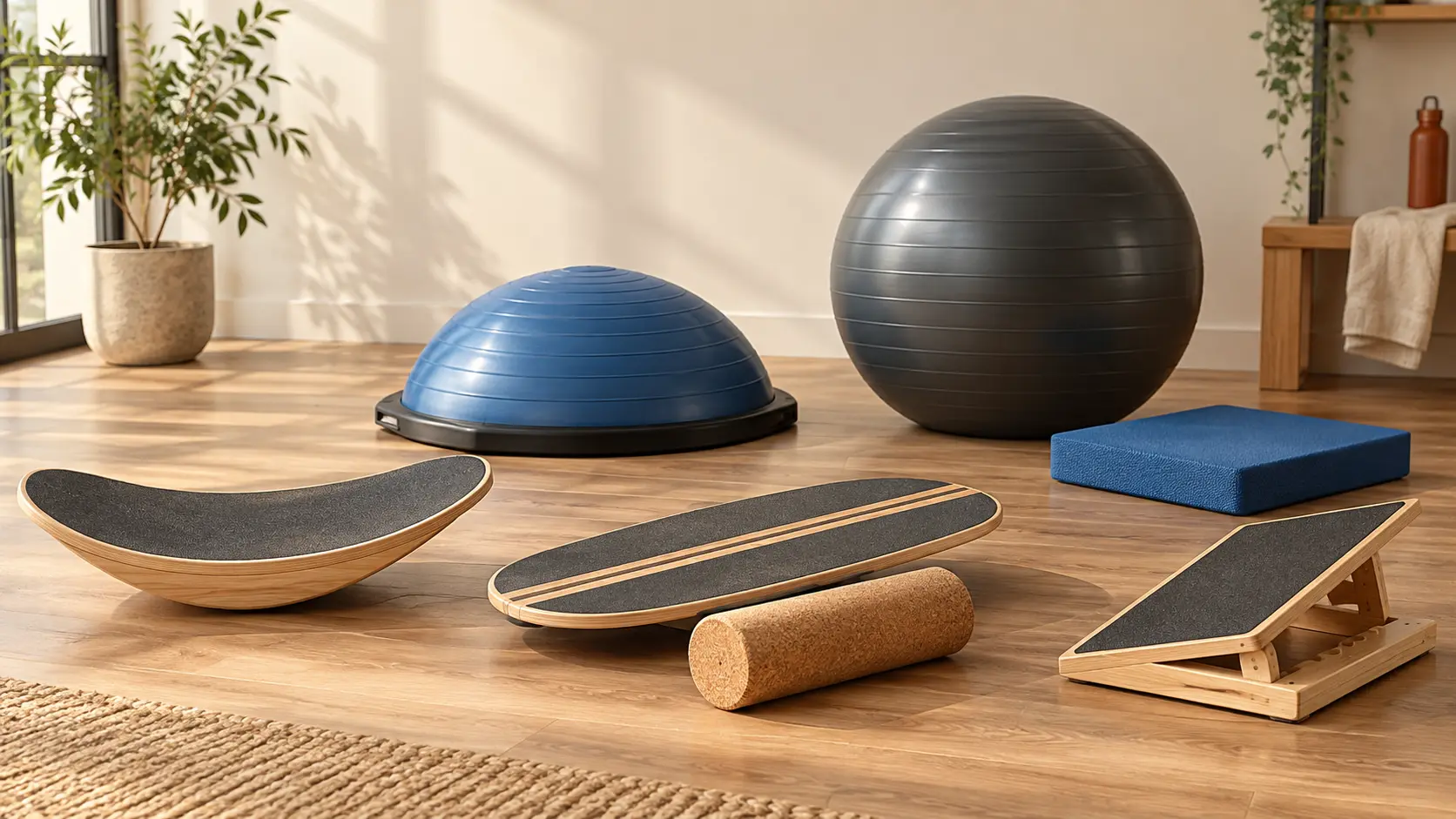
The best balance training equipment depends on what you want to improve. A rocker board offers predictable movement for beginners, a roller board creates a larger dynamic challenge, a half balance ball supports full-body workouts, and a stability ball works well for core training and supported exercises.

Best Balance Training Equipment: Quick Comparison
| Equipment | Best for | Movement type | Skill level | Testing status |
|---|---|---|---|---|
| StrongTek Professional Wooden Balance Board | Best beginner balance board | Predictable single-axis rocking | Beginner | Research-based |
| INFIDEZ Balance Surf Trainer | Best progressive roller board | Free-moving deck and cork roller | Beginner to advanced | Hands-on tested |
| BOSU NexGen Home Balance Trainer | Best half balance ball overall | Inflatable dome with stable platform | Beginner to intermediate | Research-based |
| ZELUS 23-Inch Balance Ball Trainer | Best value half ball | Half ball with resistance bands | Beginner to intermediate | Research-based |
| BOSU Elite Balance Trainer | Best performance half ball | Firmer resistance-focused dome | Intermediate to advanced | Research-based |
| TRX Stability Ball | Best full stability ball | Rolling and supported instability | All levels | Research-based |
| FITMIND Extra Thick Stability Ball | Best value full ball | Full-round exercise ball | All levels | Research-based |
| StrongTek Wooden Slant Board | Best ankle-mobility support tool | Fixed adjustable incline | All levels | Research-based |
How We Selected This Balance Equipment
I’m Charlie Brown, a certified personal trainer, nutrition coach and barefoot coach. For this guide, I compared equipment according to the qualities that matter during actual use:
- Movement pattern: Does the equipment move in one direction, multiple directions or freely beneath the user?
- Approachability: Can a beginner find a stable starting position without being overwhelmed?
- Progression: Can exercises become more challenging as control improves?
- Exercise variety: Can the tool support standing, kneeling, seated, core or strength exercises?
- Training purpose: Does the equipment suit ankle control, core strength, general balance, mobility or board-sport practice?
- Practical ownership: Floor space, storage, setup and loose components affect how often a product is likely to be used.
No single tool is best at everything. The strongest choice is the one that matches your present ability and the type of training you will perform consistently.
The Best Balance Training Equipment
1. StrongTek Professional Wooden Balance Board
The StrongTek Professional Wooden Balance Board is the easiest product here to recommend as a first dedicated balance tool. Its rocker base creates a controlled side-to-side movement rather than allowing the platform to move freely across the floor.
That predictable movement pattern gives beginners time to understand how pressure through the feet changes the board. It can support weight shifts, two-leg holds, shallow squats and basic ankle-control exercises. The rectangular deck also provides more usable standing space than many compact round wobble boards.
Advanced users may eventually outgrow its challenge, but that is not necessarily a disadvantage. A beginner-friendly board should help establish control instead of simply making the user feel unstable.
Trainer’s take · Charlie Brown, CPT
Who it suits: Anyone buying their first piece of balance equipment.
Form cue: Your first goal is a calm 30-second hold with the board level and no edge touching the floor. Once you can do that without grabbing support, you’re ready to think about harder gear.
Why I’d pick it: A predictable first tool builds the control that every other item on this list depends on.
Pros
- Predictable movement pattern
- Approachable for new users
- No loose roller to manage
- Useful for standing-desk movement
Cons
- Limited advanced progression
- Primarily challenges one movement axis
- Less sport-specific than a roller board
Best for: Beginners, controlled ankle work, basic balance exercises and occasional standing-desk use.
2. INFIDEZ Balance Surf Trainer
The INFIDEZ Balance Surf Trainer is my top choice for people who want a balance board with substantial progression potential. I personally own and use this board. What I like most is that it remains approachable enough to learn while still offering a meaningful challenge as control improves.
The wide deck rests on a separate cork roller, producing the responsive side-to-side movement associated with surf, snowboard and skateboard trainers. Unlike a fixed rocker, the board can travel with the roller, requiring continuous attention and more precise weight transfer.
Use it for controlled holds, stance practice, weight shifts and shallow squats. It requires open floor space and should be practiced near stable support. This is training equipment—not a product for distracted use while typing or watching television.
Pros
- Good progression range
- Engaging athletic challenge
- Comfortable stance area
- Useful for board-sport-style practice
Cons
- Requires clear floor space
- Harder to learn than a rocker board
- Not suitable for distracted desk use
Best for: Active adults and board-sport athletes who want a balance board that can progress beyond basic standing drills.
3. BOSU NexGen Home Balance Trainer
The BOSU NexGen Home Balance Trainer is the most versatile half-ball option in this guide. Its inflatable dome creates an unstable surface, while the rigid platform allows the trainer to remain in one location instead of rolling across the floor.
The textured dome is divided into quadrants that can help with hand and foot placement. The half-ball format supports standing balance exercises, squats, lunges, planks, push-ups, kneeling drills and core exercises.
Beginners can start dome-side up near a stable support. Platform-side-up exercises create a different and often more demanding challenge and should be introduced only after the user understands how the trainer responds.
Trainer’s take · Charlie Brown, CPT
Who it suits: People who want one piece of equipment for a full-body home workout, not just balance drills.
Form cue: For a half squat, stand dome-side up with your feet hip-width and centered on the quadrant markings, then sit back softly to a comfortable depth and drive up through your whole foot.
Why I’d pick it: It supports more types of exercise than any other item here, from standing work to planks and push-ups.
Pros
- Supports many exercise positions
- More contained than a roller board
- Useful for balance and strength training
- Clear visual placement cues
Cons
- Requires more storage space than a board
- Firmness affects how the dome responds
- Platform-up use may be inappropriate for beginners
Best for: Home exercisers who want one versatile product for balance, strength, core and full-body workouts.
4. ZELUS 23-Inch Balance Ball Trainer
The ZELUS 23-inch trainer offers the basic half-ball format along with resistance bands and a pump. It is the value-focused option for shoppers who want to try half-ball training without immediately moving to a premium BOSU model.
The attached resistance bands can support presses, rows and other upper-body movements while standing or kneeling on the dome. However, the bands should not distract from basic positioning. Learn simple holds, squats and supported weight shifts before combining instability with loaded arm exercises.
As with any inflatable trainer, check the selected model, included accessories and inflation instructions before use. Avoid assuming that every ZELUS variation has identical features or capacity.
Trainer’s take · Charlie Brown, CPT
Who it suits: Budget shoppers who want to try half-ball training before spending more.
Form cue: Leave the bands in the box for the first couple of weeks and just learn how the dome feels. When you add them, start kneeling on the dome for rows before trying anything standing.
Why I’d pick it: A low-cost way to find out whether half-ball training fits your routine.
Pros
- Lower-cost half-ball option
- Resistance bands add exercise variety
- Pump included
- Useful for home workouts
Cons
- Accessory quality may differ from premium systems
- Resistance bands can complicate beginner exercises
- Product variations require careful checking
Best for: Budget-conscious home users who want a half-ball trainer with resistance-band options.
5. BOSU Elite Balance Trainer
The BOSU Elite is intended for a different purpose than a soft, highly unstable half ball. BOSU describes the Elite as resistance-focused, using a firmer Reactive Dome designed for force production and athletic strength exercises.
That makes the Elite more appropriate for experienced users performing squats, lunges, loaded carries, push-ups or athletic stance drills. It is not automatically better for someone whose primary goal is gentle balance practice.
The higher price and specialized feel make the Elite excessive for many beginners. Its value appears when the user specifically wants a firmer platform for performance-oriented training.
Trainer’s take · Charlie Brown, CPT
Who it suits: Experienced lifters and athletes who want a firm dome they can drive force into.
Form cue: In a split-stance hold, actively press your front foot down into the dome for 10–20 seconds instead of just balancing on it. That active press is what the firmer dome is built for.
Why I’d pick it: Only if you’ll train force and power on it. Otherwise the NexGen is the better buy.
Pros
- Designed for performance training
- Firmer response than standard half balls
- Supports strength-oriented exercises
- High progression ceiling
Cons
- Premium price
- More specialized than most home users need
- Not the gentlest starting point
Best for: Experienced trainees and athletes who want a firmer half ball for resistance-focused exercise.
6. TRX Stability Ball
The TRX Stability Ball is the best fit for people who want a traditional full-round exercise ball from an established fitness-equipment brand. Unlike a half ball, a stability ball can roll in every direction and does not have a rigid platform.
This design works well for supported core exercises, hamstring curls, glute bridges, ball rollouts, wall squats and mobility positions. The ball is less suitable for unsupported standing because it can move quickly and unpredictably.
Choose the correct diameter for your height and intended exercises. A ball that is too small or too large can make seated and supported positions awkward.
Trainer’s take · Charlie Brown, CPT
Who it suits: People whose main goal is core strength rather than standing balance.
Form cue: Try “stir the pot”: forearms on the ball in a plank, then draw small slow circles with your elbows while keeping your hips level and your lower back still. Make the circles smaller before you make them faster.
Why I’d pick it: A full ball is still one of the best core tools around, and this one is built for training rather than sitting.
Pros
- Versatile for core exercises
- Useful for supported strength work
- Simple equipment category
- Works across several ability levels
Cons
- Requires careful size selection
- Can roll away during setup
- Needs more storage space when inflated
Best for: Core workouts, supported strength exercises, mobility work and users who prefer a traditional stability ball.
Check TRX Stability Ball Price Find Your Stability Ball Size
7. FITMIND Extra Thick Stability Ball
The FITMIND Extra Thick Stability Ball is the value alternative for buyers who want several size choices and an included pump. The listing offers multiple diameters, allowing shoppers to select a ball according to height and exercise needs.
Its traditional round shape supports the same general exercise categories as the TRX ball: bridges, curls, crunch variations, wall squats, mobility work and supported core training.
Claims such as anti-burst performance and maximum capacity come from the manufacturer or retailer. Inspect the ball regularly, follow the inflation instructions and keep it away from sharp objects and rough surfaces.
Trainer’s take · Charlie Brown, CPT
Who it suits: Beginners and budget shoppers who want an easy way to start ball training at home.
Form cue: Start with a wall squat: place the ball between your lower back and the wall, walk your feet out a little, and let the ball roll down with you to a comfortable depth before pressing back up.
Why I’d pick it: It covers the same everyday exercises as the TRX for less money.
Pros
- Several size options
- Pump included
- Affordable entry into stability-ball training
- Useful for core and mobility exercises
Cons
- Requires inflation and occasional adjustment
- Needs clear storage space
- Research-based recommendation only
Best for: Shoppers who want an affordable full stability ball with multiple size choices.
8. StrongTek Extra-Large Wooden Slant Board
A slant board is not an unstable balance trainer, but it can support the mobility side of a complete balance program. The StrongTek wooden slant board provides an adjustable incline for calf stretching, ankle-position work and supported squat variations.
Improving usable ankle motion may make certain balance exercises, reaches and squats more comfortable. However, standing on a slant board does not replace practicing balance on stable ground or appropriate moving equipment.
The extra-large platform provides room for a two-foot stance, while the adjustable incline allows the angle to be matched to the exercise. Use a controlled angle rather than automatically selecting the steepest position.
Trainer’s take · Charlie Brown, CPT
Who it suits: Anyone whose stiff calves or ankles make squats and single-leg balance feel awkward.
Form cue: Use it as a warm-up: a minute of straight-knee and bent-knee calf stretching on each side at a low angle, then go straight into your balance work while the ankles feel loose.
Why I’d pick it: Better ankle mobility makes every balance drill easier to do well, so it pairs well with any board or ball on this list.
Pros
- Supports ankle-mobility work
- Multiple incline positions
- Wide two-foot platform
- Useful beyond balance training
Cons
- Not an unstable balance trainer
- Steeper angles are not always better
- Requires separate balance exercises
Best for: Calf stretching, ankle mobility and supporting the movement capacity needed for squats and reaching drills.
Check StrongTek Slant Board Price Compare Adjustable Slant Boards
Types of Balance Training Equipment
Rocker Boards
A curved base creates a predictable tilt, usually along one primary axis. Rockers are generally the easiest balance boards to learn.
Wobble Boards
A centered base lets the platform tilt in multiple directions. This requires faster ankle and hip corrections than a single-axis rocker.
Roller Boards
A separate cylinder travels beneath the deck. Roller boards offer significant progression but require clear space and focused practice.
Half Balance Balls
An inflatable dome is attached to a rigid platform. Half balls can support standing, kneeling, plank, squat and strength exercises.
Full Stability Balls
A full-round ball moves in every direction. It is most useful for supported core, strength and mobility exercises rather than unsupported standing.
Foam Pads and Balance Discs
These compact tools change the surface beneath the feet. They can be useful for supported exercises but should not be assumed to be easier simply because they are small.
Slant Boards
A slant board creates a fixed incline rather than instability. It belongs in this guide as a mobility-support tool, not as a direct replacement for balance equipment.
Stable-Floor Training
The floor remains one of the most useful training tools. Single-leg holds, reaches, hinges and controlled steps should be established before advanced equipment.
What Equipment Is Best for Your Skill Level?
Beginner
Start with equipment that has a predictable response. A rocker board, full stability ball used for supported exercises or a half ball placed dome-side up provides a more manageable starting point.
Beginners should also spend time on stable-floor movements from our complete balance exercise guide.
Intermediate
Intermediate users can add multidirectional wobble boards, half-ball strength exercises and longer single-leg progressions. The equipment should add a clear training challenge rather than simply making every exercise less stable.
Advanced
Roller boards and performance half balls offer a higher progression ceiling. Advanced users should still use stable surfaces when strength, speed or force production is the primary goal.
Choose Equipment by Training Goal
| Goal | Best equipment types | Suggested product |
|---|---|---|
| Ankle control | Rocker board or wobble board | StrongTek Wooden Balance Board |
| Board-sport practice | Roller balance board | INFIDEZ Balance Surf Trainer |
| Full-body workouts | Half balance ball | BOSU NexGen |
| Performance strength | Firmer half ball | BOSU Elite |
| Core exercise | Full stability ball | TRX Stability Ball |
| Budget home workouts | Value half ball or stability ball | ZELUS or FITMIND |
| Ankle mobility | Adjustable slant board | StrongTek Wooden Slant Board |
Balance Equipment Safety
- Begin beside a countertop, railing or other stable support.
- Place the equipment on a surface recommended by the manufacturer.
- Clear furniture, weights and sharp objects from the surrounding area.
- Inspect inflatable products for damage before use.
- Confirm that adjustable parts and stops are secured.
- Learn two-foot exercises before attempting single-leg variations.
- Avoid adding heavy weights until you can control the equipment consistently.
- Stop if you experience pain, dizziness or an unexpected loss of control.
Frequently Asked Questions
What is the best balance training equipment for beginners?
A fixed rocker board is one of the most approachable dedicated balance tools because it moves along a predictable path. Beginners can also use a stability ball for supported exercises or a half ball dome-side up near stable support.
Do I need equipment to improve my balance?
No. Stable-floor exercises such as single-leg holds, tandem standing, weight shifts, reaches and controlled steps can build a strong foundation before equipment is introduced.
Is a balance board or BOSU-style trainer better?
A balance board is better for standing control and board-style movement. A half balance ball provides more exercise variety for squats, lunges, planks, kneeling drills and upper-body exercises. The better choice depends on your training goal.
What is the difference between a half ball and a stability ball?
A half ball has an inflatable dome attached to a rigid platform, while a stability ball is completely round and can roll freely. Read our half ball versus full ball comparison for a detailed breakdown.
Which balance equipment is best for ankle strength?
A rocker or wobble board can challenge the muscles controlling the foot and ankle. Equipment should complement calf, foot, hip and lower-body strength exercises rather than replace them.
Is more instability always better?
No. Excessive instability can reduce movement quality and force production. Use the least instability needed to create the training effect you want.
Final Recommendation
Choose the StrongTek wooden rocker if you want an approachable first balance board. Choose the BOSU NexGen when exercise variety matters most. Select the TRX Stability Ball for traditional core and supported strength training.
For a larger dynamic challenge, the INFIDEZ Balance Surf Trainer provides excellent progression and is the product in this guide I personally use. The BOSU Elite is the specialist option for experienced users who specifically want a firmer, resistance-focused half ball.
You do not need to purchase every equipment category. One well-matched tool used consistently is more useful than a collection of advanced products that do not fit your ability or training goals.
Leave a Reply