
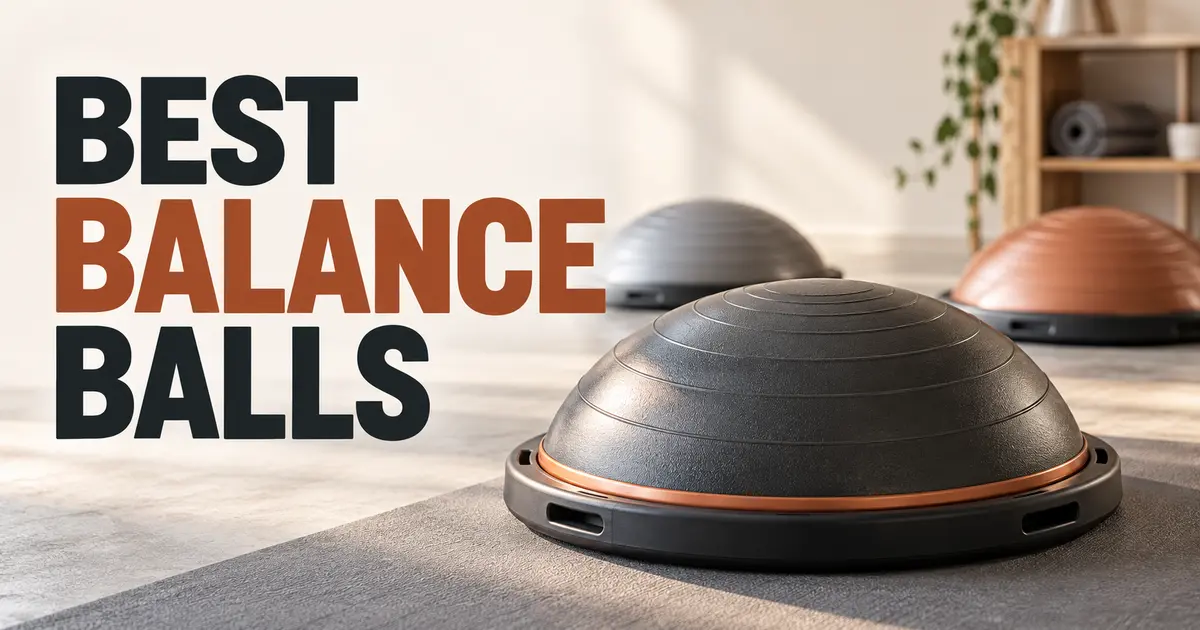
The best balance ball for exercise in this comparison is the BOSU NexGen for its versatile 26-inch platform, nonslip base and commercial-grade construction. For a value-focused home setup, the ZELUS 23-inch bundle adds resistance bands, a pump and a separate 55-centimeter yoga ball.
Best balance balls for exercise at a glance
- Best overall: BOSU NexGen 26-Inch Balance Trainer
- Best value bundle: ZELUS 23-Inch 660-Pound Balance Ball
- Best for gyms and studios: BOSU Pro 26-Inch Five-Pack
- Best performance-focused option: BOSU Elite
- Best high-capacity alternative: VEVOR 23-Inch 660-Pound Trainer
- Best mixed-accessory bundle: Lifepro Horizon
- Best starter bundle: ZELUS 23-Inch 330-Pound Trainer
Balance ball comparison
| Balance ball | Best for | Listed size or capacity | Included extras | Main consideration |
|---|---|---|---|---|
| BOSU NexGen | Best overall | 26-inch | Check the current package | Premium choice without the numerous extras included with some bundles |
| ZELUS bundle | Best value bundle | 23-inch; 660-pound capacity | 55-centimeter yoga ball, bands and foot pump | Additional equipment requires more storage |
| BOSU Pro five-pack | Studios and group training | 26-inch | Pumps and guided workouts according to the listing | The linked offer is a five-pack |
| BOSU Elite | Athletic and performance-focused training | Verify the current listing | Verify the current package | May be more specialized than a casual beginner needs |
| VEVOR | High-capacity value | 23-inch; 660-pound capacity | Resistance bands and pump | Smaller platform than the 26-inch BOSU models |
| Lifepro Horizon | Varied home workouts | 440-pound capacity | Pilates ball | Confirm whether a pump is currently included |
| ZELUS 330-pound model | Basic starter setup | 23-inch; 330-pound capacity | Resistance bands and foot pump | Lower listed capacity than the other ZELUS option |
Seven top balance balls compared
1. BOSU NexGen 26-Inch Balance Trainer
The BOSU NexGen is the strongest all-around pick for someone who wants one balance ball for balance drills, squats, lunges, planks, push-ups and mobility work. Its 26-inch dome provides more room for foot placement than the 23-inch alternatives in this guide. The listing describes commercial-grade, burst-resistant construction and a nonslip base.
That larger training surface is useful when you are learning where to position your feet or progressing to wider stances. It also makes the NexGen a practical shared option for households in which several people will use the same trainer.
Why it stands out
- Versatile 26-inch platform
- Nonslip base
- Designed for full-body training
Keep in mind
- Fewer bundled accessories than value kits
- Confirm the current package contents
2. ZELUS 23-Inch Balance Ball with 55-Centimeter Yoga Ball
This ZELUS package makes sense for a new home gym because it combines two different exercise tools: a 23-inch balance ball trainer and a fully round 55-centimeter yoga ball. Resistance bands and a foot pump are also listed. That gives you standing and supported exercises on the balance trainer, along with seated and floor-based movements using the round ball.
The listing states a 660-pound capacity for the balance trainer. Capacity is not a reason to use additional weight carelessly, but a clearly stated rating helps buyers compare models. Choose this package if you will genuinely use both pieces of equipment; otherwise, the additional ball may simply occupy storage space.
Why it stands out
- Balance trainer and 55-centimeter yoga ball
- Listed 660-pound capacity
- Resistance bands and pump included
Keep in mind
- Requires more storage
- The 23-inch platform provides less room than a 26-inch model
3. BOSU Pro 26-Inch Balance Trainer Five-Pack
The linked BOSU Pro offer is specifically a five-pack, making it a commercial or group-training purchase rather than the logical choice for most home users. For a coach, gym or training studio outfitting several stations, buying matching 26-inch balance balls can simplify class programming and equipment setup.
The listing describes commercial-grade equipment, pumps and guided workouts. Before purchasing, verify the quantity and package contents on the current product page. If you only need one balance trainer, look for a single-unit BOSU option instead of paying for equipment you will not use.
Why it stands out
- Five matching studio units
- 26-inch training surfaces
- Commercially oriented package
Keep in mind
- Not a sensible single-user purchase
- Confirm that the offer still includes five units
4. BOSU Elite Balance Trainer
The BOSU Elite is the performance-oriented balance ball in this lineup. It is most relevant to experienced exercisers and athletes who already know they will use a balance trainer for demanding lower-body, core and power-focused drills.
Beginners can still train with it, but they may receive more practical value from the NexGen or one of the accessory bundles. The supplied product title does not specify a size, weight rating or package contents, so check those details on the current listing rather than assuming they match another BOSU model.
The Elite earns its place in this comparison because it serves a distinct performance-focused buyer—not because every home exerciser needs the most specialized option.
Why it stands out
- Performance-focused balance trainer
- Suitable for progressive athletic drills
- Designed for challenging balance work
Keep in mind
- May be excessive for casual exercise
- Verify its specifications and included accessories
5. VEVOR 23-Inch Balance Ball Trainer
VEVOR’s 23-inch model is a straightforward alternative for buyers who want resistance bands, a pump and a listed 660-pound capacity without stepping into a premium BOSU model. It can support common home exercises such as supported squats, split-stance holds, bridges, planks and controlled step-ups.
The platform is smaller than the 26-inch BOSU options. That may help with storage, but it also provides less room for foot and hand placement. Check the complete base dimensions—not only the dome diameter—if you have a narrow exercise area.
Why it stands out
- Listed 660-pound capacity
- Resistance bands and pump included
- Compact 23-inch format
Keep in mind
- Less surface area than 26-inch balance trainers
- Base stability matters more than the number of accessories
6. Lifepro Horizon Half Balance Ball Trainer
The Lifepro Horizon pairs a half balance ball with a smaller Pilates ball, creating additional options for core activation, adductor exercises and supported mobility work. Its listed 440-pound capacity falls between the two ZELUS models in this comparison and should accommodate many home users when exercises are performed within the manufacturer’s directions.
This is the more relevant bundle for someone who wants a small Pilates ball rather than a full-size round exercise ball. Confirm the inflation accessories on the current listing because the supplied product title names the Pilates ball but does not explicitly mention a pump.
Why it stands out
- Includes a small Pilates ball
- Listed 440-pound capacity
- Offers good exercise variety for home use
Keep in mind
- A pump is not named in the supplied product title
- The Pilates ball is not a full-size seated exercise ball
7. ZELUS 23-Inch 330-Pound Balance Ball Trainer
This ZELUS model offers the familiar 23-inch balance ball format with resistance bands and a foot pump. Its listed 330-pound capacity is lower than the 660-pound ZELUS and VEVOR options, so compare ratings carefully if you expect the trainer to support a larger user or externally loaded exercises.
For basic bodyweight workouts, it covers the essentials without adding a separate full-size exercise ball. It is a cleaner choice than the larger ZELUS bundle when storage is limited and your program centers on dome-based balance and core work.
Why it stands out
- Resistance bands and foot pump included
- Compact home-gym footprint
- Simple entry-level package
Keep in mind
- Lower listed capacity than several competitors
- Confirm the rating for your intended exercises
How to choose a balance ball for exercise
Consider the training surface
The inflatable dome creates instability while the rigid base prevents the trainer from rolling freely across the floor. This combination works well for standing balance drills, stepping exercises, planks, supported squats and controlled strength movements.
A balance ball is not a direct replacement for a standard round exercise ball. If your workouts primarily include seated movements, wall squats, hamstring curls or back-supported exercises, watch for our separate guide to full-size stability balls.
Compare usable surface area
A 26-inch dome gives you more freedom to adjust stance width and hand position. A 23-inch balance ball is easier to store and may fit a smaller room, but its usable training surface is more limited.
Check the complete footprint, including the rigid base, before deciding where the balance trainer will be used and stored.
Treat capacity as a limit, not a performance score
A higher listed weight rating can provide more headroom, but it does not automatically mean better grip, durability or exercise performance. Your body weight, external resistance and dynamic movement all affect the stress placed on the trainer.
Remain within the manufacturer’s directions and inspect the dome, seams, plug and base regularly.
Prioritize the base and floor contact
The balance trainer should sit flat without sliding on your exercise surface. Dust, loose rugs and slick flooring can change its stability. A nonslip base helps, but it cannot compensate for an unsuitable floor.
Test simple supported movements before progressing to unsupported balance drills or faster exercises.
Choose accessories that support your workouts
Resistance bands, pumps and additional exercise balls can make a package economical. They can also create unnecessary clutter. Decide which movements you expect to perform each week, and then choose the bundle that supports those sessions.
Consider who will use it
A larger 26-inch balance trainer may be the better shared option for a household, coach or training facility. A compact 23-inch model may be easier to manage in an apartment or small home gym.
Commercial facilities should also consider replacement parts, cleaning, storage and whether they need several matching units. That is where the BOSU Pro five-pack becomes more relevant than it would be for an individual buyer.
What exercises can you do with a balance ball?
A balance ball adds an unstable surface, but instability should serve the exercise rather than become the entire goal. Useful starting movements include:
- Supported balance hold: Stand near a wall or stable rail and practice maintaining a steady position.
- Bodyweight squat: Begin with a shallow range and keep the knees tracking in the same general direction as the toes.
- Split-stance hold: Place one foot on the dome and control the hips without rushing the movement.
- Incline plank: Place your hands on the dome or platform and maintain control through the trunk.
- Glute bridge: Position your feet on the dome and lift the hips without allowing the trainer to twist.
- Dead bug press: Press the dome gently with the hands and thighs while maintaining control through the trunk.
- Supported reverse lunge: Use a wall or sturdy support while learning to control the front leg.
- Elevated push-up: Place the hands on the trainer and use an appropriate body angle for your current strength level.
For maximum strength development, stable-floor exercises normally allow greater force production and heavier loading. Use a balance ball for coordination, controlled accessory work, core training and exercise variety—not as a requirement for making every exercise more functional.
Balance ball safety
- Place the trainer on a clean, level and nonslip surface with open space around it.
- Follow the manufacturer’s inflation instructions. Overinflation can change the feel and may damage the product.
- Begin beside a wall, exercise rack or sturdy support.
- Step on and off slowly rather than jumping onto the dome.
- Master basic supported exercises before adding speed or external weight.
- Inspect the dome, plug, seams and rigid base before every workout.
- Do not use a damaged, leaking or unstable balance ball.
- Stop exercising if you experience sharp pain, dizziness or joint instability.
If you are recovering from an injury, have a history of falls or are unsure whether unstable-surface training is appropriate, consult a qualified healthcare professional.
Frequently asked questions
What is a balance ball?
A balance ball is a training tool with an inflatable dome attached to a rigid platform. It is used for balance work, core training, mobility drills and supported strength exercises. It is often described as a half-ball balance trainer.
Is a balance ball the same as a stability ball?
No. The names sometimes overlap in online product listings, but a balance ball normally has an inflatable dome and rigid base. A stability ball is usually a fully round exercise ball that can roll freely. Balance Foundry covers these as separate equipment categories.
Is a 23-inch or 26-inch balance ball better?
A 26-inch dome provides more room for stance and hand placement. A 23-inch trainer is more compact and easier to store. Neither is automatically better; match the size to your available space, body position and intended exercises.
Are balance balls good for beginners?
Yes, provided beginners start with support and simple movements. A wall-assisted balance hold or elevated plank is more appropriate than jumping, heavily loaded squats or fast changes of direction.
Can a balance ball strengthen your core?
A balance ball can help train the trunk to resist unwanted movement during planks, bridges and controlled standing exercises. Progressive resistance, appropriate technique and consistent training still matter more than instability alone.
Can you stand on the flat side of a balance ball?
Only use a balance trainer in positions approved by its manufacturer. Some products may allow platform-side-up exercises, while others may restrict them. Check the instructions for your specific model before reversing it.
Which balance ball is best for a home gym?
The BOSU NexGen is the strongest general-purpose choice in this comparison. The ZELUS 660-pound bundle is more attractive if you also want a full-round 55-centimeter yoga ball and resistance bands.
Which balance ball should a studio buy?
The linked BOSU Pro five-pack is the most directly studio-oriented package. Verify that the listing still contains five trainers and that its current terms suit your facility before purchasing.
Final verdict
Choose the ZELUS 660-pound bundle if value and exercise variety matter most, especially if a 55-centimeter round yoga ball is also on your shopping list.
For facilities, the BOSU Pro five-pack is the purpose-built bulk option. Individual buyers should avoid paying for five units when they only need one.
Whichever model you choose, match it to your available space, training plan and experience level. The best balance ball for exercise is the one that supports repeatable, controlled workouts—not simply the model with the longest accessory list.
Leave a Reply