
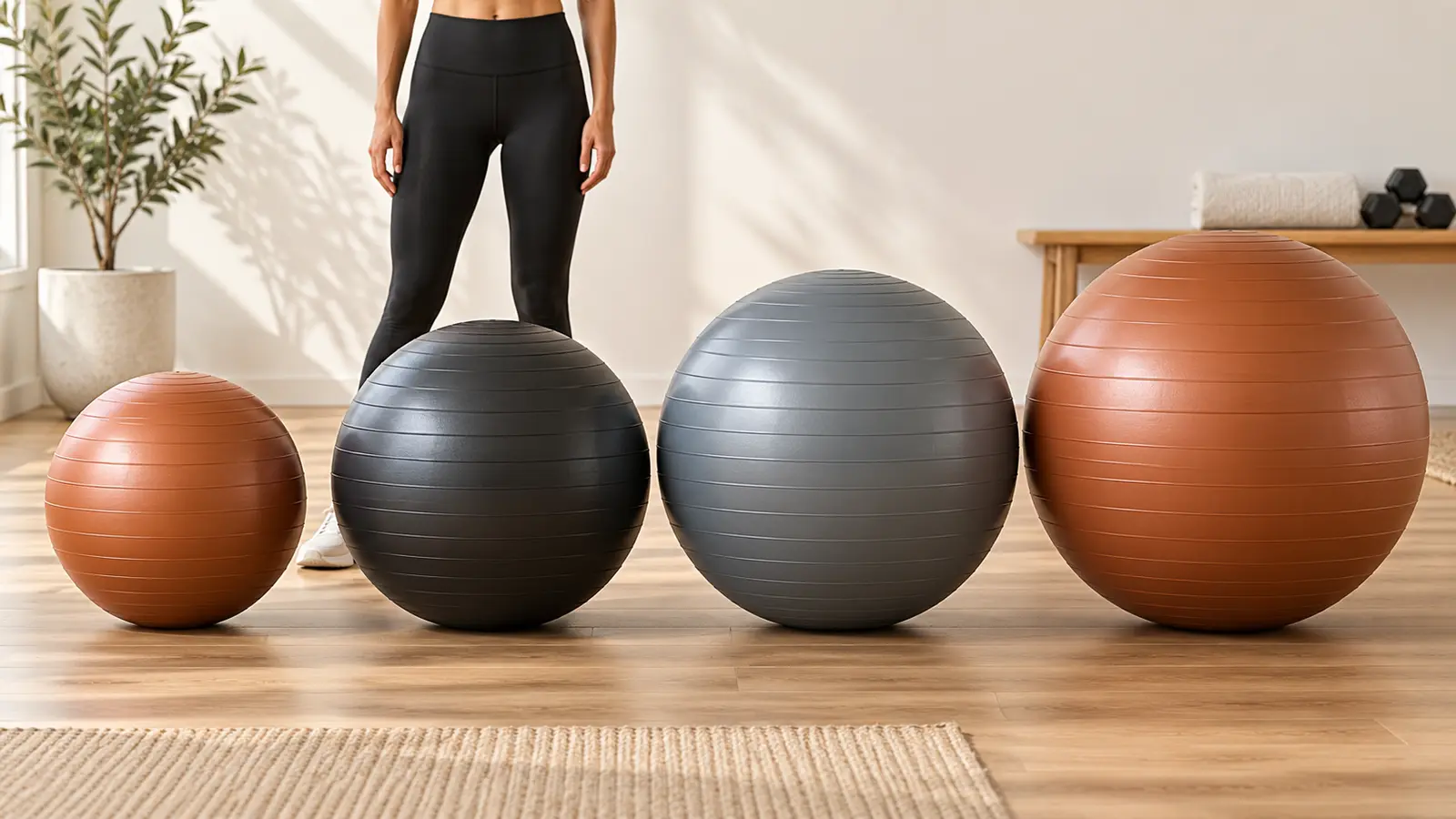
Exercise Ball Sizing Guide
Most adults will begin with a 55, 65 or 75 cm stability ball, but height is only the first step. The correct choice also depends on your proportions, how firmly the ball is inflated and whether you plan to use it for exercise, mobility work or occasional sitting.
Use the chart below to narrow your options, then perform the seated-position check before deciding that the ball fits.

Stability Ball Size Chart
These ranges provide a practical starting point. Always check the chart published for the specific ball you are buying because brand recommendations can differ.
| Ball diameter | Starting height range | Primary audience | Common uses |
|---|---|---|---|
| 45 cm About 18 inches |
Approximately 4’6″–5’0″ | Shorter users and certain exercise applications | Petite users, youth programs and movements needing a smaller support |
| 55 cm About 22 inches |
Approximately 5’1″–5’7″ | Shorter-to-average-height adults | Core exercises, mobility work and seated movements |
| 65 cm About 26 inches |
Approximately 5’8″–6’1″ | Many average-to-taller adults | General home workouts, bridges, curls, planks and mobility |
| 75 cm About 30 inches |
Approximately 6’2″–6’7″ | Taller users | Full-body exercise, sitting and movements requiring a higher support |
Why charts disagree: Some companies recommend a larger or smaller size at the same height. Ball construction, intended use and brand-specific testing can change the cutoff. When the product’s chart conflicts with a general chart, start with the manufacturer’s guidance.
How to Check Whether a Stability Ball Fits
Sit near the center of the fully inflated ball while wearing the shoes you normally use for training. Place both feet flat on the floor and look at your position from the side, ideally with a mirror or a second person.
- Your feet remain flat and stable.
- Your hips are level with or slightly above your knees.
- Your knees are near a 90-degree angle.
- Your thighs are approximately level rather than sloping sharply upward.
- You can sit tall without balancing on your toes or widening your feet excessively.
If your knees sit noticeably higher than your hips, the ball may be too small or underinflated. If your feet barely reach the floor or your knees are far below your hips, the ball may be too large.
Stability Ball Sizes Explained
Best for Shorter Users and Specific Exercises
A 45 cm ball is the smallest common adult exercise-ball size. It can suit shorter users, youth programs and exercises where a lower support position is useful.
Because it sits closer to the floor, it may also work as a prop for certain mobility drills. Taller users generally should not choose it for seated exercise simply because a small ball is easier to store.
Best for Many Users Around 5’1″–5’7″
The 55 cm ball is a common choice for shorter-to-average-height adults. It is large enough for crunches, supported bridges, wall squats and seated stability work without creating the footprint of a larger ball.
People near the upper end of the height range should perform the seated check carefully. Long legs can make a 65 cm option feel more natural even when total height points toward 55 cm.
Best for Many Users Around 5’8″–6’1″
The 65 cm ball is one of the most versatile sizes for home exercise. It can provide enough height for chest-supported movements while remaining manageable for hamstring curls, planks and mobility work.
Someone near 6 feet may fall into either a 65 or 75 cm recommendation depending on the brand, body proportions and intended use. Test your position instead of choosing only by the number on the box.
Best for Taller Users Around 6’2″ and Above
A 75 cm ball gives taller users a higher starting position and more appropriate seated geometry. It can also be useful when an exercise requires a larger support surface.
The tradeoff is storage and control. A 75 cm ball occupies considerably more room and may feel cumbersome for a shorter user, especially during prone walkouts or leg-supported core exercises.
Choose the Size for the Intended Use
For General Exercise
Start with the height chart and confirm that the ball allows good alignment during the movements you actually plan to perform. A ball that fits for sitting may feel different during planks, curls or crunches.
For Core Exercises
You need enough ball surface to support the intended part of your body without forcing awkward joint positions. For a crunch, your mid-back should be supported. For leg-supported planks, the ball should allow you to establish a controlled starting position.
For Mobility and Stretching
A slightly different size may be useful when the ball serves as a rolling support rather than a seat. Smaller balls sit lower, while larger balls reduce how far you need to reach toward the floor.
For a Desk or Ball Chair
Measure the desk and account for the chair base if the ball sits inside a frame. Your feet should stay flat and the work surface should not force your shoulders upward.
A ball-chair system uses the combined height of the ball and frame, so a normal exercise-ball chart may not predict the final seat height.
For Pregnancy or Physical Therapy
Use recommendations from the qualified professional overseeing your care. General height charts cannot account for individual medical needs, movement restrictions or the specific therapeutic purpose.
How Inflation Changes Stability Ball Fit
The printed size refers to the intended diameter when the ball is inflated according to the manufacturer’s directions. A 65 cm ball should be measured across its widest point—not from the floor over the curved surface.
Underinflation lowers the sitting height and creates a softer, broader contact area. Overinflation can exceed the intended diameter, change the feel and place unnecessary stress on the material. Do not overinflate a smaller ball to make it behave like the next size up.
Simple Measurement Method
- Mark the target height on a wall.
- Place the ball beside the wall.
- Inflate gradually.
- Use a level or straight object across the top.
- Stop at the manufacturer’s stated diameter.
Before Every Workout
- Check for cuts or worn areas.
- Inspect the plug.
- Clear sharp objects from the floor.
- Confirm the ball is not leaking.
- Follow the listed load and use restrictions.
What If You Are Between Sizes?
When your height sits at a cutoff, consider your leg length, the exercise and the manufacturer’s chart. A person with relatively long legs may prefer the larger choice for seated exercises. A smaller ball may be easier to control for certain floor movements.
If possible, test both sizes. Choose the one that supports the desired joint angles and lets you maintain control without compensating.
Common Sizing Mistakes
Buying by Height Alone
Height narrows the options, but it does not capture leg length, proportions or the planned exercise.
Ignoring the Selected Product Variation
Online listings often combine several diameters and colors. Confirm the selected size before checkout instead of assuming every color is available in the same diameter.
Using a Soft Ball to Compensate for the Wrong Size
Extreme underinflation changes how the ball moves and may conflict with the instructions. Buy the appropriate diameter rather than trying to reshape another size.
Assuming Bigger Means More Advanced
Ball diameter is primarily a fit and exercise-selection issue. A larger ball is not automatically more challenging or more effective.
Recommended Next Steps
Once you know your likely size, compare our best stability balls for exercise.
Then use the ball in our full-body stability ball exercise guide or focus on your trunk with these stability ball exercises for abs.
Frequently Asked Questions
What is the most common stability ball size?
The 55 and 65 cm sizes suit many adults, but the best choice depends on height, proportions, intended use and the specific manufacturer’s chart.
Should I get a 55 or 65 cm exercise ball?
A 55 cm ball is a common starting point for users around 5’1″–5’7″, while 65 cm commonly suits users around 5’8″–6’1″. If you are near the cutoff, compare both using the seated-fit test and the brand’s guidance.
What size stability ball should a 6-foot person use?
A 65 cm ball is a common starting point under this chart. Some brands place 6-foot users in a 75 cm range, especially for sitting, so check the product chart and your actual seated position.
Can I use a 75 cm ball if I am shorter than 6’2″?
Possibly for a particular exercise or seating setup, but it may place your hips too high or make floor movements harder to control. Fit and purpose matter more than preference alone.
How firm should a stability ball be?
Inflate it to the specified diameter and firmness in the manufacturer’s instructions. It should support you without being deliberately overinflated or excessively soft.
Is ball size measured before or after inflation?
The stated diameter describes the ball at its intended inflated size. Measure across the widest point after inflation.
Use the Chart, Then Check the Fit
The chart gives you a starting diameter: 45 cm for shorter users, 55 cm for many users around 5’1″–5’7″, 65 cm for many users around 5’8″–6’1″ and 75 cm for taller users around 6’2″ and above.
Your final decision should come from the brand chart, your intended use and the way you actually fit on the inflated ball.
Leave a Reply