
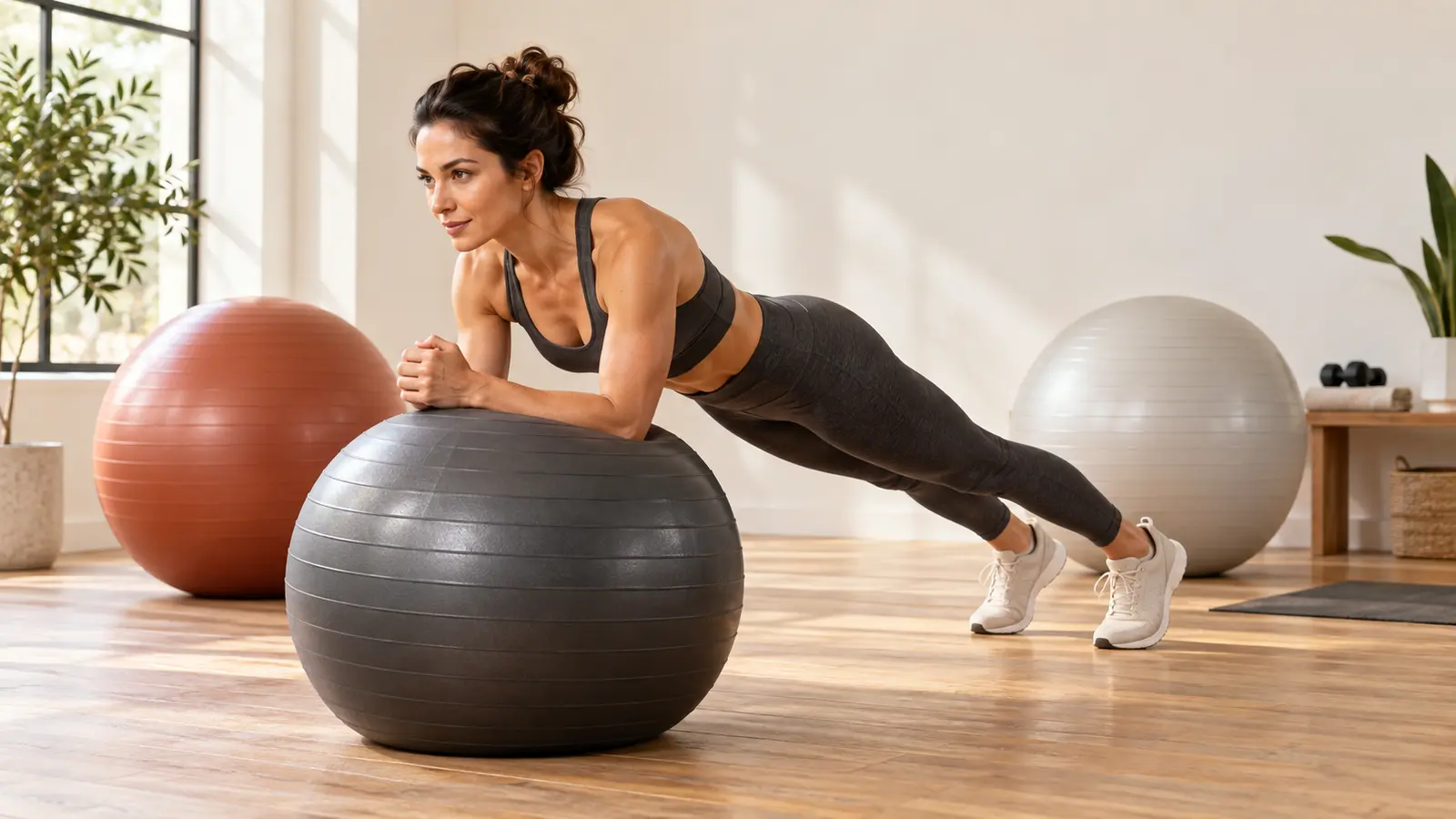
Stability Ball Buyer’s Guide
The ProBody Pilates Yoga Ball is our best all-around pick because its broad size range makes it easier to match the ball to the user and the planned exercises. The TRX Training Stability Ball is the most training-focused option, while FITMIND is a practical choice for shoppers who want several common sizes and an included pump.
This guide compares four standard round exercise balls and two ball-chair systems. The chair products are useful for active sitting, but they are not direct substitutes for a free-moving stability ball during workouts.
Affiliate disclosure: Balance Foundry may earn a commission from qualifying purchases made through links on this page, at no additional cost to you. Product availability, specifications and prices can change. Review the current listing and manufacturer instructions before buying or using any product.
Our Top Stability Ball Picks
- Best overall: ProBody Pilates Yoga Ball
- Best for structured strength training: TRX Training Stability Ball
- Best multi-size value: FITMIND Extra Thick Yoga Ball
- Best budget high-capacity option: Fitvids Anti-Burst Exercise Ball
- Best ball-and-base system: MANTRA SPORTS Yoga Ball Chair
- Best complete chair frame: Gaiam Classic Balance Ball Chair
Stability Balls Compared
| Product | Type | Best for | Listed sizes or features | Main consideration |
|---|---|---|---|---|
| ProBody Pilates Yoga Ball | Round ball | Most people and varied workouts | 45, 55, 65, 75 and 85 cm; pump | Choose the size for your body and intended movements |
| TRX Training Stability Ball | Round ball | Strength and athletic training | Training-oriented design | Confirm the current size option and included accessories |
| FITMIND Extra Thick Yoga Ball | Round ball | Home exercise, Pilates and mobility | 22, 26 and 30 inches; pump and training instructions | Inch sizing requires conversion when comparing brands |
| Fitvids Exercise Ball | Round ball | Value-focused home gyms | Quick pump; listing claims a 2,000-pound capacity | A capacity claim is not a reason for dynamic overloading |
| MANTRA SPORTS Yoga Ball Chair | Ball with base | Active sitting and controlled exercise | Base and pump | A base reduces free movement compared with a standard ball |
| Gaiam Classic Balance Ball Chair | Ball chair frame | Desk seating | 52 cm ball, frame, pump and exercise guide | Primarily furniture rather than a general-purpose exercise ball |
How We Chose These Stability Balls
This is a research-based comparison, not a claim that every product was personally tested. We reviewed the supplied listings and compared ball type, available sizing, included equipment, intended use and practical limitations.
We gave extra weight to products that suit a clearly defined user rather than treating marketing claims or unusually high load ratings as proof of quality.
Because product details can change, confirm the current size, accessories, warranty and care instructions on the seller’s page. For more about our standards, see how we review equipment.
Best Stability Balls for Exercise
1. ProBody Pilates Yoga Ball
The ProBody stands out for selection. Its listing offers 45, 55, 65, 75 and 85 cm options, giving more users a realistic chance of finding a suitable fit. That matters because an excellent ball in the wrong size is still the wrong exercise tool.
It is a versatile choice for bridges, hamstring curls, wall squats, supported mobility work and modified core exercises. A pump is included, although a separate inflation gauge or tape measure can make setup more repeatable.
- Wide range of sizes
- Useful for strength, mobility and Pilates
- Pump included
- You still need to select the correct diameter
- Very large balls require considerable storage space
- Listed load claims should not be treated as dynamic-use limits
2. TRX Training Stability Ball
The TRX option fits shoppers who see a stability ball as strength equipment rather than occasional seating. It is the most natural match here for programmed core work, rollouts, bridges and other controlled exercises.
The supplied listing title does not establish every specification, so check the current diameter and package contents before ordering. The brand name alone should not replace correct sizing or safe technique.
- Clear strength-training focus
- Suitable for progressive exercise programming
- Recognizable training-equipment brand
- Verify the current size and accessories
- May cost more than basic stability balls
- No ball eliminates the need for controlled progression
3. FITMIND Extra Thick Yoga Ball
FITMIND lists three practical diameters—22, 26 and 30 inches—along with a pump and training instructions. Those correspond roughly to the common 55, 65 and 75 cm size classes, although shoppers should follow the manufacturer’s exact chart rather than relying only on a conversion.
This is a sensible general-purpose option for home workouts, Pilates-style movement, supported stretching and introductory stability training.
- Three widely useful size options
- Pump and instructions included
- General-purpose exercise design
- Size labels are presented in inches
- Anti-burst does not mean puncture-proof
- Confirm the exact color and size combination before checkout
4. Fitvids Anti-Burst Exercise Ball
The Fitvids ball is the value pick for a basic home setup. The supplied listing includes a quick pump and advertises anti-burst, slip-resistant construction with a 2,000-pound capacity.
That number should be treated as a manufacturer or seller claim—not an invitation to jump onto the ball, add external loads or use it near its stated limit. Static laboratory ratings and real-world dynamic exercise are different conditions.
- Simple, budget-oriented package
- Quick pump included
- Suitable for basic home exercises
- Verify the selected diameter carefully
- The high capacity claim is not independently verified here
- Dynamic loading requires a substantial safety margin
Best Stability Ball Chair Systems
Important distinction: These two products are seating systems. A retaining base or chair frame changes how the ball moves, so compare them with other active-seating products rather than treating them as ordinary exercise balls.
5. MANTRA SPORTS Yoga Ball Chair
The MANTRA SPORTS system pairs a stability ball with a base, making it more controlled for sitting and selected home exercises. It suits someone who wants one product for occasional active sitting and supported movement but does not need a complete chair frame.
A ball chair may encourage position changes, but it does not automatically correct posture, build meaningful core strength or treat back pain. Alternate positions, keep sitting sessions tolerable and use a properly configured desk.
- Base helps limit rolling
- Useful for sitting and controlled exercise
- Pump included
- Less freedom of movement than a standard ball
- Not necessarily a replacement for a supportive chair all day
- Health and pain-relief claims should be viewed cautiously
6. Gaiam Classic Balance Ball Chair
The Gaiam Classic is the better fit for shoppers specifically seeking an office-style frame. Its supplied listing describes a 52 cm stability ball, chair frame, pump and exercise guide.
The frame makes the product more furniture-like and less versatile for floor workouts. Measure your desk height and review the manufacturer’s user-height guidance before buying because the 52 cm ball is part of a complete seating system.
- Purpose-built chair frame
- Pump and exercise guide included
- More contained than sitting on a loose ball
- Not a general-purpose free exercise ball
- Desk and user fit require measurement
- Active sitting still requires position changes and breaks
What Size Stability Ball Do You Need?
Use this chart as a starting point, then check the manufacturer’s sizing recommendations. Limb length, torso proportions, inflation level and the intended exercise can all change the best fit.
| User height | Common starting size | Notes |
|---|---|---|
| Under 5 feet | 45 cm | Often easier to control for smaller users |
| 5 feet to 5 feet 5 inches | 55 cm | Common small-to-medium option |
| 5 feet 6 inches to 5 feet 11 inches | 65 cm | Common general-purpose size |
| 6 feet to 6 feet 3 inches | 75 cm | May provide more suitable positioning for taller users |
| 6 feet 4 inches and taller | 85 cm | Large footprint; verify that your exercise requires it |
For sitting, your hips should generally be level with or slightly above your knees, with your feet stable on the floor. For exercise, prioritize control and the manufacturer’s movement-specific guidance. Do not deliberately overinflate a smaller ball to imitate a larger diameter.
How to Choose a Stability Ball
Start With the Correct Type
A full round stability ball rolls in every direction and works well for floor exercise. A ball with a base is more contained. A framed ball chair is primarily a seating product.
If you want a fixed platform with an inflatable dome, read our guide to half balls versus full stability balls.
Check the Diameter
Brand labels vary, so compare the inflated diameter in centimeters or inches instead of relying only on descriptions such as small, medium or large. Confirm that selecting a different color does not silently change the ball size.
Understand Anti-Burst Construction
Anti-burst generally describes a ball designed to deflate more gradually after certain punctures. It does not mean the material cannot be damaged. Keep stability balls away from sharp objects, abrasive floors, heaters, direct sunlight and pets.
Look at the Complete Package
An included pump is convenient, but inflation may still take time. A plug remover, measuring tape and clear instructions can be just as useful. Inspect the ball before every session and replace it if the surface is damaged, distorted or leaking.
Treat Weight Ratings Carefully
Product listings may publish static limits that do not describe bouncing, dropping, loaded lifting or other dynamic forces. Stay well inside the manufacturer’s permitted use and never assume the largest advertised number makes a ball safer for aggressive exercise.
What Can You Do With a Stability Ball?
Beginner Movements
- Seated weight shifts near a stable support
- Wall-supported squats
- Glute bridges with feet on the floor
- Supported thoracic mobility
Progressive Exercises
- Feet-elevated bridges
- Stability ball hamstring curls
- Stir-the-pot variations
- Controlled ball rollouts
Progress only when you can control the current version without holding your breath, rushing or losing alignment. Use an open floor space and keep the ball away from stairs, furniture edges and sharp objects.
Stability Ball Safety
- Follow the manufacturer’s inflation and user-weight instructions.
- Start beside a wall or stable support if your balance is limited.
- Do not stand on a full round stability ball.
- Inspect the ball, plug and seams before every workout.
- Do not use a ball that is leaking, distorted, cracked or damaged.
- Stop exercising if you experience sharp pain, dizziness, numbness or loss of control.
- If you are pregnant, recovering from an injury or managing a medical condition, ask a qualified healthcare professional which movements and ball size are appropriate.
Frequently Asked Questions
Is a stability ball the same as an exercise ball?
Usually, yes. Stability ball, exercise ball, Swiss ball and yoga ball commonly refer to the same large inflatable round ball. A half ball or balance trainer is a different category.
What is the best stability ball size for most adults?
Many adults start with a 55, 65 or 75 cm ball depending on their height. A 65 cm ball is common, but it is not universally correct. Use the brand’s size chart and consider the exercises you plan to perform.
Should a stability ball feel completely firm?
It should be inflated to the manufacturer’s specified diameter and feel supportive without exceeding the instructions. A small firmness adjustment can change the difficulty, but excessive underinflation or overinflation can affect performance and safety.
Are stability ball chairs good for sitting all day?
They are better treated as one seating option rather than an all-day posture solution. Alternate positions, take movement breaks and switch to a supportive chair if you become fatigued or uncomfortable.
Which options are best for exercise rather than sitting?
The ProBody, TRX, FITMIND and Fitvids models are the direct exercise-ball choices. The MANTRA SPORTS and Gaiam products are better considered active-seating systems.
Final Verdict
Choose the ProBody Pilates Yoga Ball if you want the broadest size selection and a versatile exercise tool. Choose TRX for a training-oriented option, FITMIND for a practical multi-size package or Fitvids for a basic value pick.
If your main goal is active sitting, compare the MANTRA SPORTS base system with the more furniture-like Gaiam chair—but do not expect either one to replace regular movement or an appropriate desk setup.
Leave a Reply