
Stability Ball Core Workout
The best stability ball exercises for abs do more than make your torso bend. They challenge your core to resist unwanted arching, rotation and side bending while your arms and legs move.
This guide organizes 12 stability ball ab exercises from beginner-friendly crunches, dead bug presses and seated marches to advanced knee tucks, pikes and stir-the-pot circles. You can follow the exercise descriptions individually or use one of the complete workouts below.
Training note: This guide provides general fitness education, not individualized medical advice. If you are recovering from an injury, are pregnant, have significant back pain or have a condition that affects balance, ask an appropriate healthcare professional which exercises are suitable.

Why Use a Stability Ball for Ab Exercises?
A full-round ball creates a movable surface. Your trunk must respond as the ball shifts beneath your arms, back or legs. That can turn familiar movements into coordination challenges and make it easier to vary the difficulty by changing your body position.
The ball is not automatically better than the floor, a bench or cable equipment. Its value is variety and whole-body integration. If instability prevents you from using good form, the stable version is the more useful exercise.
Crunches bring the rib cage and pelvis closer together.
Rollouts and planks train you to resist excessive lower-back arching.
Marches, walkouts and bridges challenge control as your support changes.
How to Prepare
- Use the ball on a clean, nonslip surface with open space around you.
- Inspect the surface and plug for damage before training.
- Follow the manufacturer’s inflation and user-weight instructions.
- Place the ball near a wall when learning seated or incline positions.
- Breathe continuously instead of holding your breath.
- Stop a set when you can no longer control your spine or the ball.
12 Stability Ball Exercises for Abs and Core Strength
Stability Ball Crunch
Level: Beginner
- Sit on the ball and walk your feet forward until your mid- and lower back are supported.
- Set your feet flat and keep your knees bent.
- Bring your ribs toward your pelvis, lifting your upper back slightly.
- Pause, then lower under control.
Cue: Keep your tailbone supported and avoid pulling on your head.
Target: 8–15 repetitions.
Dead Bug Ball Press
Level: Beginner to intermediate
- Lie on your back with your hips and knees bent.
- Hold the ball between your hands and knees.
- Press gently into the ball to create trunk tension.
- Extend the opposite arm and leg, return and switch sides.
Cue: Use only the range that allows your ribs and pelvis to stay controlled.
Target: 5–8 repetitions per side.
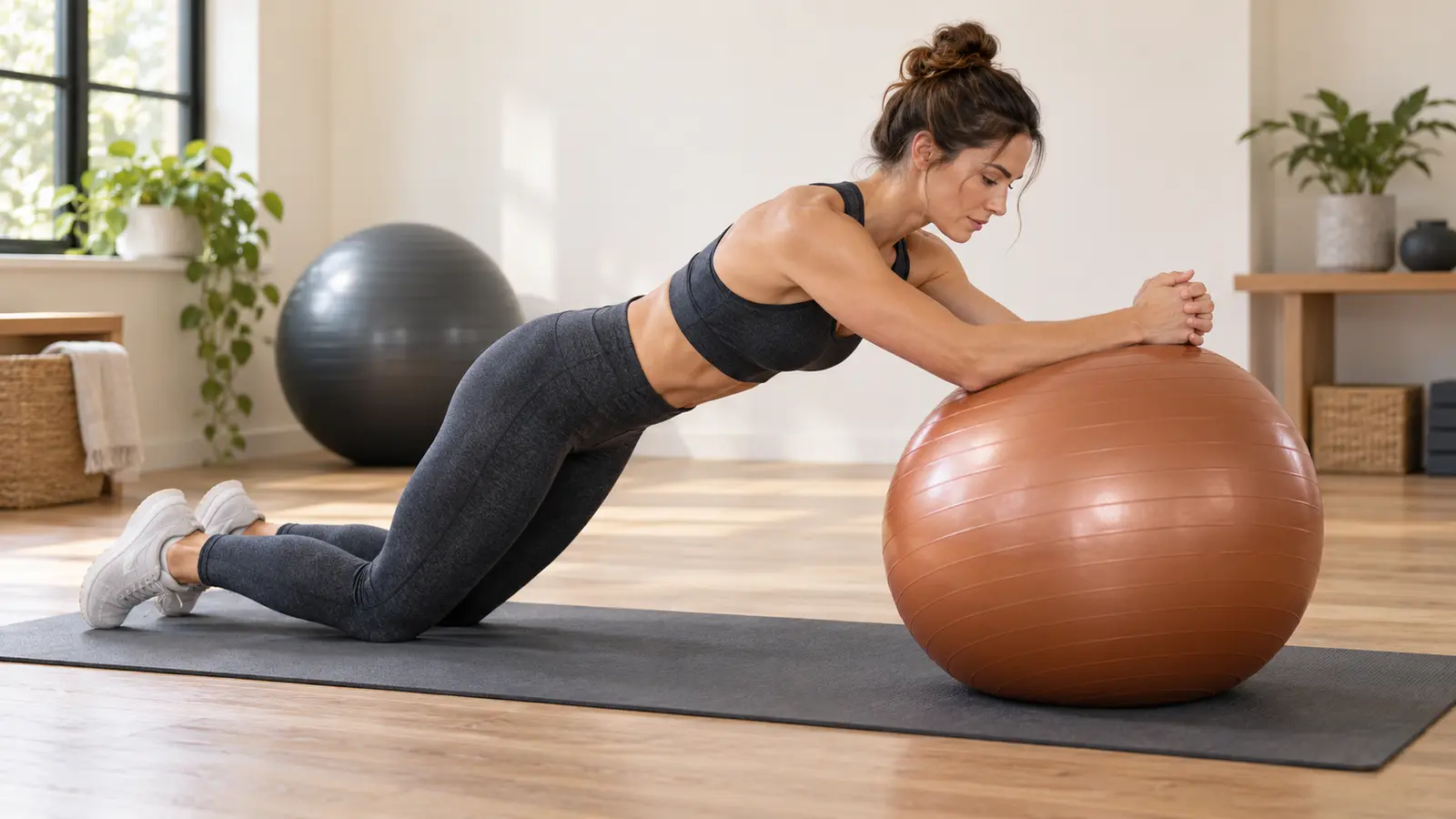
Stability Ball Forearm Rollout
Level: Intermediate
- Kneel with your forearms resting on the ball.
- Brace your abdomen and glutes.
- Roll the ball forward by extending your arms.
- Stop before your lower back arches, then pull the ball back.
Cue: Shorten the rollout before sacrificing your trunk position.
Target: 6–10 repetitions.
Incline Plank on the Ball
Level: Beginner to intermediate
- Place your forearms or hands on the ball.
- Walk your feet back until your body forms a straight line.
- Gently squeeze your glutes and brace your abdomen.
- Hold while breathing normally.
Modification: Secure the ball against a wall and use a more upright angle.
Target: 15–30 seconds.
Stability Ball Knee Tuck
Level: Advanced
- Start in a high plank with your shins on the ball.
- Keep your shoulders over your hands.
- Pull your knees toward your chest as the ball rolls forward.
- Extend your legs slowly to return.
Cue: Do not let your lower back sag when your legs straighten.
Target: 5–10 repetitions.
Stability Ball Pike
Level: Advanced
- Begin in a high plank with your feet or lower shins on the ball.
- Keep your legs relatively straight.
- Lift your hips as the ball rolls toward your hands.
- Pause at a controllable height, then return slowly.
Progression rule: Master the knee tuck and a strong ball plank first.
Target: 4–8 repetitions.
Stir the Pot
Level: Intermediate to advanced
- Kneel with your forearms on the ball.
- Create a straight line from your knees through your shoulders.
- Move your forearms in a small, controlled circle.
- Complete the repetitions, then reverse direction.
Cue: Your arms make the circle; your hips and ribs should remain quiet.
Target: 4–8 circles in each direction.
Stability Ball Pass
Level: Intermediate
- Lie on your back holding the ball above your chest.
- Lift your legs and transfer the ball from your hands to your feet.
- Lower your arms and legs only as far as you can control.
- Return to the center and pass the ball back to your hands.
Modification: Keep your knees bent and reduce the lowering range.
Target: 5–10 complete passes.
Stability Ball Side Crunch
Level: Intermediate
- Position one side of your torso against the ball.
- Stagger or brace your feet securely against a wall if needed.
- Place your hands across your chest or lightly behind your head.
- Lift your torso sideways, pause and lower with control.
Cue: Move through your torso without pulling your neck.
Target: 6–12 repetitions per side.
Stability Ball Prone Walkout
Level: Intermediate
- Lie facedown over the ball with your hands and feet on the floor.
- Walk your hands forward as the ball travels down your legs.
- Stop at the point where you can hold a rigid plank.
- Walk your hands back until your feet return to the floor.
Modification: Stop with the ball supporting your thighs rather than your shins.
Target: 4–8 walkouts.
Stability Ball Bridge March
Level: Intermediate
- Support your head and upper back on the ball with your feet flat.
- Lift your hips into a bridge.
- Shift your weight and raise one foot a small distance.
- Replace it quietly and alternate sides.
Cue: Keep your pelvis level instead of rotating toward the lifted leg.
Target: 5–8 repetitions per side.
Seated Stability Ball March
Level: Beginner
- Sit tall near the center of the ball.
- Place your feet flat and wide enough to remain steady.
- Lift one foot a small distance without leaning.
- Set it down and alternate sides.
Modification: Keep your fingertips on a wall or stable counter.
Target: 6–10 repetitions per side.
Beginner Stability Ball Ab Workout
Complete two rounds. Rest for 30–45 seconds between exercises and up to 90 seconds between rounds.
| Exercise | Repetitions or time | Main focus |
|---|---|---|
| Seated march | 8 per side | Posture and weight shifting |
| Dead bug ball press | 6 per side | Trunk control |
| Ball crunch | 10–12 | Controlled flexion |
| Wall-supported incline plank | 15–25 seconds | Anti-extension |
| Bridge march or bridge hold | 6 per side or 20 seconds | Pelvic stability |
Intermediate-to-Advanced Core Circuit
Complete two or three rounds. Select only variations you can perform without rushing or losing spinal control.
| Exercise | Repetitions | Rest |
|---|---|---|
| Forearm rollout | 8 | 30–45 seconds |
| Side crunch | 8 per side | 30 seconds |
| Knee tuck | 6–10 | 45 seconds |
| Stir the pot | 6 circles each way | 45 seconds |
| Ball pass | 6–8 | 45 seconds |
| Pike | 4–8 | 60 seconds |
How to Progress Without Losing Form
Progression Order
- Improve your position.
- Add a few seconds or repetitions.
- Increase the movement range.
- Move farther from the ball’s center.
- Add load only when appropriate.
Signs to Regress
- Your lower back repeatedly arches.
- Your hips rotate or drop.
- You hold your breath.
- The ball rolls faster than intended.
- You feel joint pain rather than muscular effort.
Common Mistakes
Trying to Make Every Exercise Unstable
The ball should support the training goal. Use a stable floor variation when it produces better alignment, more appropriate resistance or a safer learning environment.
Choosing a Ball by Guesswork
Check the inflated diameter and manufacturer’s size chart. Body height is a starting point, but your proportions and the specific exercise also affect fit.
Confusing Movement With Control
Rolling farther is not progress if your ribs flare, back arches or shoulders collapse. Own the smaller range before expanding it.
Training Through Pain
Abdominal effort and muscular fatigue are expected. Sharp back, shoulder, hip or neck pain is not. Stop and change the exercise rather than forcing the repetition.
Do Stability Ball Exercises Reduce Belly Fat?
Stability ball ab exercises can strengthen the muscles of your trunk, but they cannot selectively remove fat from your abdomen. Changes in body fat depend on overall energy balance, nutrition, activity and other individual factors. Train your core for strength, coordination and movement capacity—not as a promise of spot reduction.
Choosing the Right Equipment
Use a full-round exercise ball with a textured surface and clear inflation guidance. If you are shopping for one, see our guide to the best stability balls for exercise.
To train more than your core, use our broader guide to 15 full-body stability ball exercises. You can also compare a half ball versus a full stability ball before choosing a training style.
Frequently Asked Questions
What are the best stability ball exercises for abs?
The best choice depends on your current ability. Crunches, dead bug presses and seated marches are accessible starting points. Rollouts, knee tucks, pikes and stir-the-pot circles provide more demanding anti-extension and stabilization challenges.
Are stability ball ab exercises suitable for beginners?
Some are. Begin with the seated march, crunch, dead bug press and a wall-supported incline plank. Knee tucks and pikes are advanced exercises and should come later.
How often can I train my core?
Two or three focused sessions per week is enough for many people. Frequency depends on exercise difficulty, total training volume and recovery. Your core also works during many compound strength exercises.
How long should a stability ball core workout take?
A focused routine can take 15–25 minutes. Quality matters more than extending the session after your control declines.
Is a balance ball the same as a stability ball?
Balance ball, stability ball, Swiss ball, exercise ball and yoga ball often refer to the same full-round inflatable ball. They are different from a rigid balance board or dome-shaped half-ball trainer.
Which exercise should I master before a ball pike?
First build a controlled high plank with your shins on the ball, then master the knee tuck. The pike requires stronger shoulder support and more control through a longer lever.
Brace, Breathe and Control
A productive balance ball ab workout does not need constant shaking or maximum difficulty. Pick exercises you can repeat cleanly, breathe throughout every set and progress only when the ball remains under control.
Leave a Reply