
Balance Foundry Athlete Guide
Athletes need more than instability for instability’s sake. The right balance board should provide a challenge you can control, progress and connect to the demands of your sport—not simply make every exercise harder.
A good balance board for athletes can add targeted balance, ankle-control and coordination work to a broader strength and conditioning plan. It can be especially useful for board-sport athletes, field- and court-sport players, runners, hikers and anyone whose sport demands quick control over a changing base of support.
But transfer is specific. Research shows that balance training tends to improve the tasks being practiced more than unrelated athletic skills. A balance board should therefore complement—not replace—sport practice, heavy strength training, jumping, sprinting, change-of-direction work and appropriate conditioning.
My top overall choice is the INFIDEZ Balance Surf Trainer. I own and use it, and I like how its progression remains approachable without eliminating the challenge. The Revbalance 101 v2 is the premium choice for dedicated board-sport practice, while the Sportneer 7-Mode provides the broadest range of training configurations.
Best Balance Boards for Athletes: Quick Comparison
| Board | Best athletic use | Movement | Progression | Review basis |
|---|---|---|---|---|
| INFIDEZ Balance Surf Trainer | Best overall | Roller-based balance | High | Hands-on tested |
| Revbalance 101 v2 | Board sports | Free-moving roller | High, with adjustable stops | Research-based |
| Sportneer 7-Mode | Cross-training variety | Roller, ball and stop configurations | Very high | Research-based |
| StrongTek Professional Wooden Board | Foundational control | Single-axis rocker | Low to moderate | Research-based |
| Yes4All Professional Rocker | Budget training | Single-axis rocker | Low to moderate | Research-based |
What Balance Training Can—and Cannot—Do for Athletes
Systematic reviews report that balance training can improve postural and neuromuscular control. Injury-prevention programs that include balance exercise have also been associated with fewer ankle injuries in athletic populations. Those findings support balance work as one component of training, particularly when ankle control and recovery from perturbation matter.
However, a balance board does not automatically improve speed, strength or sport skill. A review of training specificity found that improvements may be strongest in the practiced balance task, with smaller or no transfer to untrained tasks. Standing on an unstable board is not a substitute for cutting on the field, landing from a jump, absorbing contact or riding on snow or water.
How I Evaluated These Boards for Athletes
I’m Charlie Brown, a certified personal trainer, nutrition coach and barefoot coach. For this guide, I prioritized:
- Progressive challenge: Can the board become harder without requiring reckless exercise selection?
- Movement quality: Does the athlete have room to establish, adjust and control a useful stance?
- Sport relevance: Is the design appropriate for board sports, ankle control, general athletic balance or foundational work?
- Traction and deck space: Does the platform support deliberate foot placement?
- Practical training: Can the board fit into a short warm-up, accessory block or low-fatigue skill session?
INFIDEZ is the only board here I personally own and have tested. The remaining recommendations are based on design, manufacturer information and intended use. Product capacities are manufacturer or retailer claims, not independent load-test results.
The 5 Best Balance Boards for Athletes
1. INFIDEZ Balance Surf Trainer
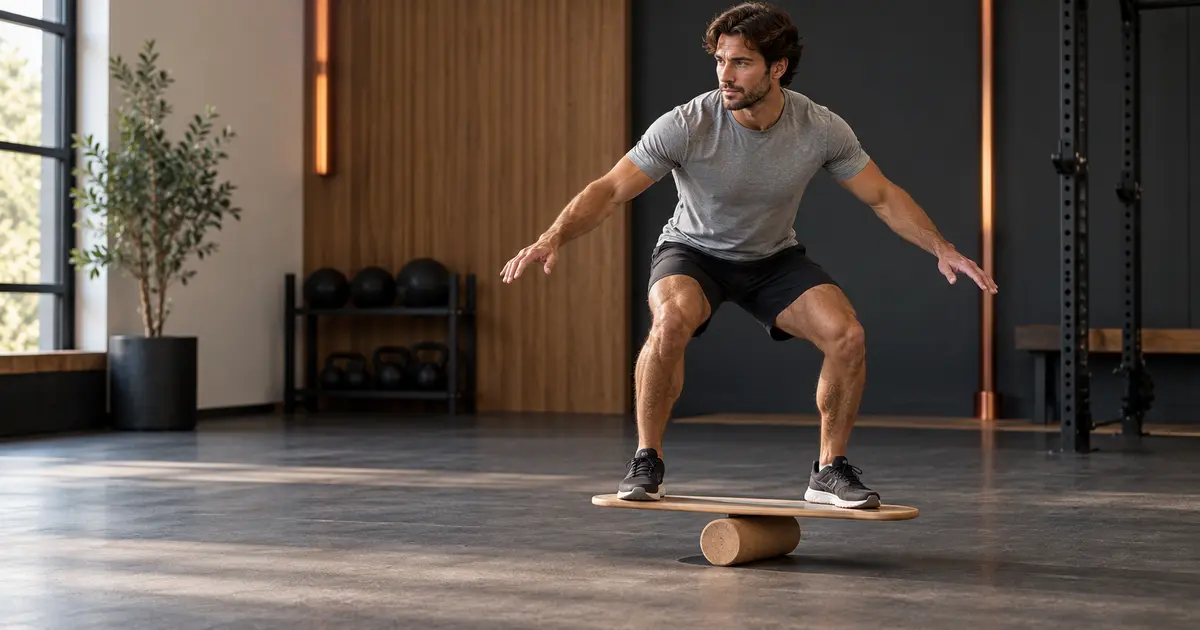
The INFIDEZ is my top athletic pick because it strikes a useful balance between accessibility and long-term progression. I personally use this board and like that the learning process feels manageable while still leaving room for better stance control, smoother corrections and more challenging movement.
The deck and cork roller create a responsive side-to-side challenge suited to surfers, snowboarders, skateboarders and wake athletes. It also works for general athletic balance when the goal is controlled weight transfer rather than sport simulation. The wide stance area provides space for partial squats, rotational control and deliberate front-to-back pressure changes.
Keep expectations realistic: it cannot reproduce speed, terrain, edge control or environmental forces. What it can do is provide repeatable practice controlling a moving platform. That makes it useful during off-season training, warm-up skill blocks or short standalone balance sessions.
Pros
- Personally tested by Charlie
- Approachable progression
- Strong fit for board-sport stances
- Enough challenge for continued practice
Cons
- Requires open floor space
- Not appropriate for distracted use
- Does not replace sport-specific practice
Best for: Athletes who want one progressive board for general balance and board-sport-oriented training.
2. Revbalance 101 v2
The Revbalance 101 v2 is the premium choice for athletes who want a dedicated roller board. Its deck travels over a separate roller, creating faster and larger balance corrections than a fixed rocker. Adjustable roller stops let the athlete limit travel early, then open the range as control improves.
Revbalance positions the 101 v2 as an all-around sport and workout trainer. The roughly 30-inch deck supports an athletic stance, while current listings commonly state a 400-pound capacity. The grippy surface and adjustable stop system are the important features for athletes—not the temptation to perform tricks before basic control is established.
This board fits surfers, skaters, snowboarders and wake athletes particularly well. It may also interest hockey or field-sport athletes, but those users should still prioritize on-ground single-leg work, deceleration and sport-specific footwork.
Pros
- High progression ceiling
- Adjustable travel range
- Wide athletic stance
- Purpose-built board-sport feel
Cons
- Premium price
- Steeper learning curve than rockers
- Requires attentive practice and clear space
Best for: Intermediate board-sport athletes seeking a premium, adjustable roller system.
3. Sportneer 7-Mode Balance Board
Sportneer is the strongest option for athletes who want several training challenges from one deck. The system includes a roller, ball and independently removable magnetic stoppers, producing seven advertised modes. That range allows a coach or athlete to manipulate direction, travel and stability rather than repeating one pattern indefinitely.
The manufacturer identifies birch construction and a listed capacity up to 450 pounds. More importantly, the stops can constrain early practice. Athletes can begin with a controlled travel range, progress toward freer rolling, then use the ball when multidirectional control is appropriate.
Versatility can become random variety if there is no plan. Choose a configuration based on the session goal and repeat it long enough to improve. Constantly changing attachments may feel entertaining without producing measurable progress.
Pros
- Multiple training directions
- Adjustable difficulty
- Useful for different athletes
- High long-term variety
Cons
- More components to store
- Requires deliberate programming
- Advanced modes are not beginner-friendly
Best for: Multi-sport athletes, coaches and households wanting several progressive configurations.
4. StrongTek Professional Wooden Balance Board
StrongTek’s wooden rocker is the better choice when an athlete needs controlled foundational work rather than a maximal balance challenge. The single-axis base creates predictable side-to-side motion. That supports weight shifts, shallow squats, controlled holds and ankle-response drills without the deck traveling away on a loose roller.
StrongTek lists a 350-pound capacity and markets the board for low-impact exercise and standing-desk use. For athletes, its value is simplicity. It can fit early offseason work, lower-fatigue warm-ups or the transition from stable single-leg training toward more reactive balance work.
Advanced athletes may quickly outgrow it, particularly if their sport already exposes them to substantial balance demands. In that case, use it for precision—quiet feet, level hips and clean knee tracking—rather than trying to manufacture difficulty with heavy weights.
Pros
- Controlled and approachable
- Good for foundational ankle control
- Simple setup
- Useful during low-fatigue sessions
Cons
- Lower progression ceiling
- Limited multidirectional challenge
- Not sport-specific
Best for: Beginner athletes and those prioritizing controlled mechanics over a dramatic challenge.
5. Yes4All Professional Rocker Board
The Yes4All Professional Rocker delivers basic single-plane balance work at an accessible price. The commonly listed professional version uses a 17.5-inch wooden platform, anti-slip surface and stated 350-pound capacity. It suits supported holds, weight shifts, partial squats and basic ankle-control drills.
Yes4All sells several similarly named variations, including rocker and 360-degree designs. Confirm the selected base before buying. The rocker discussed here is the more predictable athletic starting point; a centered wobble base introduces movement in every direction.
This is not the athlete’s last balance board, but it may be a sensible first one. It offers enough instability to reveal control errors without the price or complexity of a multi-mode system.
Pros
- Affordable
- Simple and compact
- Predictable for basic drills
- Low setup burden
Cons
- Limited advanced progression
- Variations can be confusing
- Research-based recommendation only
Best for: Athletes who want an inexpensive introduction to balance-board training.
Which Board Fits Your Sport?
Surf, skate, snow and wake
Choose INFIDEZ or Revbalance. Their roller systems better match the continuous deck corrections and wider stances common to board sports.
Soccer, basketball and court sports
Sportneer offers directional variety, while StrongTek supports foundational ankle control. Keep landing, deceleration and change-of-direction work in the program.
Running and hiking
StrongTek or Yes4All provides controlled ankle work without excessive fatigue. Prioritize calf strength, single-leg strength and actual terrain exposure as well.
General strength athletes
INFIDEZ or Sportneer can add a short coordination block. Keep primary strength lifts on stable ground where force production is the goal.
How Athletes Should Program Balance-Board Training
Place balance work where it supports the goal without reducing the quality of the main session. A simple approach is two or three short sessions per week, using one to three drills for controlled sets rather than training to exhaustion.
| Training goal | Example dose | Best placement |
|---|---|---|
| Basic control | 2–3 sets of 20–30-second holds | Warm-up or separate skill session |
| Weight shifting | 2 sets of 6–10 slow shifts per direction | Warm-up before strength work |
| Controlled squat pattern | 2–3 sets of 5–8 shallow repetitions | Accessory work, before fatigue |
| Board-sport stance practice | 3–5 rounds of 30–60 seconds | Separate low-fatigue session |
Progress one variable at a time: less hand support, a wider roller range, a more demanding attachment, longer duration or more complex movement. Do not add load, close your eyes and increase instability simultaneously.
Frequently Asked Questions
What is the best balance board for athletes?
The INFIDEZ is the best overall choice in this guide because it combines approachable progression with a challenging roller design, and it is the one board Charlie has personally tested.
Which balance board is best for surfers and snowboarders?
INFIDEZ and Revbalance 101 v2 are the strongest fits. Both use a deck-and-roller format that supports a wider stance and continuous side-to-side control.
Can balance-board training prevent ankle injuries?
Research supports balance exercise as part of some ankle-injury prevention programs, but a board alone is not a complete prevention strategy. Sport exposure, strength, workload, prior injury and program adherence also matter.
Should athletes lift weights on a balance board?
Usually, primary strength work belongs on stable ground so the athlete can produce and control force. Light exercises may be appropriate for a specific coaching goal, but adding instability is not inherently superior.
How often should athletes use a balance board?
Two or three brief sessions per week is a practical starting point. Stop before fatigue reduces control, and adjust the dose around practices, games and lower-body training.
Is a harder balance board always better?
No. Difficulty is useful only when the athlete can control it. Excessive instability can turn deliberate practice into repeated loss of position without meaningful progression.
Final Recommendation
The INFIDEZ Balance Surf Trainer is my best overall balance board for athletes because I have personally used it and value its combination of progression and ease of use. Choose Revbalance for premium board-sport practice, Sportneer for configuration variety, StrongTek for controlled foundational work or Yes4All for a lower-cost starting point.
See Best Overall on Amazon Compare All Balance Boards
Research and Product Sources
- Zech et al.: Balance training for neuromuscular control and performance enhancement
- Al Attar et al.: Balance training and ankle-injury risk
- Kümmel et al.: Specificity of balance training in healthy individuals
- Revbalance 101 v2 product information
- Sportneer 7-Mode product information
- StrongTek Professional Wooden Balance Board
Leave a Reply