
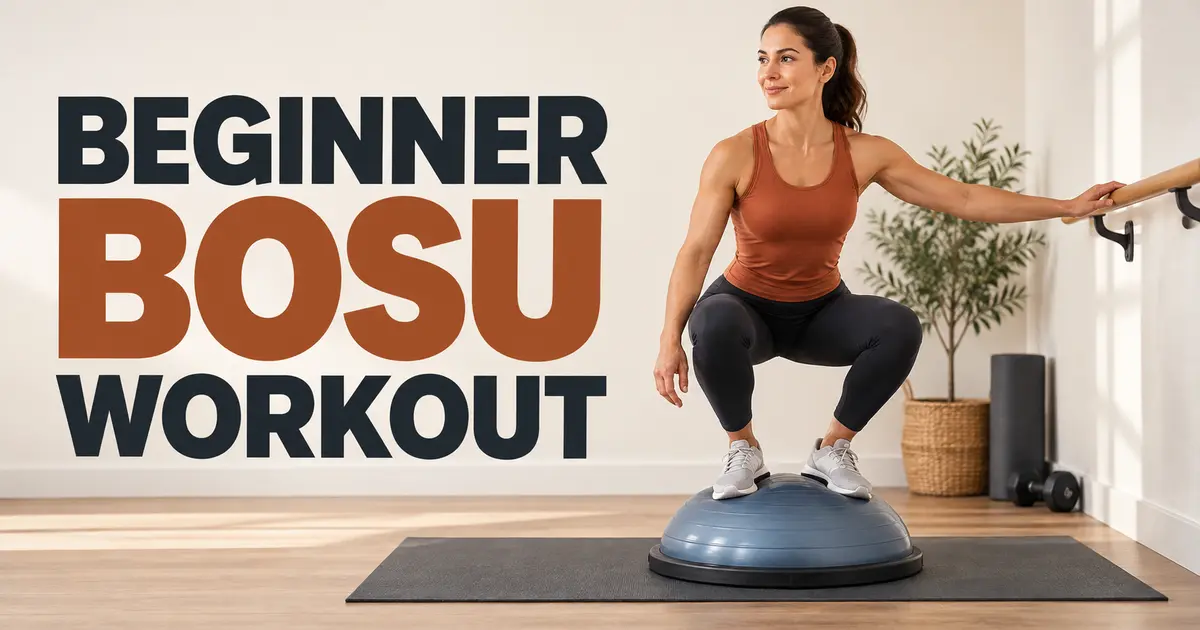
These BOSU ball exercises for beginners create a complete 20-minute workout using five approachable movements. You will practice balance, lower-body control, pushing strength and core stability without jumping or advanced tricks.
A BOSU ball can make familiar exercises feel completely different. The dome moves slightly beneath you, requiring the feet, ankles, hips and trunk to make constant small corrections. For a beginner, however, more instability is not automatically better. The goal is to stay controlled enough that you can breathe normally and maintain sound positions.
This beginner BOSU workout uses the dome side up throughout. You can keep a hand on the wall during the standing movements, elevate the plank position or shorten any interval. Those changes are smart starting points—not failed repetitions.

The 20-minute beginner BOSU workout
| Exercise | Work | Rest | Beginner focus |
|---|---|---|---|
| Supported BOSU march | 40 seconds | 20 seconds | Light wall support and slow weight shifts |
| BOSU squat | 40 seconds | 20 seconds | Shallow range with controlled knee tracking |
| Incline push-up | 40 seconds | 20 seconds | Body in a straight line; use a comfortable depth |
| Glute bridge | 40 seconds | 20 seconds | Press evenly through both feet |
| Plank hold | 40 seconds | 20 seconds | Use the knees-down option when needed |
One pass through all five movements takes five minutes. Complete three rounds for the 15-minute circuit. If 40 seconds is too long, use 20 seconds of work and 40 seconds of rest for your first session. You can gradually reverse that ratio as your control improves.
What you need and how to set up
- A properly inflated BOSU or comparable half-ball balance trainer
- A level, nonslip training surface
- A clear area with enough room to step off safely
- A wall or sturdy support for the marching and squat exercises
- An interval timer set to 40 seconds of work and 20 seconds of rest
Inspect the dome, plug, seams and base before beginning. The ball should feel supportive rather than excessively hard, and the base should stay flat without sliding. Follow the inflation and use directions for your specific model.
If you are still choosing equipment, see our guide to the best balance balls for exercise for a comparison of BOSU and other half-ball trainers.
Three-minute warm-up
Minute 1: March in place
March beside the BOSU ball rather than on it for your first minute. Let the arms swing naturally and gradually lift the knees a little higher. The purpose is to raise your body temperature and prepare for movement, not to test your balance immediately.
Minute 2: Bodyweight squats
Stand on the floor with the feet around hip- to shoulder-width apart. Sit the hips down and back while keeping the whole foot connected to the floor. Use a comfortable depth and stand tall without snapping the knees backward.
Minute 3: Arm circles and overhead reaches
Perform small arm circles and gradually increase their size. Alternate with relaxed overhead reaches while keeping the ribs controlled. Avoid forcing the arms into a painful range.
Five BOSU ball exercises for beginners
1Supported BOSU march
- Place the BOSU ball dome-side up beside a wall.
- Step onto the center of the dome one foot at a time while keeping one hand lightly on the wall.
- Find a tall position with soft knees and level hips.
- Slowly lift one foot, replace it and repeat on the other side.
- Continue for 40 seconds without rushing.
Coaching cue: Think “quiet feet.” The goal is a small, controlled weight shift rather than lifting each knee as high as possible.
2BOSU squat
- Stand near the center of the dome with the feet placed comfortably apart.
- Keep a hand near the wall if needed.
- Brace gently through the trunk and sit into a shallow squat.
- Keep the knees moving in the same general direction as the toes.
- Press through both feet to return to standing.
Coaching cue: Use only the depth you can control. A smooth quarter squat is more useful than a deep squat that causes the feet, knees or hips to collapse.
3Incline push-up
- Kneel in front of the BOSU ball and place both hands on the dome.
- Walk the feet backward until your body forms a straight diagonal line.
- Bend the elbows and lower the chest toward the dome.
- Stop before the shoulders roll forward or the hips begin to sag.
- Press through both hands to return to the starting position.
Coaching cue: Keep the hands pressing evenly into the dome. The ball should not tip sharply toward one side.
4Glute bridge with feet on the BOSU
- Lie on your back with both feet placed on top of the dome.
- Position the feet about hip-width apart and keep the knees bent.
- Gently brace the trunk and press evenly through both feet.
- Lift the hips until the shoulders, hips and knees form a comfortable line.
- Lower slowly without allowing the knees to fall inward or outward.
Coaching cue: Lift with the hips instead of arching the lower back. The BOSU should remain centered beneath both feet.
5Forearm plank on the BOSU
- Kneel behind the BOSU ball and place both forearms on the dome.
- Keep the elbows beneath or slightly ahead of the shoulders.
- Extend the legs and create a straight line from the head through the heels.
- Gently squeeze the glutes and maintain normal breathing.
- End the set when the hips begin to sag or rise.
Coaching cue: A plank is a position, not a contest against the clock. Stop before you lose the position.
Two-minute cooldown
Minute 1: Supported calf stretch
Stand facing a wall with both hands supported. Step one foot back and gently press the heel toward the floor. Hold for about 30 seconds before changing sides. Keep the stretch comfortable and avoid bouncing.
Minute 2: Slow breathing
Sit comfortably on a chair or stand with both feet on the floor. Inhale gently through the nose, then use a relaxed, slightly longer exhale. Let the shoulders settle rather than forcing an exaggerated breath.
How to progress this beginner BOSU workout
Repeat the workout two or three times per week, leaving recovery time between sessions when the movements are new. Progress only one variable at a time:
- Reduce support: Move from a full-hand grip to fingertip support during the march and squat.
- Improve your range: Use a slightly deeper squat or push-up while maintaining control.
- Increase work time: Build from 20 seconds to 30 seconds and then 40 seconds.
- Slow the tempo: Take three seconds to lower during squats, push-ups or bridges.
- Add a round: Only after three rounds feel controlled, consider adding a fourth round during a future session.
Do not remove support, increase the range, extend the interval and add resistance simultaneously. The purpose of progression is to make an exercise slightly more demanding while preserving your ability to control it.
Common beginner mistakes
- Looking straight down: Use a point on the wall or floor several feet ahead to help maintain your orientation.
- Locking the knees: Keep a soft, athletic position during standing exercises.
- Holding your breath: Reduce the difficulty until you can breathe normally.
- Moving too quickly: Slower repetitions reveal whether you actually control the BOSU.
- Choosing instability over form: Return the exercise to the floor if the ball prevents a safe position.
- Training through pain: Muscular effort is expected, but sharp or increasing joint pain is a reason to stop.
Frequently asked questions
Is a BOSU ball good for beginners?
Yes. Beginners should start dome-side up, keep support nearby and use familiar movements. The BOSU adds instability, so the first goal is control rather than speed, depth or heavy resistance.
How often should a beginner do BOSU exercises?
Two or three short sessions per week can provide practice while allowing recovery. Your overall program should still include stable-surface strength training, aerobic activity and mobility work appropriate for your goals.
Should beginners stand on the flat side?
This routine keeps the dome side up. Platform-side-up exercises create a different and potentially greater challenge. Follow the instructions for your specific trainer and master basic dome-side-up movements first.
Can I do this workout without a BOSU-brand trainer?
A comparable half-ball balance trainer may work if it is designed for these exercises, properly inflated and used according to its instructions. BOSU is a brand name, while similar products may be described as half-ball or balance-ball trainers.
What if I cannot work for 40 seconds?
Start with 20 seconds of work and 40 seconds of rest. You can also perform fewer repetitions, use more support or complete one or two rounds instead of three.
Will BOSU exercises improve balance?
They provide an opportunity to practice controlling your body on an unstable surface. Results depend on consistent practice, appropriate exercise selection and progression. Balance training should complement, rather than replace, general strength and movement training.
Final coaching notes
A productive beginner BOSU workout should look controlled rather than dramatic. Use wall support when you need it, shorten the intervals when your form begins to change and return an exercise to the floor if the unstable surface becomes the only thing you are fighting.
Start with the version you can perform confidently and increase the challenge gradually. Better balance comes from repeated, controlled practice—not from choosing the most unstable exercise available.
Return to the workout
Leave a Reply