
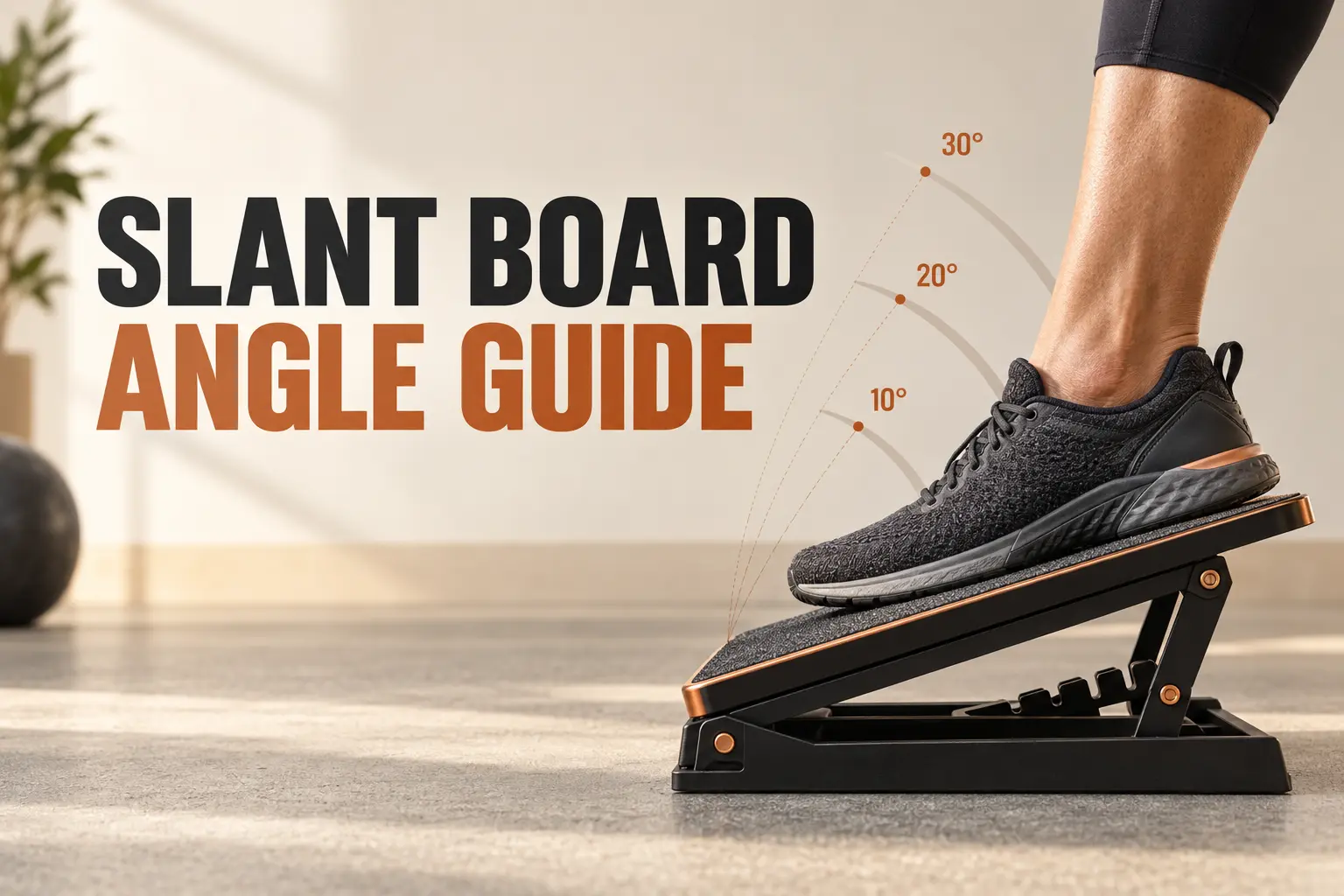
The angle of a slant board determines how much dorsiflexion and calf flexibility an exercise requires. A shallow incline usually feels more accessible, while a steeper setting creates a stronger stretch or a larger heel lift. The best slant board angle depends on the exercise, your current mobility, and whether you can maintain control without pain.
Those ranges are starting points rather than rigid rules. Adjustable boards differ in length, surface texture, and measured angle, and two people can experience the same setting very differently. If you are new to incline training, review our guide on how to use a slant board before increasing the height.

Slant Board Angle Chart
| Incline | General intensity | Common uses | Best suited for |
|---|---|---|---|
| 10° | Gentle | Warm-ups, introductory stretching and balance practice | Beginners and people easing into incline work |
| 15° | Light to moderate | Everyday calf stretching and ankle-mobility exercises | Most recreational users |
| 20° | Moderate | Deeper calf stretching, ankle mobility and heel-elevated exercises | Users comfortable at lower settings |
| 25° | Strong | Heel-elevated squats and more demanding stretching | Experienced users with adequate control |
| 30° | Advanced | High-incline variations when a specific exercise requires them | Advanced users who tolerate the position comfortably |
What Each Slant Board Angle Is Best For
A gentle starting angle
A 10-degree incline introduces the elevated position without demanding a large amount of ankle range. It is a sensible place to begin if you have not used a slant board before or if steeper settings immediately cause your heel to lift, your knee to collapse inward, or your balance to become uncertain.
This setting can also work well during a warm-up. You can use it for short calf stretches, gentle ankle rocks or supported standing while you learn how the board feels.
Everyday mobility and calf stretching
For many users, 15 degrees provides a noticeable stretch without feeling excessively aggressive. It is a practical setting for regular calf work, particularly when you want to spend time in the position without fighting to maintain balance.
When stretching, keep the entire foot supported and use a wall, rail or sturdy piece of furniture if needed. You should feel controlled tension through the calf—not sharp pain in the ankle, Achilles tendon or foot.
A moderate stretch and mobility challenge
A 20-degree slant board angle increases the ankle position and generally creates a stronger calf stretch. This setting may be useful after you can comfortably use 10 or 15 degrees while keeping your heel down and your weight evenly controlled.
It can also support progressive ankle dorsiflexion exercises. Progress gradually instead of forcing the knee farther forward simply because the board allows a greater angle.
A stronger incline for stretching and squats
At 25 degrees, the board provides substantial heel elevation. That can reduce the ankle-dorsiflexion demand during a heel-elevated squat, but it also changes your balance and how pressure is distributed through the foot.
A stronger incline can help some people maintain a more upright torso during squats, but it should not be used to disguise painful movement. Begin with body weight and stable support before adding external resistance. See our guide to the best slant boards for squats if squat training is your primary goal.
An advanced setting—not a default goal
A 30-degree angle creates a steep platform. Some adjustable boards include this setting, but that does not mean every user or exercise requires it.
Use this level only when you can enter and exit the position safely, maintain stable foot contact, and complete the exercise without pain or uncontrolled movement. There is no need to progress to 30 degrees if a lower setting already provides the training effect you need.
What Angle Should You Use for Calf Stretching?
A good starting calf-stretch angle is usually between 10 and 15 degrees. If that position feels comfortable and you can keep your heel supported, you can experiment with 20 degrees for a stronger stretch.
Use the following form cues:
- Place the entire forefoot securely on the board.
- Keep the heel down rather than allowing it to float.
- Point the toes generally forward.
- Keep the knee aligned with the foot.
- Hold a stable surface instead of struggling for balance.
- Move into mild or moderate tension without bouncing.
Keeping the knee straighter tends to place more emphasis on the gastrocnemius. Slightly bending the knee shifts more of the stretch toward the soleus. For equipment recommendations, see our comparison of the best slant boards for calf stretching.
What Angle Should You Use for Squats?
Many people begin heel-elevated squats with an incline between 15 and 20 degrees. This provides noticeable elevation without immediately placing the feet on the board’s steepest setting.
A higher angle can make it easier to keep the torso upright and allow the knees to travel forward, but it also shifts the exercise mechanics. Choose an angle that lets you:
- Maintain full and secure foot contact.
- Keep the knees tracking in line with the feet.
- Control both the lowering and rising portions of the squat.
- Avoid excessive pressure or discomfort in the knees and ankles.
- Complete the desired depth without losing balance.
Read our complete guide to slant board squats, benefits and proper form before adding weight.
How to Find Your Best Slant Board Setting
- Start at the lowest available angle. Give yourself time to assess the surface, grip and balance before increasing the incline.
- Check your foot contact. Your foot should feel secure rather than sliding, twisting or hanging off the platform.
- Perform the intended movement slowly. Test several controlled repetitions or a brief stretch instead of immediately committing to a long hold.
- Watch for compensations. Reduce the angle if your heel lifts, foot rolls, knee collapses inward or body weight shifts uncontrollably.
- Increase one setting at a time. Progress only when the current angle feels stable and no longer produces the intended challenge.
Does Board Length Affect the Angle?
Yes. Angle is only one part of the setup. Platform length, width and foot placement also influence how a slant board feels.
A short board may leave part of a larger foot unsupported even when the incline is appropriate. A wider or longer platform can provide more room to adjust your stance, especially during squats. Non-slip material and a stable base are equally important because an appropriate angle is not useful if the board shifts under load.
If you want several settings in one platform, compare the best adjustable slant boards. An adjustable model lets you begin conservatively and change the incline as your exercise or mobility goal changes.
Common Slant Board Angle Mistakes
Starting at the steepest setting
The highest setting is not a test you need to pass. Starting too high can make it difficult to maintain foot pressure, balance and proper alignment.
Using the same angle for every exercise
Calf stretching, ankle rocks and heel-elevated squats have different purposes. Adjust the board to the movement rather than treating one setting as universally correct.
Forcing the heel downward
Your heel should stay supported during a calf stretch, but you should not force it down against sharp discomfort. Lower the incline until you can maintain contact comfortably.
Ignoring the board’s stability
Confirm that the supports are fully seated and the board is placed on a firm, level surface. Do not use an adjustable setting that feels loose or unstable.
Progressing based only on the angle number
Board markings may not be perfectly consistent between manufacturers. Judge the setting by your position and movement quality rather than assuming every labeled angle will feel identical.
Frequently Asked Questions
What is the best slant board angle for beginners?
Most beginners should start around 10 degrees. A 15-degree incline may also be appropriate when the user can maintain stable foot contact and complete the intended exercise without pain.
What angle is best for stretching the calves?
A setting between 10 and 20 degrees works for many calf-stretching routines. Begin at the lower end and increase only when you can keep your heel down and maintain controlled tension.
What angle should I use for heel-elevated squats?
Many users begin between 15 and 20 degrees. More experienced users may prefer 20 to 25 degrees, depending on their footwear, ankle mobility, squat mechanics and comfort.
Is a steeper slant board angle better?
No. A steeper board changes the exercise and increases the mobility or balance demand. The best angle is the lowest setting that safely produces the desired training effect.
Can a slant board improve ankle mobility?
A slant board can support calf stretching and controlled ankle-mobility exercises, but results depend on consistent practice, appropriate loading and the cause of the restriction. Review our guide to using a slant board for ankle mobility for specific applications.
The Bottom Line
There is no single slant board angle that works best for every person or exercise. A 10-degree incline offers a gentle introduction, 15 to 20 degrees covers many calf-stretching and mobility applications, and 20 to 25 degrees provides a stronger option for experienced users and heel-elevated squats.
Start lower, pay attention to foot contact and alignment, and increase the angle only when you can maintain control. The goal is not to reach the steepest setting—it is to select the setting that helps you perform the exercise well.
Continue Exploring Slant Boards
This article is for general educational purposes and is not a substitute for individualized medical advice. Consult a qualified healthcare professional if you have an injury, significant pain, recent surgery or concerns about safely performing these exercises.
Leave a Reply