
Balance Foundry Equipment Comparison
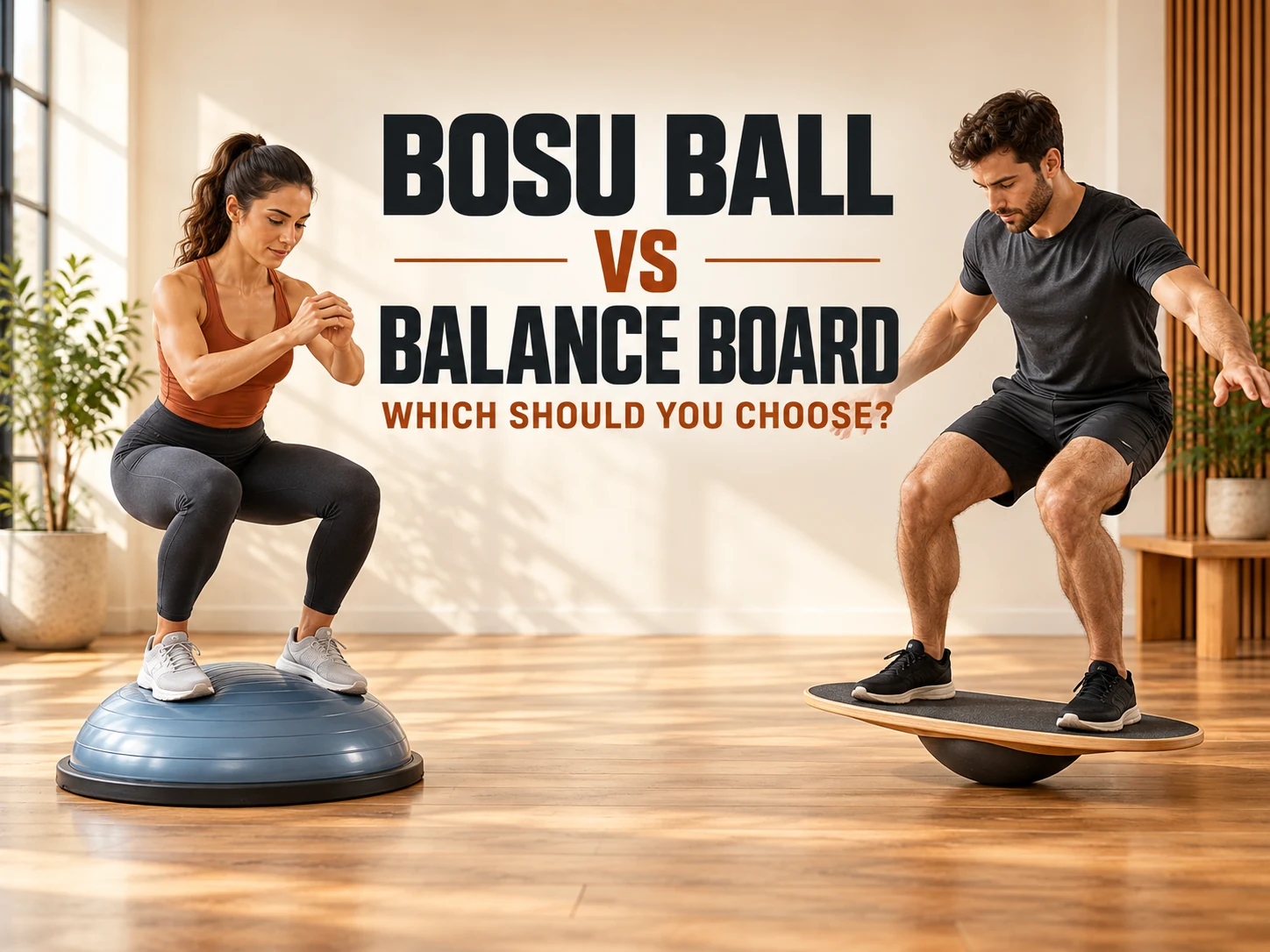
A BOSU-style half-ball trainer and a balance board can both challenge balance, but they do it in different ways. A BOSU provides a cushioned unstable dome and supports a wider range of strength and floor exercises, while a balance board usually creates a more direct standing challenge through the feet and ankles.
Neither option is automatically better. The better tool depends on the type of movement you want to practice.
The comparison also depends on what you mean by “balance board.” Rocker boards, wobble boards, and roller boards create very different movement patterns, while BOSU-style trainers all share the basic concept of an inflatable dome attached to a rigid platform.

BOSU Ball vs. Balance Board: What’s the Main Difference?
BOSU / Half-Ball Trainer
A BOSU-style trainer combines an inflatable dome with a rigid flat platform. The dome compresses under body weight, creating instability while still providing cushioning.
It can be used for standing drills, squats, lunges, step-ups, planks, push-ups, core exercises, and other supported movements.
Balance Board
A balance board uses a rigid standing platform that tilts, rocks, pivots, or rolls over a fulcrum or curved base.
Because the standing surface itself moves, balance boards often place more obvious demand on foot, ankle, and lower-leg control.
If you want more detail on the different board designs, our wobble board vs. balance board comparison explains how board movement changes the training experience.
BOSU Ball vs. Balance Board Comparison
| Feature | BOSU Ball | Balance Board |
|---|---|---|
| Primary movement | Soft, compressible multidirectional instability | Tilt, rock, pivot, or roll depending on board type |
| Beginner accessibility | Often easier with support and simple drills | Varies widely by board design |
| Foot and ankle demand | Moderate | Usually higher |
| Core exercise variety | Excellent | Moderate |
| Lower-body strength exercises | Very versatile | Good, depending on board type |
| Upper-body exercises | Planks, push-ups, mountain climbers and more | More limited |
| Reactive balance challenge | Moderate to high | High on wobble and roller designs |
| Storage | Larger footprint | Usually more compact |
| Cushioning | Inflatable dome | Rigid platform |
| Exercise variety | Broader overall | More specialized toward standing balance |
These are general differences. A low-profile rocker board can be easier than some BOSU exercises, while a roller board can be dramatically more difficult than either.
Which Is Better for Beginners?
A BOSU-style trainer often provides more beginner-friendly ways to start because you do not have to begin by standing on it.
Beginners can start with:
- hands-supported dome exercises,
- seated or kneeling work,
- supported step-ups,
- partial squats near a stable support,
- basic plank variations.
Our BOSU ball exercises for beginners includes a structured introductory workout.
A balance board can also be appropriate for beginners, especially a predictable rocker board with a limited range of motion. The key is choosing the right board rather than assuming every balance board is beginner-friendly.
See our balance board exercises for beginners if standing board training is your preferred direction.
Which Is Better for Foot and Ankle Control?
For focused standing foot and ankle work, the balance board generally has the edge.
A rigid platform makes small shifts easier to feel through the feet. Rocker and wobble designs can require constant ankle adjustments as you control the board’s movement.
That makes a balance board a natural fit for:
- standing ankle-control drills,
- single-leg balance progressions,
- foot pressure awareness,
- reactive balance practice.
If that is your main goal, see our best balance boards for ankle strength.
A BOSU can still challenge the ankles, especially during standing and single-leg exercises, but its compressible surface changes how force is distributed under the foot.
Which Is Better for Core and Strength Training?
The BOSU is generally more versatile for combining instability with traditional strength and core exercises.
Common BOSU movements include:
- squats,
- split squats and lunges,
- step-ups,
- planks,
- push-ups,
- mountain climbers,
- bridges,
- supported core exercises.
That variety is one reason the BOSU works well for someone who wants one tool to support several types of exercise.
A balance board still trains the trunk, particularly while standing, but most board designs offer fewer comfortable hand-supported or floor-based exercise options.
Which Is Better for Athletic Balance Training?
The answer depends on the sport and the movement you want to train.
Balance boards can be particularly useful when you want to challenge:
- rapid weight shifts,
- standing coordination,
- foot and ankle reactions,
- board-sport-style balance.
Roller boards in particular can create a large moving challenge underneath the feet, which can make them useful for experienced users interested in surfing, snowboarding, skating, or other board-sport movement.
Our best balance boards for athletes looks at equipment specifically from an athletic-training perspective.
BOSU trainers may be preferable when athletic training includes a broader mix of strength, jumping, landing, upper-body, and core exercises.
Which Is Better for Squats?
Both can be used for squat variations, but the experience is different.
A BOSU provides a larger cushioned surface and is often easier to use for two-legged squat variations. A balance board may create more pronounced side-to-side or multidirectional platform movement depending on the design.
Neither should replace ordinary stable-ground squatting when the primary goal is producing high force or progressively loading the squat.
Which Is Better for a Home Gym?
Choose BOSU for Versatility
One half-ball trainer can support balance, strength, floor exercises, core work, and mobility. That versatility may justify its larger footprint.
Choose a Board for Simplicity
Balance boards are typically thinner, easier to store, and quick to pull out for short standing-balance sessions.
If space is limited, a simple rocker or wobble board is usually easier to store under furniture or against a wall.
A BOSU-style trainer requires more floor and storage space but can replace several more specialized pieces of instability equipment.
What About BOSU Ball Benefits?
BOSU training can add instability, exercise variety, and new progression options, but it should not be treated as a magic tool for balance, strength, or injury prevention.
Our BOSU ball benefits guide separates practical training uses from claims that can be overstated.
BOSU Ball or Balance Board: Which Should You Choose?
Choose a BOSU Ball If You Want:
- more exercise variety,
- a cushioned unstable surface,
- core and upper-body exercises,
- supported lower-body training,
- beginner-friendly progression options,
- one versatile home-workout tool.
Choose a Balance Board If You Want:
- more direct foot and ankle demand,
- standing balance practice,
- reactive platform movement,
- board-sport-style training,
- a compact piece of equipment,
- quick balance sessions at home or work.
Frequently Asked Questions
Is a BOSU ball better than a balance board?
Not universally. A BOSU is usually more versatile for full-body exercises, while a balance board often provides more direct standing foot-and-ankle balance training.
Which is harder, a BOSU ball or balance board?
It depends on the exercise and board type. A beginner rocker board may be easier than advanced BOSU exercises, while a roller balance board can be much more difficult than basic BOSU standing drills.
Which is better for ankle training?
Balance boards generally provide a more direct foot-and-ankle challenge during standing exercises. BOSU trainers can still challenge ankle control but spread the instability across a compressible dome.
Which is better for core exercises?
A BOSU generally offers more core-exercise variety because it supports planks, push-ups, mountain climbers, bridges, seated work, and other floor-based movements.
Can beginners use a balance board?
Yes, but board choice matters. A controlled rocker board near a sturdy support can be much more approachable than a roller board or highly unstable wobble board.
Can I use both a BOSU ball and balance board?
Yes. They overlap, but they are not identical. A BOSU works well for broader instability and strength exercises, while a balance board can provide more focused standing balance and ankle-control work.
Final Verdict
If you want one versatile instability tool for a wide range of workouts, the BOSU ball is usually the better starting point.
If your main goal is standing balance, ankle control, reactive movement, or board-sport-style training, a balance board is the more specialized choice.
The best decision comes from matching the movement of the equipment to the movement you actually want to train.
Compare BOSU-Style Trainers Compare Balance BoardsContinue Comparing Balance Equipment
- Balance & Stability Balls Hub — BOSU, half-ball, and stability-ball guides.
- Balance Boards Hub — buyer guides, exercises, and board comparisons.
- Best Balance Balls for Exercise — compare half-ball trainers.
- Best Balance Boards — compare board styles and use cases.
- BOSU Exercises for Beginners — start with a structured half-ball workout.
- Balance Board Exercises for Beginners — learn basic standing progressions.
- Half Ball vs. Full Stability Ball — compare the other major ball-equipment decision.
Leave a Reply