
Build Better Ankle Control With the Right Level of Instability
The best balance board for ankle strength is not necessarily the hardest one. A useful board lets you create controlled movement, progress gradually and train consistently without turning every session into a fall-prevention exercise.
A balance board challenges the muscles around the foot and ankle to make repeated corrections as the platform tilts or moves. That makes it useful for training stability, coordination and balance. But unstable-surface practice is only one part of ankle strengthening: it should complement direct resistance exercises such as calf raises and appropriately loaded inversion, eversion and dorsiflexion work.
Our best overall choice is the StrongTek Wooden Balance Board because its rocker and advanced 360-degree variations create a practical pathway from predictable movement to multidirectional control. Beginners who want the simplest starting point should consider the Yes4All rocker, while the Sportneer offers the broadest range of configurations. The INFIDEZ is the advanced, hands-on-tested choice for dynamic roller-board practice.
StrongTek Wooden Balance Board
Best for most users because the product family provides a predictable rocker option and a more demanding 360-degree wobble option for progressive ankle-control work.
Best Balance Boards for Ankle Strength at a Glance
| Product | Award | Movement | Best for | Review basis | Amazon |
|---|---|---|---|---|---|
| StrongTek Wooden Balance Board | Best overall | Rocker or 360° wobble variation | Progressive ankle control | Research-based | View |
| Yes4All Professional Rocker Board | Best for beginners | Predictable side-to-side rocking | Foundational weight shifts | Research-based | View |
| Sportneer 7-Mode Balance Board | Most versatile | Roller, ball and adjustable stops | Multiple progression paths | Research-based | View |
| INFIDEZ Balance Surf Trainer | Best advanced roller | Deck over cork roller | Reactive balance and board sports | Hands-on tested | View |
Listings, product variations, included parts and availability can change. Confirm the active Amazon configuration before ordering.
How We Chose These Balance Boards
Testing transparency: Charlie Brown personally owns and uses the INFIDEZ Balance Surf Trainer. The other three products are research-based selections evaluated through manufacturer and retailer information, movement pattern, adjustability, platform grip, usable size and suitability for gradual progression. Read the full Review Methodology.
For ankle-focused training, we favored controllable instability over novelty. A board must allow the user to practice deliberate weight shifts and maintain joint alignment. We also selected four different approaches because a low rocker, a central wobble base and a free roller place meaningfully different demands on the user.
We did not treat manufacturer capacity ratings as independent proof of durability, and we did not rank a board higher simply because it was more difficult. More instability can reduce exercise quality when it exceeds the user’s current control.
Detailed Balance Board Reviews
1. StrongTek Wooden Balance Board
StrongTek offers the most straightforward progression for users who want to move from controlled rocking to multidirectional ankle corrections.
The basic rocker variation moves primarily in one plane, helping users learn controlled pronation/supination or forward/backward shifts depending on board orientation. The advanced crossed-base version permits 360-degree tilting, increasing the demand on the muscles controlling the ankle and foot.
The important limitation is that the Amazon page may offer the rocker and advanced model as separate variations rather than both bases in one package. Select the intended configuration before checkout. Beginners should start with the rocker; experienced users seeking multidirectional work can choose the advanced version.
Pros
- Beginner and advanced movement options
- Firm wooden platform
- Compact training footprint
- Useful for two-foot and supported single-leg drills
Cons
- Variations may be sold separately
- No on-the-fly height adjustment
- Not personally tested by Balance Foundry
2. Yes4All Professional Rocker Board
The Yes4All keeps the challenge simple: one wooden platform, one fixed rocker and one predictable movement plane.
A fixed rocker is often a better first step than a round wobble board because the deck cannot tilt unpredictably in every direction. Users can orient it for side-to-side or front-to-back control, keep both feet planted and gradually reduce reliance on hand support.
There is little mechanical progression once the basic movement becomes easy. Difficulty must come from stance, tempo, reach tasks or carefully introduced single-leg work. That simplicity is ideal for foundational practice but less appealing for users who want one board to remain challenging for years.
Pros
- Most approachable movement pattern
- No loose roller or extra pieces
- Compact and simple to store
- Can also suit light standing-desk movement
Cons
- Limited mechanical progression
- No multidirectional wobble
- Advanced users may outgrow it
3. Sportneer 7-Mode Balance Board
The Sportneer combines multiple supports and adjustable stops, giving users more ways to change the direction and magnitude of instability.
The roller emphasizes lateral travel and reactive control, while the ball introduces multidirectional movement. Magnetic removable stoppers can limit the board’s travel to create a more manageable starting range. This variety makes the system useful for households with different ability levels or users who enjoy changing drills.
It is not the simplest option for isolated ankle work. The longer deck and loose supports demand more whole-body control, and changing configurations creates a learning curve. Users should master the easiest stopped setup beside stable support before attempting freer modes.
Pros
- Seven listed configurations
- Roller, ball and magnetic stops
- Several progression routes
- Large birch deck
Cons
- More parts and setup decisions
- Greater fall risk than a fixed rocker
- May be excessive for basic rehabilitation drills
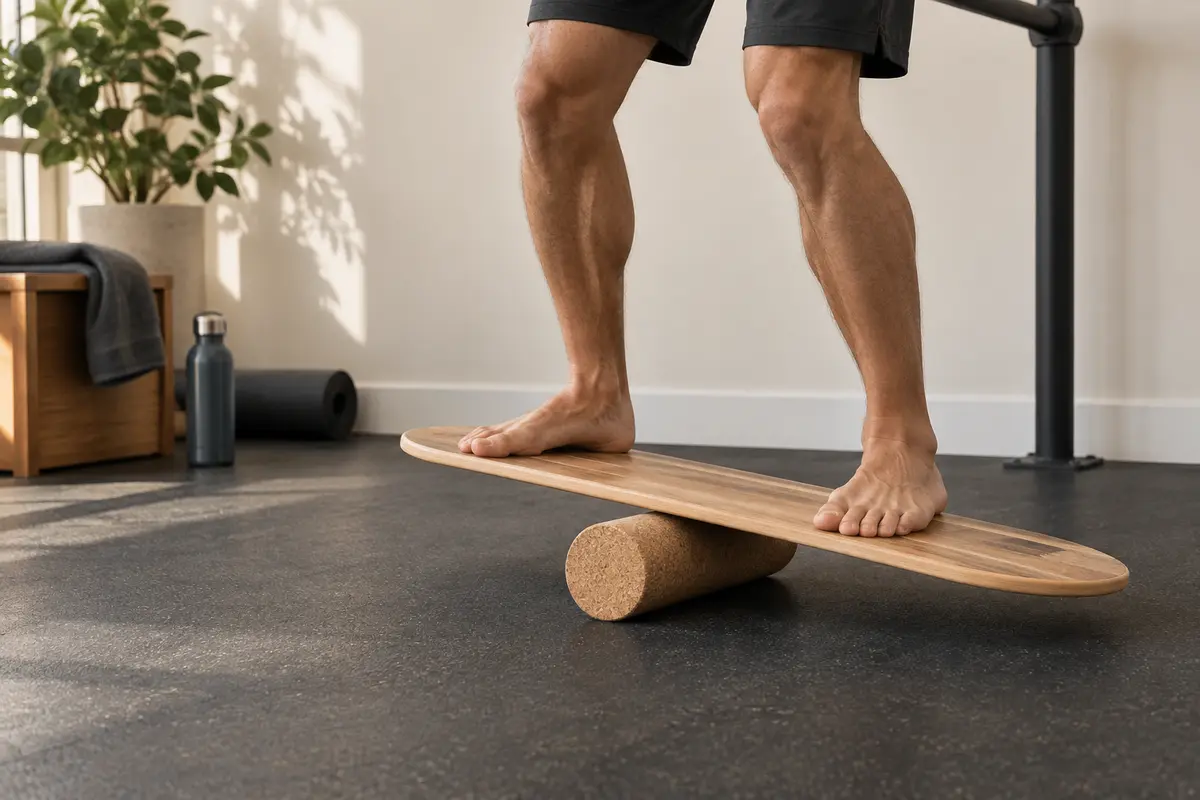
4. INFIDEZ Balance Surf Trainer
The INFIDEZ is the most dynamic option here and Charlie’s choice for users who already have basic ankle control and want a progressive roller-board challenge.
A roller board requires the ankles to respond within a whole-body task as the deck travels over the cylinder. That can be valuable for reactive balance and board-sport preparation, but it is not the first choice for a painful, newly injured or frequently unstable ankle.
Use it after establishing controlled two-foot balance on easier equipment. Start beside a genuinely stable support and keep the travel restricted until mounting, centering and stepping off are repeatable.
Pros
- Personally tested by Charlie
- Useful easier-to-harder progression
- Dynamic whole-body ankle reactions
- Strong board-sport crossover
Cons
- Too dynamic for many beginners
- Not a rehabilitation device
- Needs more clear floor space
How Balance Boards Challenge Ankle Strength and Stability
Repeated Corrections
As the platform tilts, muscles around the ankle contract to manage the movement and return the body toward center. Slower, controlled corrections are more useful than frantic edge-to-edge motion.
Position Awareness
Unstable surfaces challenge the sensory-motor system to detect joint position and organize a response. This is commonly described as proprioceptive or neuromuscular training.
Single-Leg Control
Once two-foot work is easy, supported single-leg drills increase the demand on the foot, ankle, hip and trunk. They should be added only when the board and support setup are appropriate.
A 2024 systematic review reported benefits from balance training for people with chronic ankle instability, and clinical guidelines for lateral ankle sprains include proprioceptive and balance-focused exercise within rehabilitation. These findings support structured balance work—not unsupervised self-treatment with the hardest available board.
How to Choose a Balance Board for Ankle Strength
Start With the Movement Pattern
A rocker moves in one primary plane and is easiest to predict. A central wobble base tilts in every direction. A roller allows the platform itself to travel and is more dynamic. Choose the simplest pattern that still challenges you.
Look for Adjustable Difficulty
Travel stops, interchangeable bases or separate product variations make progression easier to manage. If a board cannot be mechanically adjusted, you can still change stance width, hand support, tempo and exercise selection.
Check Grip With Your Preferred Footwear
The top surface should keep the foot planted without being uncomfortably abrasive. Barefoot users should look for a comfortable texture and inspect the deck for damaged wood or sharp edges before every session.
Match the Platform to Your Feet
A compact round board can work for narrow two-foot stances and single-leg drills. A longer roller deck provides more stance freedom but requires more room. Confirm the usable standing area rather than relying only on overall dimensions.
Plan for Support and Floor Protection
Identify a solid countertop, rail or other support before the first session. Hard bases and rollers may mark sensitive flooring; use only a firm mat compatible with the product, since thick padding can change the board’s behavior.
Do Not Buy by Instability Alone
A taller base or free roller may look more effective, but excessive instability can reduce time under control and encourage compensations. The right challenge lets you keep the foot planted, knee aligned and movement deliberate.
A Simple Beginner Balance-Board Routine
This general routine is for healthy adults using a low rocker or beginner-friendly setup. It is not a rehabilitation prescription.
- Supported two-foot hold: Stand with both feet on the board, lightly hold a stable support and find center for 20–30 seconds.
- Controlled edge taps: Slowly lower one edge toward the floor, return through center and repeat on the other side for 6–10 controlled repetitions.
- Front-to-back weight shifts: If the board orientation allows it, shift pressure toward the forefoot and heel without curling the toes or losing posture.
- Reduced hand support: Move from a firm grip to fingertip contact only when the first drills are consistently controlled.
- Short freestanding holds: Release support for a few seconds while keeping it within immediate reach. End the set before form deteriorates.
Two or three short sessions per week may be easier to recover from and perform well than occasional long sessions. If a clinician has provided a schedule, follow that plan instead.
Frequently Asked Questions
Do balance boards strengthen ankles?
They challenge the muscles around the ankle to make repeated stabilizing corrections and can support balance, control and muscular endurance. For complete strength development, combine appropriate balance work with progressive resistance exercises.
What type of balance board is best for weak ankles?
A low fixed rocker is usually the most predictable starting point. “Weak ankles” can describe several different problems, so pain, repeated sprains or giving way should be assessed before progressing to wobble or roller boards.
Is a wobble board better than a rocker board?
A wobble board creates multidirectional instability and is usually more challenging. A rocker is better for learning controlled weight shifts. The better choice depends on current ability and training goals.
How often should I use a balance board?
Healthy beginners can start with short sessions two or three times per week and progress according to control and recovery. Rehabilitation frequency should be set by the treating professional because diagnosis and healing stage matter.
Can a balance board prevent ankle sprains?
Research supports proprioceptive and balance training as part of some ankle-sprain prevention programs, especially in athletic populations. A board alone cannot eliminate injury risk, and the exercise program matters more than simply owning the equipment.
Should I use a balance board barefoot?
Barefoot practice can provide direct contact when the deck is clean, comfortable and grippy. Shoes may offer protection or feel more secure on abrasive surfaces. Use the option that allows controlled foot placement without slipping.
Can I use a balance board after an ankle sprain?
Possibly, but timing and difficulty should be guided by a qualified healthcare professional. Beginning too early or using excessive instability can aggravate symptoms or reinforce poor movement.
Is a roller board good for ankle rehabilitation?
A roller board is generally too dynamic for early rehabilitation. It may become appropriate later for sport-specific reactive balance when recommended by a clinician, but a rocker or wobble board usually offers more controllable starting conditions.
Research and Review Standards
This guide combines product research, Charlie Brown’s experience as a Certified Personal Trainer and Barefoot Coach, and published clinical literature. It is educational and does not replace medical evaluation or physical therapy.
Our Final Recommendation
Choose the StrongTek Wooden Balance Board for the clearest path from rocker-based practice to multidirectional wobble work. Select the Yes4All when simplicity matters most, the Sportneer for multiple training configurations or the hands-on-tested INFIDEZ for advanced reactive roller practice.
Learn more in our wobble board vs. balance board comparison, explore the best wooden balance boards, or return to the Balance Boards Hub.
Leave a Reply