
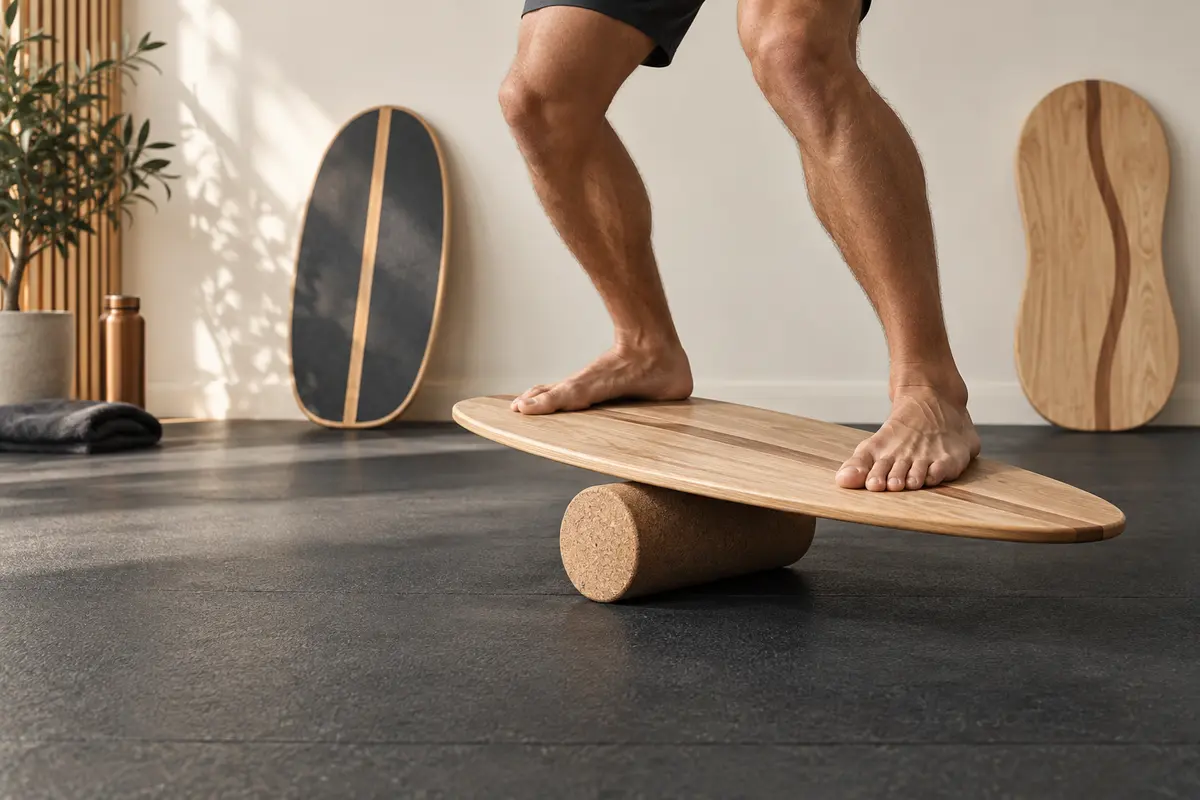
Wooden Balance Boards for First Steps, Fitness and Board-Sport Skills
Wood creates a firm, responsive platform, but the experience changes dramatically depending on what sits underneath it. We compared rocker, wobble, roller and multi-mode designs to help you choose the right challenge.
Searching for a balance board wood design can lead to products that look similar but behave very differently. A fixed rocker tips in one direction and is relatively predictable. A wobble base moves in every direction. A loose roller travels beneath the deck and demands quicker reactions. Choosing by appearance alone can leave a beginner with too much board—or an experienced rider with too little room to progress.
Our best overall wooden balance board is the INFIDEZ Balance Surf Trainer. Charlie Brown, Balance Foundry’s founder and a Certified Personal Trainer and Barefoot Coach, owns and uses this model. Its approachable progression is the deciding factor: it is easy to begin with controlled movement and continue increasing the challenge instead of immediately facing a completely free roller.
Best Overall: INFIDEZ Balance Surf Trainer
Charlie’s top choice for its useful progression, easy entry point and ability to remain challenging as balance improves.
Best Wooden Balance Boards at a Glance
| Product | Award | Movement style | Best suited to | Review basis | Amazon |
|---|---|---|---|---|---|
| INFIDEZ Balance Surf Trainer | Best overall | Deck and cork roller with progression features | Progressive training and board sports | Hands-on tested | View |
| StrongTek Wooden Balance Board | Best staged wobble board | Rocker and 360-degree wobble options | Beginner-to-intermediate balance work | Research-based | View |
| Yes4All Professional Rocker Board | Best simple rocker | Side-to-side rocking | Beginners and standing desks | Research-based | View |
| Sportneer 7-Mode Balance Board | Most versatile | Roller, ball and adjustable stops | Variety and skill progression | Research-based | View |
Product listings, models, included parts, colors, sellers and availability can change. Confirm the active Amazon listing before ordering.
How We Reviewed These Wooden Balance Boards
Testing transparency: Charlie personally owns and has used the INFIDEZ Balance Surf Trainer. He has not represented the other three boards as hands-on tested. Those selections were evaluated through manufacturer and retailer specifications, design features, intended use and how clearly each model fills a different buyer need. Read our complete Review Methodology.
We prioritized controllable progression, deck grip, usable standing area, movement style, construction, floor contact and the ability to match the product to an appropriate experience level. We did not rank boards solely by the number of accessories or a seller’s stated weight capacity.
A high-capacity listing does not independently prove durability, and a more unstable board is not automatically better. The best design is the one that provides enough challenge to improve control without making every session a fight to stay on the deck.
Wooden Balance Board Reviews
1. INFIDEZ Balance Surf Trainer
The INFIDEZ earns our top position because it makes roller-board training approachable without removing the potential for a serious challenge.
That progression matters. Loose-roller boards can feel intimidating because the deck may shift quickly when a new user puts weight on it. The INFIDEZ provides a more manageable path into the movement, which can make practice more productive and less frustrating. As control improves, the setup offers room to work toward a freer, more reactive ride.
The surf-style deck and cork roller suit users interested in surfing, snowboarding, skateboarding or simply more dynamic balance training. The textured surface helps the feet stay connected to the deck, although every roller board still carries a meaningful fall risk and should be introduced beside a stable support.
Pros
- Personally tested by Charlie
- Excellent path from easier to harder practice
- Responsive board-sport feel
- Cork roller and anti-slip standing surface
Cons
- More demanding than a fixed rocker
- Requires open floor space
- Not the first choice for casual standing-desk use
2. StrongTek Wooden Balance Board
The StrongTek stands out for offering a predictable rocker-style starting point and a more challenging multidirectional wobble option.
A rocker limits movement primarily to one plane, making reactions easier to anticipate. Moving to a rounded wobble base introduces motion in every direction and asks more of ankle strategy and whole-body control. Having both formats in one system gives users a logical next step without purchasing an entirely different trainer.
This is a better fit for controlled fitness drills, ankle work and progressive stability practice than for simulating a surfboard on a roller. Users should verify exactly which base pieces are included with the selected Amazon variation, because product packages can change.
Pros
- Two distinct difficulty styles
- Logical transition from rocker to wobble
- Wooden non-slip platform
- Useful for fitness and stability drills
Cons
- Does not reproduce a loose-roller feel
- Base changes add setup steps
- Included components should be confirmed before buying
3. Yes4All Professional Rocker Board
The Yes4All is the simplest option here: a broad wooden platform that rocks side to side without a separate roller or ball.
Limiting motion to one direction makes this board easier to understand than a wobble disc or loose roller. That makes it a practical introduction to shifting weight, maintaining a centered stance and adding gentle movement at a standing desk. The current listing describes a wooden 17.5-by-13.5-inch platform, anti-slip contact and a 350-pound maximum recommendation.
Simplicity is both its strength and limitation. It is easy to place and use, but there is no meaningful adjustment system and skilled users may outgrow the challenge. It is better for basic controlled rocking than tricks or board-sport simulation.
Pros
- Predictable side-to-side movement
- No loose parts to align
- Compact enough for desk use
- Approachable starting option
Cons
- Limited progression
- No front-to-back or free-roller mode
- May be too easy for advanced users
4. Sportneer 7-Mode Balance Board
Sportneer’s combination of a roller, ball and adjustable magnetic stoppers creates more configurations than any other board in this comparison.
The removable stoppers can restrict travel for a more controlled challenge, while the different supports change how the platform moves. Roller modes emphasize lateral control; the ball introduces multidirectional instability. That variety can keep one board useful across different drills and experience levels.
Versatility also means more pieces to store and more setup decisions. A user who only wants gentle standing-desk movement may find it unnecessarily complex. The manufacturer lists birch construction and a 450-pound capacity, but those remain manufacturer claims rather than Balance Foundry test results.
Pros
- Seven listed training configurations
- Roller, ball and magnetic stoppers included
- Wide range of movement challenges
- Substantial wooden deck
Cons
- More parts to manage
- Requires time to learn each setup
- May be excessive for casual beginners
Four Types of Wooden Balance Boards
Rocker Boards
A curved or angled base produces controlled movement, usually in one direction. Rockers are the most predictable choice for beginners, standing desks and basic weight-shifting drills.
Wobble Boards
A rounded center point lets the platform tilt in every direction. Wobble boards demand multidirectional ankle and hip reactions but do not slide across the floor like rollers.
Roller Boards
A separate cylinder moves beneath the deck. This creates larger, faster displacement and a board-sport feel. Adjustable stops can make the learning curve more manageable.
How to Choose a Wooden Balance Board
Choose the Movement Before the Material
The wood deck affects firmness and feel, but the base determines difficulty. Choose a rocker for predictable motion, a wobble board for all-direction stability work or a roller for dynamic board-sport practice.
Look for a Real Progression Path
Beginners benefit from stops, limited travel or interchangeable bases. A board that can be made easier allows you to practice quality movement first. A board that can later be made harder offers better long-term value.
Match the Deck to Your Stance
Check usable width and length, not just the overall product dimensions. Longer decks provide more stance options for roller training, while a compact rocker may fit more naturally under a standing desk.
Consider Surface Grip and Barefoot Comfort
Aggressive grip tape works well with shoes but may be uncomfortable barefoot. Softer traction surfaces can suit barefoot practice, provided they still prevent the feet from sliding. Keep the deck clean and dry.
Protect the Floor and Create Clear Space
Rollers and hard wooden bases can mark sensitive flooring. Use a compatible exercise mat when recommended, but avoid thick or soft surfaces that make the setup behave unpredictably. Allow enough clear space for the board and your body if you step off.
Treat Capacity Figures as One Data Point
Check that the listed maximum accounts for your body weight and anything you plan to hold. Capacity is not a guarantee of balance, grip or durability, and retailer specifications should be reconfirmed on the current product page.
How to Start Using a Wooden Balance Board
- Clear the area. Use a level, dry surface away from furniture, sharp edges, children and pets.
- Add stable support. Begin beside a wall, heavy countertop or sturdy rail that will not move if you grab it.
- Use the easiest configuration. Install travel stops, choose the rocker base or select the least unstable setup available.
- Step on deliberately. Place one foot near the outer portion of the deck, shift weight slowly and then add the second foot while holding support.
- Practice small movements. Aim for controlled weight shifts and brief centered holds rather than large tilts or immediate tricks.
- Progress one variable at a time. Increase rolling distance, reduce hand support or add movement—but do not change everything in the same session.
- Step off before adjusting. Never move stops, change bases or reposition the roller while standing on the board.
Frequently Asked Questions
Are wooden balance boards better than plastic boards?
Neither material is universally better. Wood often feels firmer and is common in larger rocker and roller designs. Plastic can be lighter, less expensive and easier to clean. Base design, grip, dimensions and progression matter more than material alone.
Which type of wooden balance board is best for beginners?
A fixed rocker is generally the most predictable starting point. Beginners interested in roller boards should choose a model with stops or another way to limit travel and should initially practice beside stable support.
Can I use a wooden balance board barefoot?
Yes, if the surface is clean, comfortable and provides adequate traction. Avoid barefoot use on abrasive grip tape or damaged wood. Charlie’s barefoot-coaching perspective is to prioritize controlled foot contact, not simply remove shoes regardless of the surface.
Do balance boards help strengthen ankles?
They can challenge the muscles that control the foot and ankle and train balance reactions. They are not a substitute for rehabilitation, and more instability is not automatically better. Use an appropriate difficulty and stop if the ankle repeatedly collapses or becomes painful.
Can a balance board be used at a standing desk?
Yes, but a low, predictable rocker is usually more practical than a loose roller. Desk use should involve occasional controlled movement, and the desk itself should not be treated as a handrail unless it is stable enough for that purpose.
Is a roller balance board good for surf or snowboard training?
It can help develop dynamic balance, stance awareness and rapid weight-shift reactions that are relevant to board sports. It cannot reproduce water, snow, speed or sport-specific technique, so treat it as supplemental training.
How long should a beginner use a balance board?
Start with short sessions of a few controlled minutes. Quality matters more than duration. Stop when fatigue causes repeated deck contact, uncontrolled stepping or loss of posture, and build time gradually.
Our Final Recommendation
The INFIDEZ Balance Surf Trainer is our best overall wooden balance board because Charlie has personally used it and found its progression unusually approachable. Choose the Yes4All for simple, predictable rocking, the StrongTek for a rocker-to-wobble progression or the Sportneer when maximum configuration variety matters most.
Continue exploring our Balance Boards Hub, visit the Slant Boards Hub, or learn how Balance Foundry evaluates equipment.
Leave a Reply