
Wobble Board or Balance Board? Start With the Movement
A wobble board is a type of balance board—not its opposite. The useful comparison is between the wobble board’s multidirectional tilt and the more predictable motion of rocker or roller-based designs.
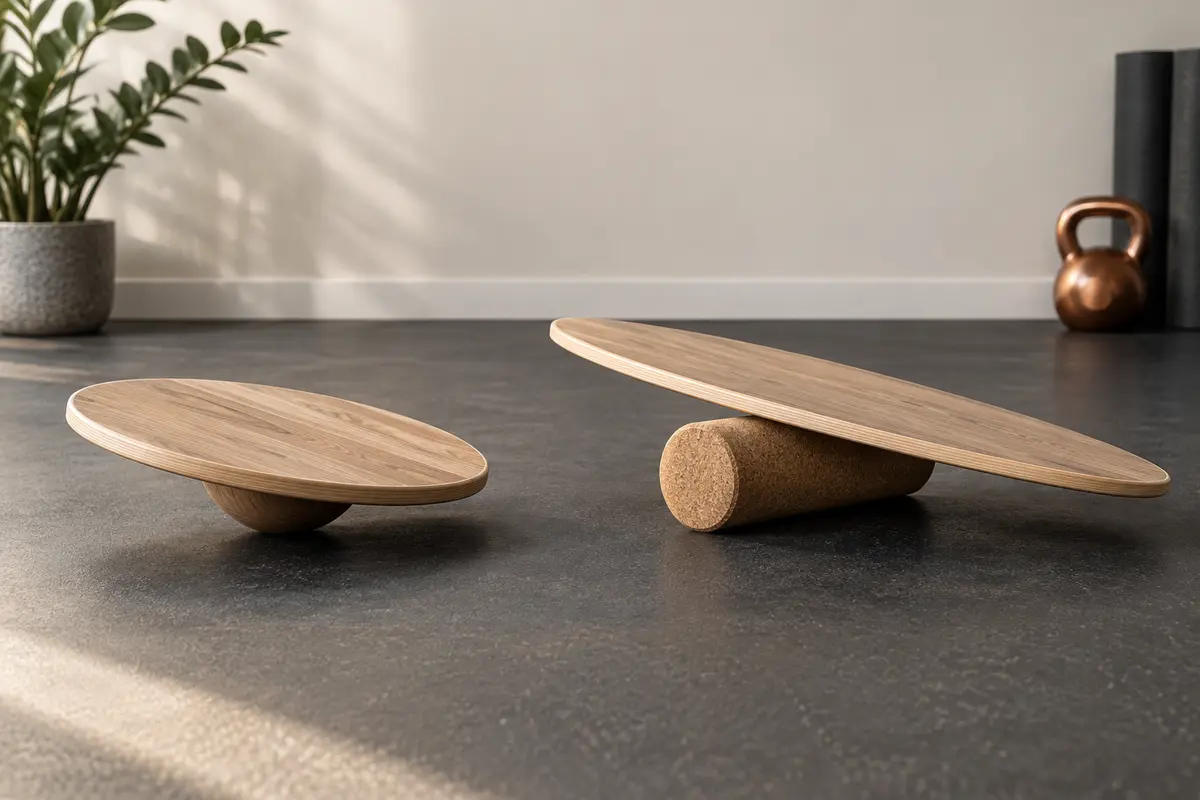
The terms wobble board and balance board are often used as if they describe two separate products. Technically, a balance board is the broad equipment category. Wobble boards, rocker boards and roller boards all belong inside it. What separates them is the shape beneath the platform and the directions in which the deck can move.
If you entered a phrase such as “balance board wobble” while trying to find the right equipment, the decision becomes much easier once you identify your intended movement. A rounded wobble base is usually best for compact multidirectional stability drills. A fixed rocker offers a gentler introduction. A deck moving over a separate roller creates a larger, more dynamic challenge suited to reactive balance and board-sport practice.
Which Type Is Best?
Choose a wobble board for multidirectional ankle control, compact fitness drills and clinician-directed rehabilitation exercises. Choose a rocker board for the easiest, most predictable starting point or light movement at a standing desk. Choose a roller balance board for dynamic whole-body training, quicker reactions and board-sport crossover.
There is no universal winner. The best board is the one whose movement matches your goal and current ability.
Wobble Board vs. Other Balance Boards at a Glance
| Feature | Wobble board | Rocker board | Roller board |
|---|---|---|---|
| Base | Rounded or hemispherical point attached beneath deck | Fixed curved rail or side-to-side base | Separate cylinder beneath deck |
| Movement | Tilts in every direction; may rotate | Primarily one plane | Deck travels over roller; larger displacement |
| Typical difficulty | Beginner to advanced, depending on base height | Most approachable | Most dynamic and fall-sensitive |
| Best for | Ankle control, multidirectional stability, compact drills | First-time users, predictable rocking, standing desks | Reactive balance, board sports, full-body coordination |
| Space needed | Low | Low | Moderate; clear fall area required |
| Progression | Stance, hand support, single-leg drills or base height | Stance and reduced support; often limited mechanically | Travel stops, stance, roller direction and advanced skills |
| Best first choice? | For general fitness users comfortable with instability | Yes, for cautious beginners | Only with stops and stable support |
What Is a Wobble Board?
A wobble board has a rigid platform positioned over a rounded central base. Because the contact point is small and curved, the platform can tip forward, backward and side to side—and combine those directions. Some models also allow the deck to rotate.
That multidirectional freedom is the defining characteristic. Your feet, ankles, knees, hips and trunk make continuous adjustments to keep the platform controlled. A large, low base produces a milder challenge; a taller or narrower contact point generally creates more tilt and demands faster corrections.
Wobble boards are commonly used in balance training and rehabilitation settings. Research involving people with chronic ankle instability has found improvements in measures of static and dynamic balance after structured wobble-board programs. Those findings do not mean every retail board or unsupervised routine will treat an injury, and results cannot automatically be generalized to every user.
What Is a Balance Board?
“Balance board” is an umbrella term for a standing platform made intentionally unstable by a rocker, wobble base, roller, sphere, cushion or other support. In ordinary shopping language, however, people sometimes use “balance board” to mean a roller board—the long deck-and-cylinder style associated with surfing, skating and snowboarding.
That loose usage causes most of the confusion. A wobble board is always a balance board, but not every balance board is a wobble board. Before comparing products, look underneath the deck. The support mechanism tells you more than the product name.
Wobble
Central rounded base with multidirectional tilt. Compact and responsive around the ankle.
Rocker
Fixed curved base with one primary motion plane. Predictable and easier to control.
Roller
Separate moving cylinder under a longer deck. Dynamic, reactive and typically more advanced.
Wobble Board vs. Balance Board: The Key Differences
1. Direction of Movement
A wobble board tilts in multiple directions around a central point. A rocker usually moves in one plane. A roller board can travel farther laterally and may also pitch or rotate depending on the deck, roller and stops. Multidirectional does not automatically mean “better”; it simply changes the control problem.
2. Where You Feel the Challenge
On a wobble board, the platform stays in roughly the same location while its edges rise and fall. This often makes small ankle corrections prominent. On a roller board, the deck itself moves across the roller, so the user must manage a larger shift of the body and board together. Rocker boards sit between stable ground and the other designs, allowing controlled weight transfer without free travel.
3. Learning Curve
A shallow rocker is usually easiest because the direction and end range are predictable. A wobble board adds more directions but normally remains centered over its attached base. A free roller introduces the possibility that the deck will travel quickly or contact the floor, which raises the consequence of a poor correction.
4. Exercise Variety
Wobble boards suit two-foot stands, supported single-leg work, controlled squats, weight shifts and some upper-body exercises. Rockers work well for basic standing, calf raises and front-to-back or side-to-side control. Roller boards excel at stance practice, reactive holds, board-sport positions and more advanced movement combinations.
5. Portability and Storage
Round wobble boards and compact rockers are generally easiest to store. A roller system needs a longer deck plus a separate cylinder, and multi-mode systems may include several supports and stops. Measure the storage area as well as the training area before buying.
6. Rehabilitation Use
Wobble boards appear frequently in ankle-stability research, but equipment choice and exercise dosage should match the individual. A person recovering from an ankle sprain, surgery, neurological condition or repeated falls should not choose the most unstable option based on a product comparison alone. Follow the plan provided by a qualified clinician.
Which Board Is Best for Your Goal?
Choose a Wobble Board If You Want:
- Multidirectional tilt in a compact footprint
- Progressive two-leg and supported single-leg drills
- More emphasis on controlling the deck around a central point
- A tool that may fit a clinician-designed ankle program
- Fitness variety without a loose roller
Choose Another Balance Board If You Want:
- A gentler rocker for first-time practice
- Low-level movement while working at a standing desk
- A surf, skate or snowboard-inspired stance
- Large lateral deck travel and faster reactions
- Adjustable roller stops and trick progression
| Your goal | Best starting type | Why |
|---|---|---|
| First balance board | Rocker | Single-plane movement is easiest to predict and control. |
| General ankle and stability drills | Wobble | Multidirectional tilt creates varied correction demands in little space. |
| Standing desk movement | Low rocker | Predictable motion is less distracting than a roller or tall wobble base. |
| Surf, skate or snowboard crossover | Roller | The moving deck creates a more dynamic board-style challenge. |
| One device with several challenges | Multi-mode system | Interchangeable roller, ball or stops provide different movement patterns. |
| Injury rehabilitation | Clinician selected | The diagnosis, healing stage and individual capacity should determine the device. |
Examples of Each Balance Board Type
These examples show how the categories differ. Charlie has personally tested the INFIDEZ. The StrongTek and Yes4All are research-based examples; Balance Foundry has not represented them as hands-on tested.
StrongTek Wooden Balance Board
Available in rocker and advanced 360-degree configurations, making it useful for comparing one-plane movement with multidirectional wobble training. Confirm the selected Amazon variation before purchasing.
Yes4All Professional Rocker Board
A fixed wooden rocker with predictable side-to-side movement. It is the most approachable example here for beginners or light standing-desk use.
INFIDEZ Balance Surf Trainer
Charlie’s personal board. He likes its ease of use and progression, which allow a more controlled starting point before working toward a freer roller challenge.
For more wooden options and a detailed product comparison, see our guide to the best wooden balance boards.
How to Start Safely on Any Balance Board
- Clear the area. Train on a level, dry surface away from furniture, sharp edges, children and pets.
- Use stable support. Begin beside a secure countertop, rail or heavy piece of furniture that will not move when touched.
- Select the easiest setup. Choose a rocker, low wobble base or narrow roller travel before trying unrestricted movement.
- Start with two feet. Learn to mount, center the deck and step off under control before progressing to one-leg work.
- Keep movements small. Early practice should emphasize quiet control rather than forcing the deck to its maximum edge.
- Progress one variable. Reduce hand support, narrow the stance, increase travel or add movement one change at a time.
- Stop when control fades. Repeated edge strikes, frantic stepping or collapsing posture signal that the set is finished.
Frequently Asked Questions
Is a wobble board the same as a balance board?
A wobble board is one type of balance board. “Balance board” is the broader category, which also includes rocker boards, roller boards and multi-mode designs.
Is a wobble board harder than a balance board?
That comparison depends on the other board. A wobble board is generally harder than a shallow rocker but often less dynamic than an unrestricted roller board. Base height, deck size, stops and stance can change the difficulty substantially.
Which is better for beginners?
A fixed rocker is usually the easiest starting point because it moves in one predictable direction. A low wobble board can also work for beginners who have stable support nearby. A roller board should have travel stops or another beginner configuration.
Which board is better for ankle strengthening?
Wobble boards are commonly used for multidirectional ankle and balance drills, but “better” depends on the person and goal. For pain, recurrent sprains or rehabilitation, use the device and exercise plan recommended by a qualified clinician.
Do wobble boards improve proprioception?
Structured unstable-surface training can challenge sensory-motor control, and studies in some populations report improvements in balance or proprioception-related measures. Results depend on the training program and cannot guarantee the same outcome for every user.
Is a wobble board good for a standing desk?
It can be, but a low rocker is generally less distracting and easier to step off. A multidirectional wobble board demands more attention and may not suit prolonged use while concentrating on work.
Can a balance board replace strength training?
No. Balance-board practice can supplement a program, but it does not replace progressive strength work on stable surfaces. Unstable surfaces may reduce how much force or load you can safely produce during an exercise.
Should I use a balance board barefoot?
Barefoot practice can provide direct contact with the platform when the surface is comfortable, clean and sufficiently grippy. Shoes may be preferable on abrasive surfaces or when additional protection is needed. Control and safety matter more than a universal footwear rule.
Research and Review Standards
This comparison combines Charlie Brown’s perspective as a Certified Personal Trainer and Barefoot Coach with published research. Product examples are separated into hands-on and research-based selections under our Review Methodology.
The Bottom Line
A wobble board is the better choice when you want compact, multidirectional instability. A rocker is better when predictability and ease of use come first. A roller board is best when you want a dynamic challenge with stronger board-sport crossover.
Start with the lowest level that lets you move deliberately. The goal is not to make the platform as unstable as possible—it is to improve your ability to control the movement.
Continue with the Balance Boards Hub, compare the best wooden balance boards, or explore our growing Mobility Hub.
Leave a Reply