
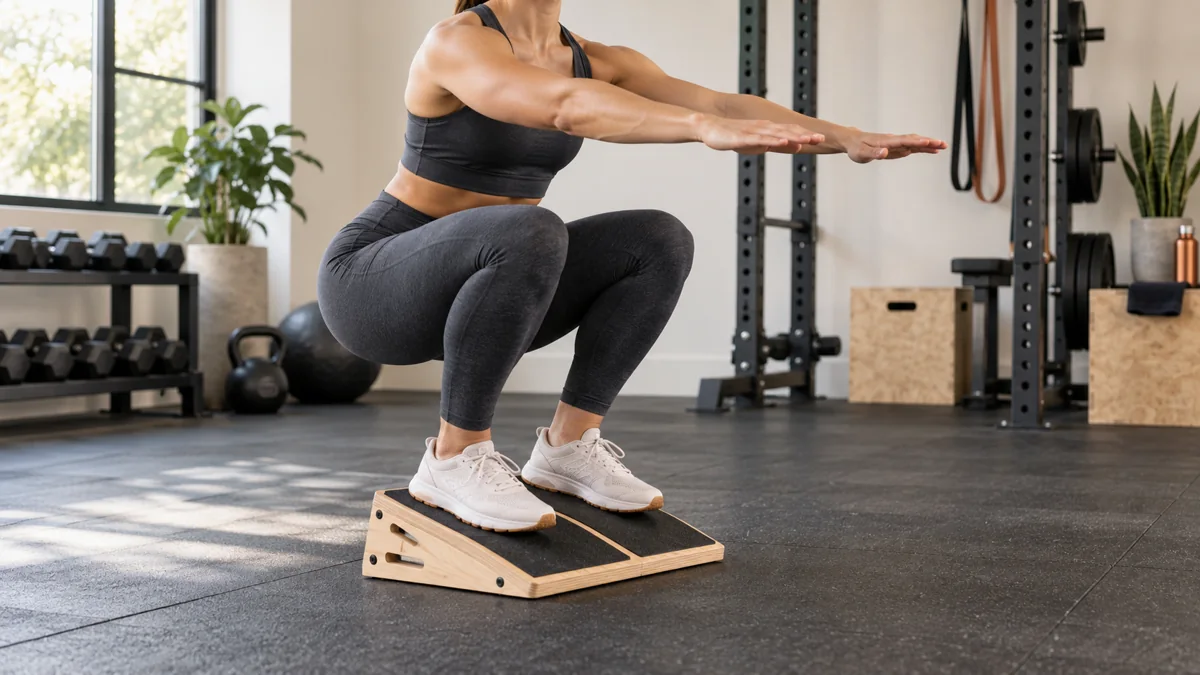
Start With Control, Then Add Challenge
These beginner balance board exercises build from supported standing and small weight shifts to squats, reaches and single-leg control. The goal is quiet, repeatable movement—not maximum wobble.
A balance board turns a stable standing surface into a moving problem your feet, ankles, hips and trunk must solve together. For beginners, the best results come from choosing an appropriate board, placing stable support within reach and mastering small movements before adding speed or complexity.
This guide includes exercises for rocker, wobble and roller boards, but they are not interchangeable. A fixed rocker has predictable one-plane movement. A central wobble base tilts in every direction. A roller board lets the entire deck travel over a separate cylinder and usually requires the most caution. Read our wobble board vs. balance board comparison if you are unsure which type you own.
Before You Step on the Board
- Place the board on a clean, dry, level surface recommended by its manufacturer.
- Clear enough space to step forward, backward or sideways without hitting furniture.
- Use a wall, fixed rail or heavy countertop for support. A rolling chair is not stable support.
- Wear secure shoes or train barefoot only if the surface is comfortable, clean and sufficiently grippy.
- Use the easiest available configuration: low rocker, shallow wobble base or restricted roller travel.
- Practice stepping off intentionally before trying to balance without hand support.
Modify the Exercises for Your Board Type
Rocker Board
Best for learning. Orient the movement front-to-back or side-to-side. Exercises involving edge taps and calf raises are easiest to understand on this design.
Wobble Board
Allows multidirectional tilt. Keep movements smaller, use a wider stance and maintain fingertip support longer before progressing to reaches or single-leg work.
Roller Board
Use travel stops and stable support. Focus first on mounting, centered holds and tiny lateral shifts. Do not attempt calf raises, marching or single-leg exercises on a free roller as a beginner.
12 Balance Board Exercises for Beginners
Supported Mount and Dismount
- Stand beside secure support and place one foot on the lower or more stable side of the deck.
- Transfer weight gradually while holding the support.
- Place the second foot at a comfortable width and bring the board toward center.
- Pause, then reverse the process and step off under control.
Two-Foot Center Hold
- Stand with feet about hip- to shoulder-width apart.
- Keep knees softly bent and ribs stacked over the pelvis.
- Use both hands at first, then reduce to fingertips if the board remains controlled.
- Aim to keep the deck close to level without holding your breath.
Controlled Edge Taps
- Begin centered with both hands or fingertips on support.
- Slowly lower one edge until it lightly touches the floor.
- Return through center without overshooting.
- Repeat toward the opposite edge.
Side-to-Side Weight Shifts
- Shift pressure gradually toward the right foot while keeping both feet planted.
- Return to center and shift toward the left.
- Keep the hips over the board rather than leaning the shoulders dramatically.
- Move only through a range you can reverse smoothly.
Forward-and-Back Weight Shifts
- Shift pressure toward the balls of the feet without lifting the heels.
- Return through center.
- Shift pressure toward the heels without lifting the toes or sitting far backward.
- Keep the movement slow and the knees aligned with the toes.
Wobble-Board Clock
- Imagine the board’s front edge is 12 o’clock.
- Guide the edge toward 12, then 3, 6 and 9 o’clock in sequence.
- Connect the positions into one slow circle.
- Reverse direction while keeping the feet fully planted.
Supported Mini Squat
- Begin centered with fingertips on support.
- Send the hips slightly back and bend the knees a few inches.
- Keep pressure distributed across heel, base of the big toe and base of the little toe.
- Stand tall without locking the knees.
Alternating Forward Reach
- Hold center with a soft bend in the knees.
- Release one hand from support and reach it forward a short distance.
- Return the hand, recenter and repeat with the other arm.
- Increase reach only when the board stays quiet.
Supported Calf Raise
- Orient the rocker so it permits controlled front-to-back movement.
- Hold support with both hands.
- Lift the heels slightly while keeping pressure through the big- and little-toe bases.
- Lower slowly and stop if the board shifts unpredictably.
Supported Weight-Unloading March
- Hold secure support with both hands.
- Shift weight toward one foot.
- Make the opposite foot light or lift it only a fraction of an inch.
- Replace it, recenter and switch sides.
Supported Single-Leg Hold
- Hold support firmly and shift weight over one foot.
- Lift the other foot just clear of the board.
- Keep the stance knee soft and pelvis level.
- Replace the foot before control fades, then switch sides.
Stopped Roller Glide
- Install the shortest or easiest travel-stop setting and stand beside secure support.
- Mount the board and find center.
- Shift just enough for the deck to glide a short distance over the roller.
- Reverse before contacting the stop hard and return through center.
A 10-Minute Beginner Balance Board Routine
| Exercise | Work | Rest/transition | Board notes |
|---|---|---|---|
| Supported mount and dismount | 5 repetitions | 30 seconds | All types |
| Two-foot center hold | 3 × 20 seconds | 20 seconds | All types; use stops on rollers |
| Side-to-side weight shifts | 2 × 30 seconds | 20 seconds | All types; small roller range |
| Forward-and-back shifts | 8 repetitions | 20 seconds | Rocker or wobble |
| Mini squats | 2 × 6 repetitions | 30 seconds | Rocker or low wobble |
| Forward reaches | 5 per arm | 30 seconds | Keep one hand near support |
| Controlled dismount | 3 repetitions | Finish | All types |
Practice two or three nonconsecutive days per week at first. End sooner if fatigue turns smooth corrections into frantic stepping. Published guidance commonly recommends regular balance practice, but individual needs and rehabilitation schedules vary.
Beginner-Friendly Equipment Examples
You do not need the most advanced board to benefit. A predictable rocker is often the better learning tool; a roller board should offer a way to restrict travel.
Yes4All Professional Rocker Board
A research-based equipment example with predictable side-to-side movement and no loose roller. Balance Foundry has not represented this product as hands-on tested.
INFIDEZ Balance Surf Trainer
Charlie’s personal board. Its progression and approachable setup make it a better entry into roller training than beginning with unrestricted travel.
Compare more options in our guide to the best wooden balance boards.
How to Progress Without Simply Making the Board Wilder
Change only one variable at a time. A useful progression may look like this:
- Both hands on support.
- Fingertip support.
- Short hands-free holds.
- Longer holds with the same board setting.
- Small arm reaches.
- Narrower stance.
- More movement range or a harder mechanical setting.
- Supported single-leg work on an appropriate rocker or wobble board.
Closing the eyes removes visual information and can increase difficulty sharply. It is not an early beginner progression and should never be attempted on a free roller board.
Common Beginner Mistakes
Starting Too Advanced
Buying the most unstable setup can shorten useful practice time. Start where you can produce repeated, controlled movement.
Gripping With the Toes
Curling the toes aggressively may create tension without improving control. Keep broad contact through the heel and forefoot.
Chasing a Perfectly Still Board
Some motion is expected. The goal is to manage it smoothly, not freeze every movement through stiffness and breath-holding.
Using Unstable Support
A chair that rolls or tips can turn a small balance loss into a fall. Choose support before stepping onto the board.
Progressing Through Fatigue
Stop when edge strikes, knee collapse or frantic steps increase. More time is not useful when movement quality is gone.
Treating Pain as Training
Muscular effort is different from sharp joint pain, swelling or giving way. Those signs call for stopping and appropriate evaluation.
Frequently Asked Questions
How long should a beginner use a balance board?
Start with 5–10 minutes, including rests and transitions. A shorter session with controlled repetitions is more useful than continuing until every movement becomes sloppy.
How often should beginners do balance exercises?
Two or three days per week is a practical general starting point for healthy adults. Individual rehabilitation or fall-prevention programs may use a different schedule prescribed by a qualified professional.
Which balance board is easiest for beginners?
A low fixed rocker is usually easiest because it moves in one predictable plane. Wobble boards add multiple directions, while loose roller boards are generally the most dynamic.
Should a beginner use a balance board barefoot?
Barefoot use can provide direct contact if the surface is clean, comfortable and grippy. Secure athletic shoes are also appropriate. Avoid socks alone on a slick surface.
Can beginners do squats on a balance board?
Supported mini squats can be appropriate on a low rocker or wobble board after the user can hold center reliably. Beginners should not load heavy squats or attempt them on an unrestricted roller.
Are balance board exercises good for ankles?
They can challenge ankle control and postural balance. They do not replace direct strength exercises or individualized care for pain, injury or recurrent instability.
Can older adults use a balance board?
Some can, but fall risk, health conditions and current ability must be considered. Older adults with balance impairment or a fall history should get individualized guidance and use secure support rather than starting independently.
When should I move to a harder board?
Progress when you can mount, hold center, perform the planned movement and dismount without repeated edge strikes, breath-holding or heavy reliance on support across several sessions.
Research and Coaching Perspective
This guide combines Charlie Brown’s experience as a Certified Personal Trainer and Barefoot Coach with published research on balance and unstable-surface training. The exercise selection is general fitness guidance rather than treatment.
Start With the First Five Exercises
Most beginners do not need all 12 movements on day one. Begin with mounting, the center hold, controlled edge taps and the two basic weight shifts. Add mini squats and reaches only after the board feels predictable.
Explore the Balance Boards Hub, compare wobble and balance board types, or see our guide to the best balance boards for ankle strength.
Leave a Reply