
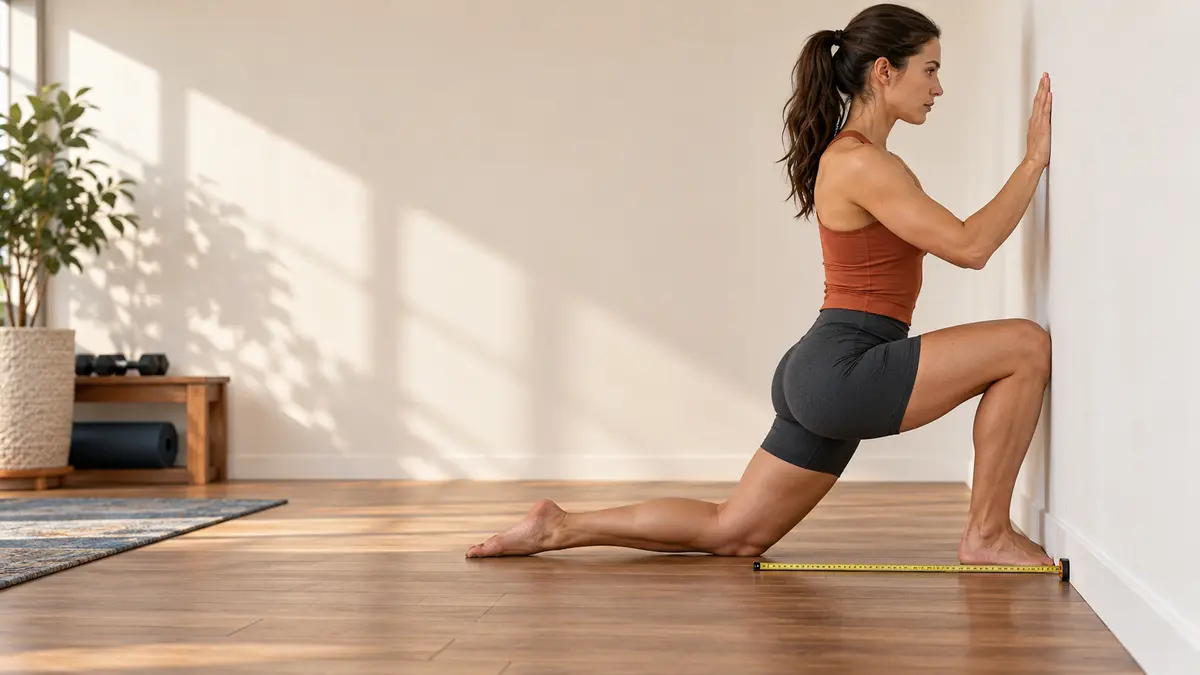
The knee-to-wall test gives you a practical way to measure weight-bearing ankle dorsiflexion. The difficult part is interpreting the result. A number that is typical for one age group, sport or testing method may not mean the same thing in another context.
What ankle dorsiflexion measures
Dorsiflexion is the motion that brings the top of the foot toward the shin. In a weight-bearing position, the shin travels forward over a foot that stays planted. You use this motion during walking, descending stairs, squatting and many athletic positions.
The knee-to-wall ankle mobility test measures this motion under load. Researchers commonly report either toe-to-wall distance in centimeters or forward tibial inclination in degrees. These are related, but they should not be treated as identical measurements.
What counts as a normal range?
Large normative studies show that weight-bearing lunge results vary with age and sex. Smaller studies also differ because researchers use different foot positions, measuring tools and endpoints. That means a useful reference range must name the method and population behind it.
| Result | What it may tell you | What it cannot tell you alone |
|---|---|---|
| Comfortable forward knee travel with heel down | The ankle tolerates loaded dorsiflexion in that test position. | Whether every squat, running or pain problem comes from the ankle. |
| A consistent side-to-side difference | One ankle may move differently and deserves closer attention. | Which tissue or joint structure creates the difference. |
| A score that changes over several weeks | Your measured range has changed under consistent conditions. | Whether the change automatically improves performance. |
How age and activity change the interpretation
Mobility can change across the lifespan, but age is only one part of the picture. Training history, prior injury, current symptoms, footwear habits and the demands of your activities all affect how much dorsiflexion is useful.
General exercise
Look for comfortable motion, a stable heel and enough range for your chosen squat, step or lunge.
Running and hiking
Consider repeated downhill steps, uneven terrain and how the ankle behaves when fatigue builds.
Strength training
Stance width, heel elevation and squat style change the amount of ankle travel required.
After injury
Use professional guidance when swelling, instability or pain affects the test.

How to measure your score consistently
- Choose distance or angle. Do not alternate between methods when tracking progress.
- Place the foot straight. Keep the heel, second toe and knee generally aligned.
- Move the knee forward. Touch the wall without letting the heel lift or the arch collapse excessively.
- Find the farthest controlled position. Avoid bouncing or forcing the endpoint.
- Record both sides. Note the date, warm-up and any pain or stiffness.
If your goal is to change the result, use a focused group of ankle dorsiflexion exercises. A slant board for ankle mobility can also help you organize calf stretching, while foot and toe mobility exercises address the base supporting the ankle.
How much change is meaningful?
Measurement error matters. One study of active adults reported a minimal detectable change of about 1.7 degrees for a single-limb angle measurement. That does not create a universal rule for every device, but it illustrates why tiny day-to-day changes should not be overinterpreted.
Retest every one or two weeks under similar conditions. A repeated improvement that also makes squatting, stepping or walking feel easier is more useful than chasing a fraction of a centimeter every day.
When to get help
Seek qualified medical or rehabilitation guidance for sudden loss of motion, significant swelling, inability to bear weight, persistent pain, repeated giving way or a major side-to-side difference following injury. Mobility testing can describe movement; it cannot diagnose the cause of a restriction.
Distance versus angle measurements
Toe-to-wall distance is convenient because it requires only a ruler or tape measure. Angle measurement uses an inclinometer or a validated phone method placed along the shin. Distance is influenced more directly by foot length and limb proportions, while angle more directly describes tibial inclination. Pick one method and keep it consistent.
Record enough detail that you can reproduce the test: which foot was measured, whether you warmed up, whether the knee tracked over the second or third toe, and whether the endpoint was limited by calf tension, a front-of-ankle pinch or balance. Those notes are often more useful than the number alone.
A practical four-week tracking approach
Test at baseline, practice your chosen mobility work two or three times per week and retest after two weeks and four weeks. Avoid testing aggressively every day. Daily fluctuations in temperature, recent training and stiffness can make small changes look more meaningful than they are.
- Week 0: Record two controlled trials per side.
- Weeks 1–2: Use calf mobility, ankle rocks and active control exercises.
- Week 2: Retest under the same conditions.
- Weeks 3–4: Continue or adjust the routine based on movement quality.
- Week 4: Compare the scores and the task you care about, such as squat depth or downhill comfort.
Why a “positive test” is not a diagnosis
The phrase “positive knee-to-wall test” is often used loosely online. Unlike a medical test designed to identify a particular condition, the weight-bearing lunge test primarily quantifies movement. A limited score may be relevant, but it does not tell you by itself whether the calf, ankle joint, pain response, technique or another factor is responsible.
Frequently asked questions
Is 10 centimeters a perfect knee-to-wall score?
No. Ten centimeters is a commonly discussed reference, not a universal standard. Body proportions, method, age and activity all affect interpretation.
Should both ankles have exactly the same score?
Not necessarily. Small differences are common. A persistent or growing difference becomes more relevant when it affects movement or follows an injury.
Does a low score mean my calf is tight?
Possibly, but not automatically. Joint mechanics, test technique, symptoms and foot position can also influence the result.
Research used
- International normative values for the weight-bearing lunge test
- Radiographic validity of the weight-bearing lunge test
- Reliability and detectable change for ankle dorsiflexion measurement
Health note: This article is for general education and is not a diagnosis or individualized medical advice. Stop if an exercise causes sharp pain, swelling, numbness or instability, and consult a qualified professional when appropriate.
Leave a Reply