
Balance Foundry Mobility Guide
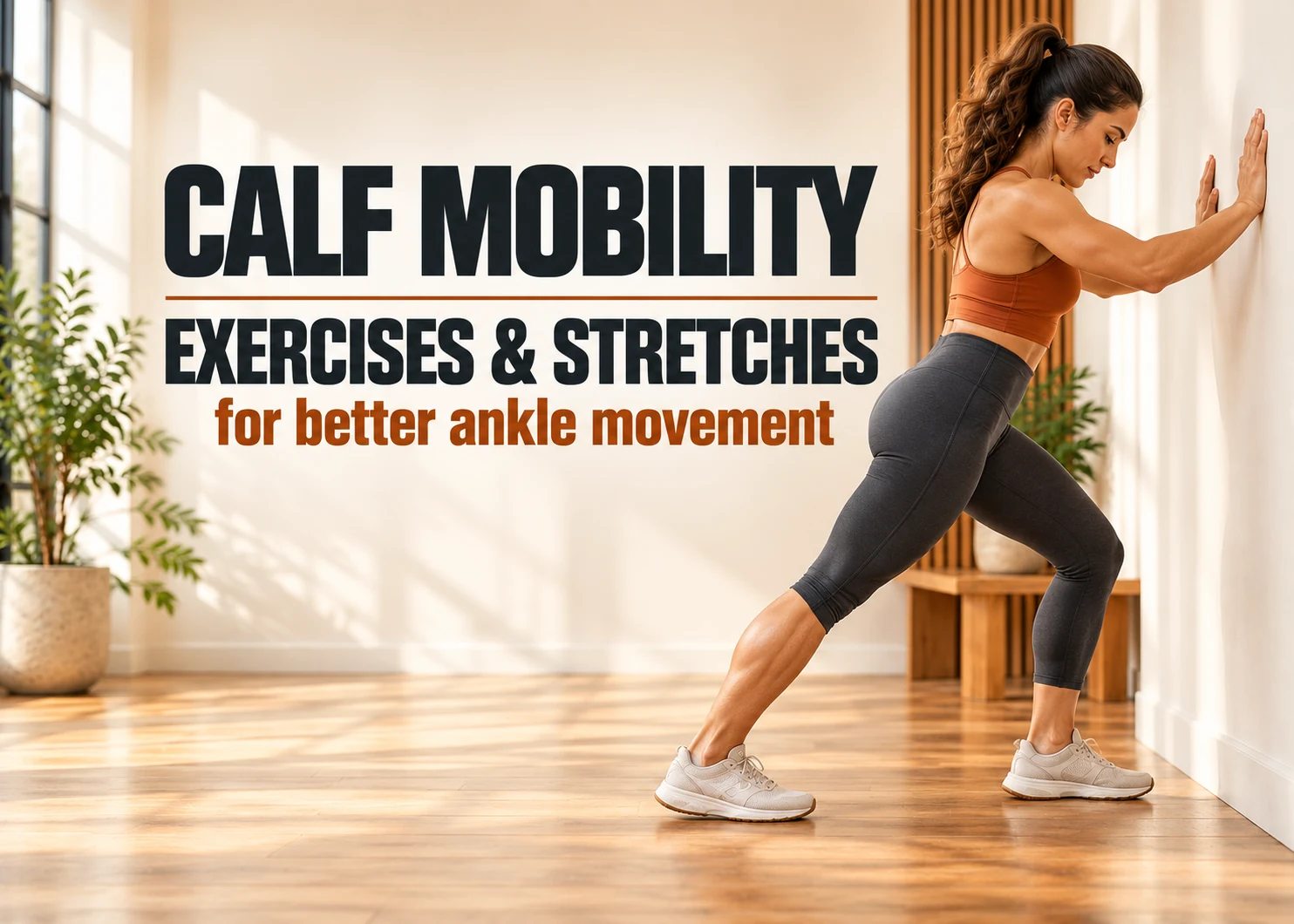
Calf mobility exercises can improve how comfortably your ankle moves forward over the foot by combining straight-knee calf work, bent-knee soleus work, controlled dorsiflexion drills, and lower-leg strength.
The calves play a major role in ankle movement, walking, squatting, running, hiking, and balance. When the back of the lower leg feels stiff, you may notice limited forward knee travel, early heel lift, or a tendency to compensate somewhere else.
Calf mobility is not just about stretching one muscle. The gastrocnemius crosses both the knee and ankle, while the soleus sits deeper and works differently when the knee is bent. That is why a complete routine should include both positions.
What Is Calf Mobility?
Calf mobility is the ability of the lower leg and ankle to move through a useful range while the muscles and joints remain controlled.
In practice, calf mobility is closely related to ankle dorsiflexion—the movement that brings the shin forward over the foot while the heel stays down.
Limited calf and ankle movement may show up during:
- squats,
- stairs,
- walking uphill,
- running,
- lunges,
- hiking,
- balance exercises.
If you are unsure whether your ankle range is actually limited, use the knee-to-wall ankle mobility test before assuming the calves are the problem.
Gastrocnemius vs. Soleus: Why Knee Position Matters
Straight-Knee Calf Work
The gastrocnemius crosses both the knee and ankle. Keeping the knee straight generally places more stretch through the larger superficial calf muscle.
Bent-Knee Calf Work
Bending the knee reduces some gastrocnemius tension and shifts more emphasis toward the deeper soleus muscle.
Because both muscles contribute to ankle function, using only one knee position leaves part of the picture out.
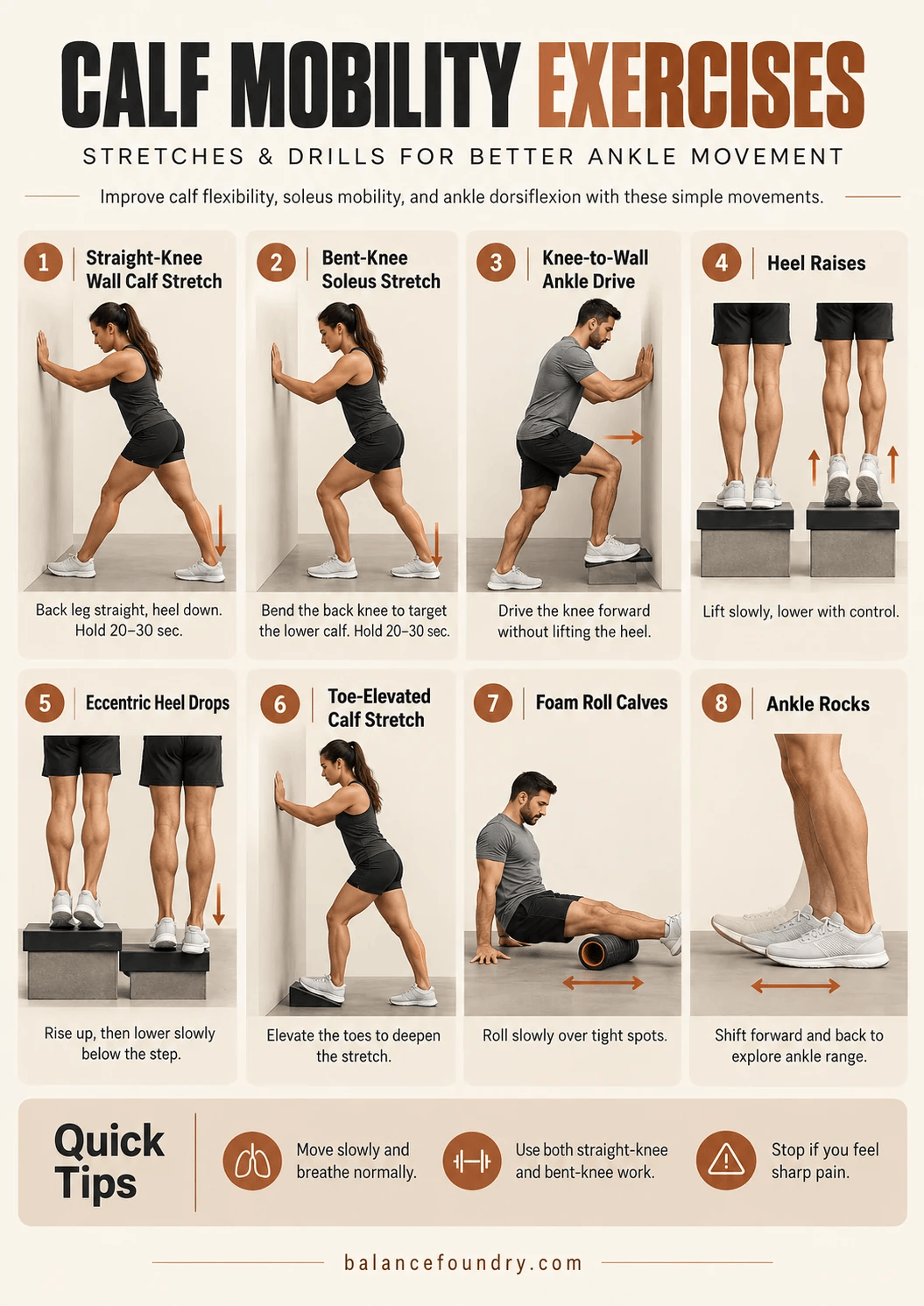
8 Calf Mobility Exercises and Stretches
Straight-Knee Wall Calf Stretch
This classic stretch places more emphasis on the gastrocnemius.
- Stand facing a wall and place both hands on it for support.
- Step one foot back.
- Keep the back knee straight and heel down.
- Lean forward until you feel a stretch through the upper calf.
- Hold 20 to 30 seconds.
Keep the back foot pointing mostly forward instead of letting it turn sharply outward.
Bent-Knee Soleus Stretch
Bending the knee shifts more emphasis toward the deeper soleus.
- Stand facing a wall.
- Step one foot back slightly.
- Keep the heel down.
- Bend the back knee while gently moving forward.
- Hold 20 to 30 seconds.
The stretch will often feel lower in the calf than the straight-knee version.
Knee-to-Wall Ankle Drive
This drill turns calf mobility into a controlled ankle-dorsiflexion movement.
- Stand with one foot a short distance from a wall.
- Keep the entire foot flat.
- Drive the knee forward toward the wall.
- Keep the heel down.
- Return and repeat 8 to 12 times.
Increase the distance only when you can keep the heel grounded and the motion smooth.
Controlled Heel Raises
Mobility works best when you can control the range you have. Heel raises strengthen the calf through plantarflexion and complement dorsiflexion work.
- Stand near a sturdy support.
- Rise onto the balls of your feet.
- Pause briefly at the top.
- Lower slowly.
- Perform 10 to 15 repetitions.
Eccentric Heel Drops
Slow heel lowering combines calf strength with controlled lengthening.
- Stand on a step with the heel free to move.
- Rise onto the toes using both legs.
- Shift more weight to one side if appropriate.
- Lower the heel slowly below the step.
- Return to the top with control.
Use a railing or wall for support. Avoid dropping quickly into the bottom position.
Toe-Elevated Calf Stretch
Raising the front of the foot can increase the ankle angle while allowing you to control the position.
- Place the forefoot on a small wedge, plate, or slant board.
- Keep the heel on the floor.
- Keep the knee straight for more gastrocnemius emphasis.
- Bend the knee slightly for more soleus emphasis.
- Hold 20 to 30 seconds.
For equipment options, see our best slant boards for calf stretching.
Foam Roll the Calves
Foam rolling can provide temporary pressure and help the calf feel less tight before mobility work.
- Sit with the calf resting on a foam roller.
- Support yourself with your hands.
- Roll slowly along the calf.
- Pause briefly over areas that feel tight.
- Spend 30 to 60 seconds per side.
Do not grind aggressively into painful spots or directly behind the knee.
Ankle Rocks
Ankle rocks are a simple way to explore dorsiflexion with repeated controlled motion.
- Stand in a staggered stance or half-kneeling position.
- Keep the front heel down.
- Shift forward over the foot.
- Return to the start.
- Repeat 8 to 15 times per side.
This is a useful warm-up before squats, lunges, walking, or hiking.
A Simple 8-Minute Calf Mobility Routine
| Exercise | Volume | Main Focus |
|---|---|---|
| Foam Roll Calf | 30 sec per side | General lower-leg preparation |
| Straight-Knee Calf Stretch | 30 sec per side | Gastrocnemius |
| Bent-Knee Soleus Stretch | 30 sec per side | Soleus |
| Knee-to-Wall Drives | 10 reps per side | Ankle dorsiflexion |
| Heel Raises | 12 reps | Calf strength and control |
This combination gives you both mobility and strength instead of relying entirely on passive stretching.
Can a Slant Board Help With Calf Mobility?
A slant board can make calf stretching easier to standardize by creating a consistent incline under the foot.
That can be useful for both straight-knee and bent-knee calf positions because you can adjust the knee while keeping the foot supported.
It does not automatically make the stretch more effective. The angle should still allow you to keep the foot controlled and avoid forcing the ankle into an uncomfortable range.
If you already own one, see our how to use a slant board for ankle mobility. If you are shopping, our best slant boards for calf stretching compares equipment specifically for this use.
Common Calf Mobility Mistakes
1. Only Stretching With a Straight Knee
Straight-knee calf stretches are useful, but they do not place the same emphasis on the soleus. Include bent-knee work too.
2. Letting the Heel Lift During Dorsiflexion
If the heel lifts during knee-to-wall work, you may be moving beyond the ankle range you can actually control.
3. Turning the Foot Outward
Rotating the foot outward can create the appearance of more range without actually improving forward ankle movement.
4. Bouncing Into the Stretch
Use smooth movement or steady holds rather than fast bouncing at the end of range.
5. Ignoring Strength
Better mobility is more useful when you can control it. Heel raises and slow eccentric work help the calf manage the range you are developing.
When Should You Do Calf Mobility Exercises?
- Before training: Use dynamic ankle rocks and knee-to-wall drives.
- After long periods of sitting: Add gentle calf and ankle movement.
- Before squats or lunges: Use dorsiflexion drills if ankle range feels restricted.
- After activity: Use light calf stretching if it feels comfortable.
- During mobility sessions: Combine calves with feet, ankles, hips, and upper-body work.
For a complete sequence, use our 10-minute full-body mobility routine.
How Often Should You Work on Calf Mobility?
Light mobility work can often be performed several times per week or daily if it remains comfortable.
You do not need long sessions. A few minutes of straight-knee work, bent-knee work, and controlled ankle movement can be enough to build consistency.
Frequently Asked Questions
What are the best calf mobility exercises?
A balanced routine can include straight-knee calf stretches, bent-knee soleus stretches, knee-to-wall ankle drives, heel raises, eccentric heel drops, ankle rocks, and optional foam rolling.
What’s the difference between a calf stretch and a soleus stretch?
A straight-knee calf stretch generally emphasizes the gastrocnemius more, while bending the knee shifts more emphasis toward the soleus.
Can tight calves limit ankle dorsiflexion?
Calf tension can contribute to limited dorsiflexion, but ankle range can also be affected by joint structure, previous injury, control, technique, and individual anatomy.
Do calf raises improve mobility?
Calf raises are primarily a strength exercise, but they can complement mobility work by helping you control the ankle through a larger range.
Is a slant board good for calf stretching?
A slant board can provide a consistent incline for calf stretching and makes it easy to use both straight-knee and bent-knee positions. The angle should still remain comfortable and controlled.
How long should I hold a calf stretch?
A practical starting point is about 20 to 30 seconds for a comfortable static stretch. Dynamic mobility drills can be performed for repetitions instead.
Final Takeaway
Better calf mobility comes from more than one long stretch. Use straight-knee and bent-knee positions, practice controlled ankle dorsiflexion, and include calf strength so you can control the range you build.
If ankle movement is your main goal, combine this routine with ankle-specific work and periodically reassess your range.
Review the 8 Exercises Visit the Mobility HubContinue Building Ankle and Calf Mobility
- Ankle Dorsiflexion Exercises — build controlled forward ankle movement.
- Knee-to-Wall Ankle Mobility Test — measure and track ankle range.
- Slant Board for Ankle Mobility — use an incline board for controlled ankle work.
- Best Slant Boards for Calf Stretching — compare calf-stretching equipment.
- Ankle Mobility for Squats — connect ankle range to squat depth and control.
- Foot Mobility Exercises — work on foot and toe movement from the ground up.
Browse all movement guides in the Balance Foundry Mobility Hub.
Leave a Reply