
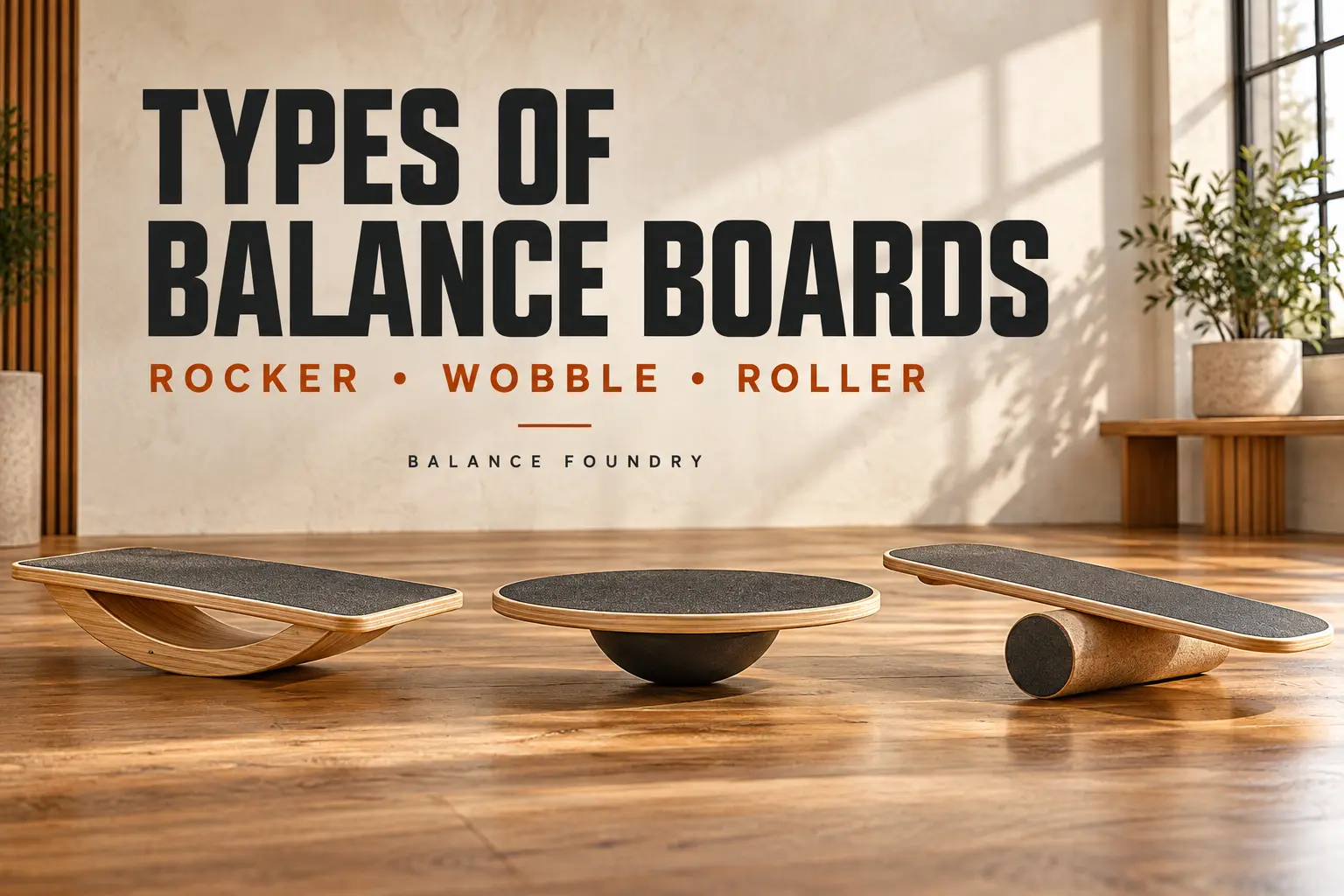
The main types of balance boards may look similar at first, but their movement patterns feel very different underfoot. A rocker board tilts along one primary axis, a wobble board can tip in every direction, and a roller board moves freely over a separate cylinder. Those mechanical differences determine how quickly each board feels approachable, what skills it develops, and where it fits best.
This guide provides the broader equipment taxonomy behind balance-board training. If you are specifically deciding whether a wobble board belongs in the larger balance-board category, read our focused wobble board vs. balance board comparison. Here, we are comparing three distinct designs so you can choose the right starting point and progression path.

Rocker vs. Wobble vs. Roller Board at a Glance
| Board type | How it moves | Learning curve | Best suited to | Desk suitability |
|---|---|---|---|---|
| Rocker board | Tilts along one primary axis | Lowest | Beginners, controlled weight shifts, basic ankle work | Generally the best of the three |
| Wobble board | Tilts in all directions around a central base | Moderate | Ankle strength, coordination, core engagement, general fitness | Possible, but more demanding |
| Roller board | Deck moves freely over a separate roller | Highest | Advanced balance, surfing and snowboarding preparation | Usually impractical |
What Is a Rocker Board?
A rocker board uses a fixed fulcrum or curved underside to create a predictable tipping motion. Most models move side to side, although the board can sometimes be turned to train a front-to-back weight shift. Because the base remains attached to the deck, it cannot suddenly roll away from the user.
That constrained movement makes the rocker board easier to understand. You can feel the edge approaching the floor, return toward center, and repeat the movement without managing every direction at once. It is still unstable, but the challenge is organized around one primary axis.
Where rocker boards work well
- Beginning balance practice: The predictable pathway lets new users focus on posture, soft knees, and controlled weight transfer.
- Ankle control: Slow side-to-side movement challenges the muscles that help control the foot and ankle without requiring a full 360-degree response.
- Standing desks: A limited range of motion is easier to manage while typing, reading, or participating in a call.
- Warmups: Gentle rocking can introduce movement before more demanding exercises.
A rocker board is not automatically “easy.” Deck height, curvature, width, and stops can change the difficulty significantly. However, it usually offers the simplest entry point among these three designs. That makes it a strong choice for someone who wants frequent low-level practice rather than a highly technical challenge.
What Is a Wobble Board?
A wobble board places a deck over a centered dome or rounded base. Instead of following one track, it can tilt forward, backward, side to side, and through circular combinations. The goal may be to keep the edges off the floor, make controlled taps, or move the rim through a smooth circle.
Because the board can tip toward any point, your ankles, hips, and trunk must respond to constantly changing feedback. The challenge is more complex than a rocker board, but the base generally remains beneath the deck. That makes it less unpredictable than a loose roller while still providing meaningful multidirectional training.
Where wobble boards work well
- Ankle-strength applications: Multidirectional tilting asks the lower leg to control inversion, eversion, plantarflexion, and dorsiflexion within the board’s available range.
- General fitness: Squat holds, controlled reaches, and supported single-leg drills can add a balance component to training.
- Core engagement: The trunk works to keep the body organized over a shifting base, especially during slow movements.
- Coordination: Circular tilts and deliberate edge taps require more precise control than simple side-to-side rocking.
Wobble boards vary widely. Some are compact plastic discs with a sharper tilt, while others are broad wooden decks with a smoother response. Surface grip and base geometry matter as much as the material. Our guide to the best wooden balance boards explains how wood construction, deck shape, and grip affect the experience.
What Is a Roller Balance Board?
A roller balance board uses two separate pieces: a long deck and a cylindrical roller. The deck is placed across the roller and can travel laterally as the cylinder moves underneath it. Nothing fixes the two pieces together, so the system demands constant control of both tilt and position.
This free movement creates a steeper learning curve. A beginner must prevent the deck from touching down while also keeping it from shooting too far toward either end of the roller. End stops can reduce the chance of the roller escaping completely, but they do not remove the need for attentive technique.
Where roller boards work well
- Surfing and snowboarding applications: The lateral movement and continuous corrections feel more specific to board-sport stance and control.
- Athletic progression: Once basic standing is secure, users can add deeper positions, turns, catches, reaches, or sport-specific patterns.
- Reactive balance: The loose roller requires faster adjustments than a fixed rocker or centered wobble base.
- Skill practice: The board itself can become a practice discipline rather than simply a platform used during other exercises.
A roller board is usually a poor choice for multitasking at a desk. It demands visual attention, open floor space, and enough clearance for the deck to travel. It is better treated as dedicated training equipment. Athletes can explore more specific applications in our guide to choosing a balance board for athletes.
Which Type Is Best for Ankle Strength?
All three boards can challenge the lower leg, but they do so differently. A rocker board provides a clear, repeatable path for controlled weight shifts. A wobble board exposes the ankle to movement in multiple directions. A roller board makes the whole body react to a moving platform, but it may be too demanding if isolated ankle control is the main goal.
For general ankle-strength training, a wobble board often provides the most direct blend of multidirectional movement and manageable control. A rocker board may be the better starting point when you need a simpler pattern. A roller board makes more sense after basic strength and balance are already established.
If you are recovering from an injury, experiencing pain, or dealing with repeated ankle instability, ask a qualified medical professional which movements are appropriate. Unstable-surface training should complement—not replace—an individualized rehabilitation plan.
Which Balance Board Works Best at a Standing Desk?
A standing-desk board should encourage movement without demanding your full concentration. That usually favors a low rocker design with a broad deck, moderate tilt, and grippy surface. You can shift positions periodically and step off easily when focused work takes priority.
A wobble board may suit short movement breaks, but its multidirectional tilt can become tiring during longer work sessions. A roller board is rarely appropriate because it needs more attention and room. See our complete guide to selecting a balance board for a standing desk for setup and usage considerations.
Which Type Should Beginners Choose?
Choose a rocker board if…
You want the most predictable movement, plan to use the board at a desk, or prefer a gradual first step into balance training.
Choose a wobble board if…
You are comfortable with basic balance and want multidirectional ankle, core, and coordination work in a compact format.
Choose a roller board if…
You already have a balance foundation and want the largest skill ceiling or a stronger connection to surfing and snowboarding.
Most true beginners will progress more confidently on a rocker board. However, a broad, low wobble board can also be an appropriate first board when used beside stable support. Whichever design you choose, start with short sessions and learn how to step off safely. Our balance board exercises for beginners provide a practical starting routine.
Which Type Has the Most Progression Potential?
The roller board generally offers the highest skill ceiling because the deck and roller move independently. You can progress from supported standing to hands-free holds, deeper athletic positions, reaches, catches, and more complex board-sport patterns. Small changes in roller diameter, deck shape, stance, and movement can meaningfully increase the demand.
A wobble board provides excellent exercise variety, particularly when combined with squats, presses, reaches, and single-leg work. Its progression potential is broad for general fitness even if the balancing skill itself eventually becomes familiar. A rocker board has the least complex movement pattern, but that simplicity is valuable for frequent use, controlled drills, and desk work.
- Learn controlled weight shifts on a rocker board.
- Develop multidirectional control on a wobble board.
- Advance to a roller board when you can maintain posture and step off confidently.
This sequence is useful, but it is not mandatory. The best board is the one that matches your current ability and the activity you actually plan to practice.
How to Compare Balance Boards Before Buying
Board type is only the first decision. Also compare deck size, surface traction, base shape, maximum tilt, end stops, weight capacity, floor compatibility, and storage space. A wide deck can feel more forgiving, while a taller or more aggressively curved base usually increases the challenge. Rubber protection beneath the board can also reduce slipping and protect hard floors.
Product descriptions do not always use the same terminology. Some sellers call every unstable platform a wobble board, while others use “balance board” only for roller systems. Look at the mechanism instead of relying on the name. Our roundup of the best balance boards compares options by use case so you can evaluate the design rather than the label.
Frequently Asked Questions
Is a rocker board the same as a wobble board?
No. A rocker board primarily tilts along one axis, while a wobble board tilts in multiple directions around a centered base. Both belong to the broader balance-board category.
Is a roller balance board good for beginners?
It can be learned by a beginner, but it has the steepest learning curve of the three types. Start beside a sturdy support, use a clear nonslip area, and consider beginning with a rocker or low wobble board if you are not confident stepping off.
Which balance board is best for surfing?
A roller board typically provides the closest match to the continuous lateral adjustments and board control associated with surfing. It does not reproduce the ocean, but it can support dry-land stance and coordination practice.
Can I use a balance board every day?
Many people can use one frequently when sessions are brief and appropriately challenging. Stop if technique deteriorates or you experience pain. Training quality matters more than staying on the board for as long as possible.
Final Verdict
Rocker, wobble, and roller boards are not simply easier and harder versions of the same tool. Each creates a different movement environment. Choose a rocker board for predictable beginner-friendly tilting and standing-desk movement, a wobble board for multidirectional ankle and general fitness work, or a roller board for advanced skill development and board-sport preparation.
Start with control, keep stable support nearby while learning, and progress only when you can maintain a relaxed athletic stance. The right board should challenge your balance without turning every session into a scramble.
Safety note: Balance training involves a fall risk. Use a clear, nonslip area and stable support when needed. This article provides general education and is not medical advice.
Leave a Reply