
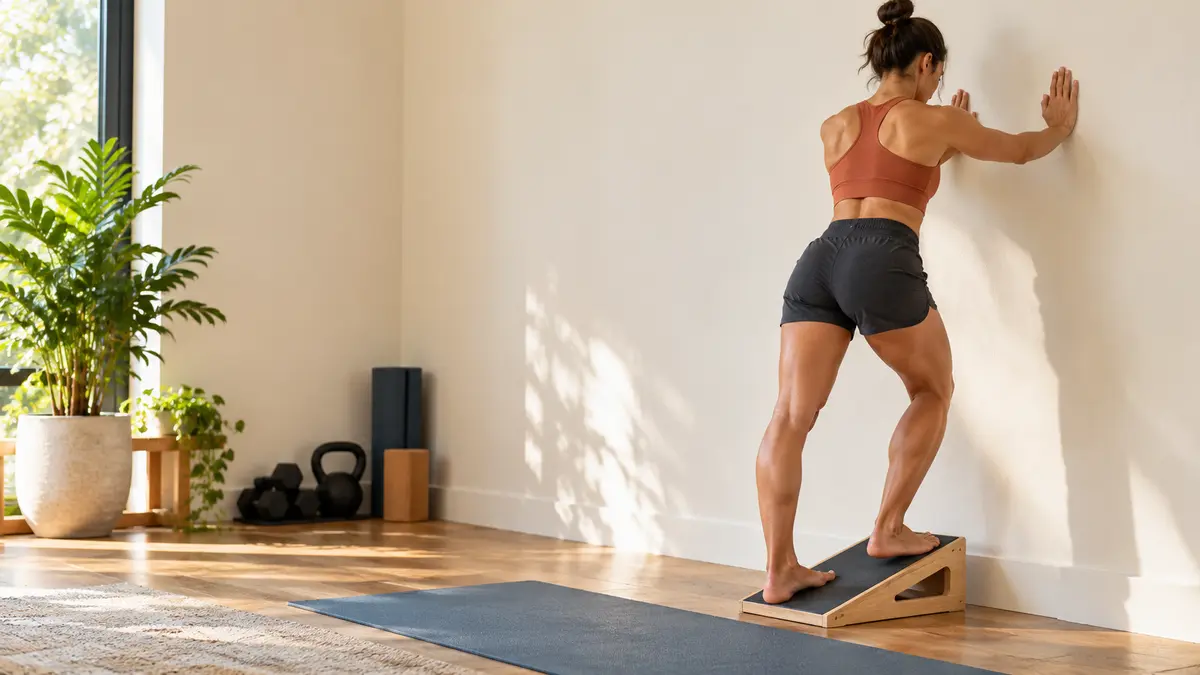
A slant board makes calf stretching easy to repeat because it fixes the foot on a consistent incline. Changing the knee position changes the length and contribution of the two-joint gastrocnemius relative to the deeper soleus.
Set up the slant board
- Place the board on a hard, nonslip surface beside a wall or sturdy support.
- Begin with a low incline. Higher is not automatically better.
- Place the full foot on the board with the heel supported.
- Stand tall and distribute pressure across the whole foot.
- Move only until you feel a firm, tolerable calf stretch.
Use the slant-board angle guide if you are unsure where to begin. The broader slant-board setup guide covers board placement and general safety.

Straight-knee slant board calf stretch
Stand with the stretching knee straight but not forcefully locked. Keep the heel planted and shift your body forward as one unit. You should usually feel the stretch higher in the calf.
Form cues
- Point the foot generally forward.
- Keep the arch from collapsing abruptly.
- Do not push the knee backward.
- Hold a support so balance does not limit the stretch.
Bent-knee slant board calf stretch
From the same foot position, soften the knee and let it travel forward while the heel stays down. Keep the torso stacked rather than dropping into a deep squat. Many people feel this version lower in the calf or closer to the Achilles region.
Form cues
- Bend the knee gradually while maintaining heel contact.
- Keep the knee tracking in the direction of the middle toes.
- Use a smaller angle if the ankle pinches in front.
- Avoid bouncing at the end range.
| Variation | Typical emphasis | Useful for |
|---|---|---|
| Straight knee | Gastrocnemius in a lengthened position | General calf stretching and straight-leg ankle mobility |
| Bent knee | Greater soleus emphasis | Loaded ankle travel used in squats, stairs and downhill steps |
| Alternating both | Broader calf complex exposure | General mobility routines |
How long should you hold?
Start with 20 to 30 seconds per position for two rounds. A stretch should feel firm but manageable. Longer holds are not useful if you compensate, lose heel contact or create joint pain.
If ankle range is your primary goal, combine calf stretching with active ankle dorsiflexion exercises. Stretching can be one part of the plan, but loaded control helps you use the available range.
Common mistakes
- Choosing the steepest angle immediately.
- Letting the heel float above the board.
- Turning the foot outward to avoid ankle motion.
- Forcing through a sharp pinch at the front of the ankle.
- Using the stretch as treatment for unexplained pain.
Build a short calf-mobility routine
Begin with one minute of easy walking or ankle circles. Perform two 20- to 30-second straight-knee holds and two bent-knee holds per side. Follow the static work with six to ten slow ankle rocks or bodyweight squats so you practice controlling the available range.
Use the routine after a general warm-up or at a separate mobility session. Long, aggressive stretching immediately before explosive work may not be the best fit for every athlete. Before running or jumping, prioritize movement that gradually raises temperature and rehearses the activity.
How angle changes the stretch
A steeper incline increases the starting dorsiflexion demand. That can create a stronger sensation, but it can also encourage the heel to lift, the foot to turn outward or the knee to move away from its normal line. Start with the lowest angle that produces a clear calf stretch while preserving alignment.
Progress hold time or consistency before increasing incline. An adjustable board is helpful because you can use a lower setting for the bent-knee version and a different setting for the straight-knee version instead of forcing both positions at one angle.
Stretch sensation versus warning signs
A broad pulling sensation through the calf is different from a sharp point of pain. Stop if you feel sudden pain, numbness, tingling, marked Achilles tenderness or a hard pinch at the front of the ankle. If symptoms persist, stretching harder is not the solution.
If you are choosing equipment, see the best slant boards for calf stretching. A wide, stable surface and manageable adjustment system matter more than chasing the highest possible angle.
Frequently asked questions
Should I keep both knees straight?
The stretching-side knee position matters most. The other leg and your support position should help you stay stable.
Why do I feel the bent-knee stretch near my Achilles tendon?
The soleus and Achilles complex remain involved as the knee bends. Reduce the angle if the sensation becomes sharp or localized pain.
Can I stretch both calves at once?
Yes, but a single-leg setup often makes it easier to control knee position and compare sides.
Research used
- Wall versus inclined-board triceps surae stretching
- Gastrocnemius-soleus stretching and dorsiflexion
- Calf stretching box trial
Health note: This article is for general education and is not a diagnosis or individualized medical advice. Stop if an exercise causes sharp pain, swelling, numbness or instability, and consult a qualified professional when appropriate.
Leave a Reply