
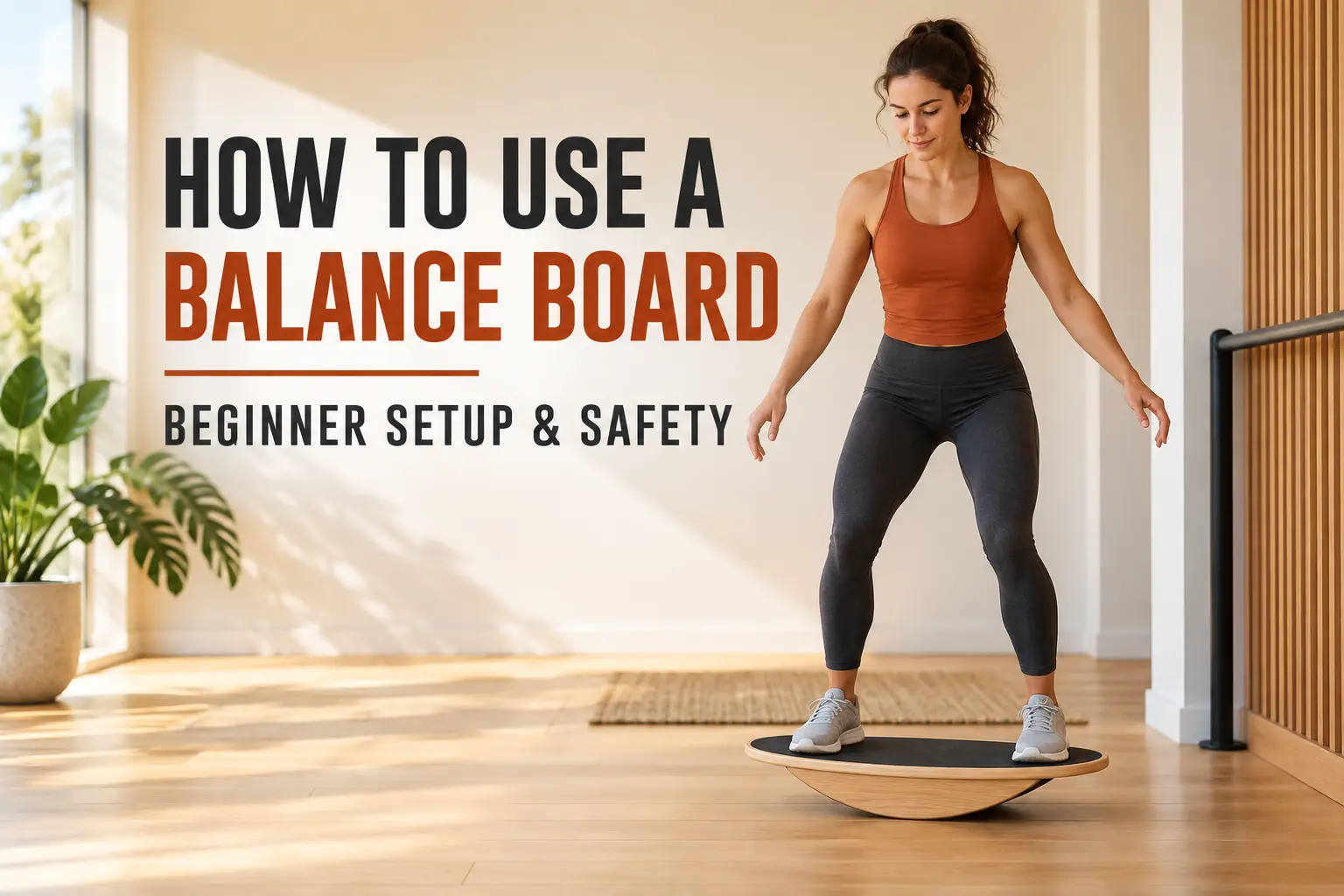
Learning how to use a balance board begins with a safe setup, a stable point of support and small, controlled movements. You do not need to perform deep squats, stand on one leg or attempt tricks during your first session. The initial goal is simply to find the center of the board and control its movement.
The exact technique depends on whether you are using a rocker board, wobble board or roller board. This guide focuses primarily on beginner-friendly rocker and wobble boards. Roller boards move more freely and require a more cautious progression.
If you are still choosing equipment, start with our guide to the best balance boards or learn how the major designs differ in our wobble board versus balance board comparison.

Before You Step on the Balance Board
A few minutes of preparation can make your first session more controlled and less intimidating. Do not place the board on an unstable mat, thick carpet or slippery surface unless the manufacturer specifically recommends it.
How to Use a Balance Board Step by Step
-
Position the board near your support.
Place it close enough to a wall, rail or sturdy chair that you can reach the support without leaning or twisting. -
Place your first foot on the board.
Put one foot near the outer portion of the platform while keeping most of your weight on the floor. -
Steady the board before adding the second foot.
Use your hand support and first foot to keep the board from moving abruptly. -
Step up with the second foot.
Position your feet approximately hip-width apart. Adjust the stance based on the size and shape of the platform. -
Soften your knees.
Avoid locking your legs. A small knee bend allows the ankles, knees and hips to respond to the board. -
Keep your chest tall and eyes forward.
Looking at a fixed point in front of you is generally easier than looking directly down at the board. -
Find the center.
Shift your weight slowly until neither edge is resting heavily on the floor. The board does not need to remain perfectly motionless. -
Begin with small weight shifts.
Move forward, backward or side to side through a range you can control. Touching an edge lightly is acceptable while learning. -
Step off slowly.
Bring one edge of the board to the floor, transfer your weight toward your support and remove one foot at a time.
What Is the Correct Balance Board Stance?
A good beginner stance should feel athletic but relaxed. Exact foot placement varies by board size and design, but these cues work for many rocker and wobble boards:
- Place the feet approximately hip-width apart.
- Keep the feet centered from front to back.
- Distribute pressure across the heel, base of the big toe and base of the little toe.
- Keep the knees soft rather than locked.
- Allow the knees to track generally in line with the feet.
- Keep the hips above the feet instead of leaning far forward or backward.
- Maintain a tall chest and relaxed shoulders.
- Look at a stable point in front of you.
A wider stance usually makes balancing easier because it gives you more leverage over the board. Moving the feet closer together generally increases the difficulty.
Five Beginner Balance Board Movements
1. Supported center hold
Use both hands or one hand on a stable support. Shift your weight until the board is approximately centered, then try to keep the edges from touching the floor.
Begin with: 15–20 seconds for three rounds.
2. Forward and backward shifts
On a board that permits front-to-back movement, shift your weight slowly toward the toes and then back toward the heels. Keep the movement small enough that you remain in control.
Begin with: 5–8 controlled repetitions in each direction.
3. Side-to-side shifts
Move your weight toward one foot and then the other. Avoid quickly dropping one edge to the floor. Think about gradually increasing and decreasing pressure beneath each foot.
Begin with: 5–8 repetitions per side.
4. Controlled edge touches
Allow one edge of the board to touch the floor lightly, return to center and repeat on the opposite side. The goal is control rather than speed.
Begin with: 4–6 touches per side.
5. Shallow balance-board squat
Once you can maintain a centered stance, bend the knees and hips slightly while keeping the board as controlled as possible. Return to standing without locking the knees.
Begin with: 5 slow repetitions while using support.
For a larger exercise selection, continue to our balance board exercises for beginners.
How Long Should a Beginner Use a Balance Board?
Balance training does not require long, exhausting sessions. Short periods of focused practice are often easier to control and repeat consistently.
Simple beginner session
Supported center hold: 20 seconds
Forward and backward shifts: 5 repetitions each way
Side-to-side shifts: 5 repetitions per side
Rest: 30–60 seconds
Complete: 3 rounds
Two or three short sessions per week can provide enough practice for a beginner to become familiar with the board. More is not automatically better. Stop the session when fatigue causes your posture or control to deteriorate.
How to Progress Your Balance Training
Change only one variable at a time. Progressing several variables together makes it difficult to know whether the exercise is appropriate for your current ability.
| Starting level | Progression | Why it is harder |
|---|---|---|
| Two-hand support | One-hand support | Less external assistance |
| One-hand support | Fingertip support | Requires more self-correction |
| Fingertip support | Hands hovering nearby | Removes continuous assistance |
| Wide stance | Slightly narrower stance | Reduces leverage over the board |
| Short intervals | Longer intervals | Requires sustained control |
| Small weight shifts | Larger controlled shifts | Uses more of the available movement range |
| Standing holds | Shallow squats or reaches | Adds movement while balancing |
How to Use Different Types of Balance Boards
Rocker boards
Rocker boards generally move along one primary axis. This makes the direction of movement easier to predict and often makes them a practical starting point for beginners.
Begin by placing your feet perpendicular to the rocking direction. Practice controlling the board as it moves from one edge toward the other.
Wobble boards
Wobble boards tilt in multiple directions around a fixed point. They require you to manage forward, backward, side-to-side and diagonal movement.
Begin with a wider stance and stable hand support. Concentrate on keeping the platform near level rather than circling the edge rapidly around the floor.
Roller boards
Roller boards use a separate cylinder beneath the platform. Because both the platform and roller can move, they are less predictable than fixed-pivot boards.
Use a board with end stops, place it near sturdy support and consider having another person spot you. Do not begin with tricks, jumps or deep squats.
Our guide to wooden balance boards includes several board styles and explains how their construction affects the training experience.
Common Beginner Mistakes
Looking down the entire time
Briefly checking your foot position is reasonable, but continuously staring at the board can encourage you to fold forward. Once positioned, look toward a stable point ahead.
Locking the knees
Keeping the legs completely rigid makes it harder to respond smoothly. Maintain a small knee bend and allow the ankles, knees and hips to share the work.
Making movements too large
Beginners often try to use the board’s entire range immediately. Smaller movements make it easier to learn how your weight affects the platform.
Trying to keep the board perfectly still
The board will move. Balance training is about controlling and responding to that movement, not eliminating it entirely.
Removing support too soon
Using a wall or chair is not cheating. Reduce your dependence on support gradually as your control improves.
Progressing multiple variables at once
Avoid narrowing your stance, closing your eyes, adding weight and increasing the session length simultaneously. Change one element and assess the result.
Training through pain
Muscular effort and mild fatigue can be normal. Sharp pain, numbness, joint pain or repeated instability are reasons to stop.
Can a Balance Board Strengthen Your Ankles?
Balance-board exercises challenge the muscles that control the feet and ankles as they respond to changes in platform position. The difficulty depends on the type of board, stance, support and movement range.
Balance-board practice should be progressed gradually, especially if you have a history of ankle injury. Learn more in our guide to choosing and using a balance board for ankle strength.
Balance Board Safety Guidelines
- Use the board on a firm, level and non-slippery surface.
- Keep the surrounding area clear.
- Use stable support until you can control the board independently.
- Check the board for damage or loose components.
- Follow the manufacturer’s weight and usage guidelines.
- Avoid jumping onto or off the board.
- Do not begin with weights, resistance bands or closed-eye drills.
- Stop if you experience sharp pain, numbness, dizziness or repeated loss of control.
- Use appropriate supervision when balance limitations increase fall risk.
Frequently Asked Questions
Is a balance board suitable for beginners?
Yes, provided the board matches the user’s ability and is used near stable support. Rocker boards and lower-profile wobble boards are often easier to learn than free-moving roller boards.
How long should I stand on a balance board?
Beginners can start with 20–30-second intervals for three to five rounds. Increase the time gradually when you can maintain control and good alignment.
Should I wear shoes on a balance board?
Athletic shoes can provide grip and protection, while bare feet can provide more direct sensory feedback. Follow the board manufacturer’s recommendations and avoid socks alone on a slippery surface.
Should the balance board touch the floor?
Occasional controlled edge contact is normal, especially for beginners. The long-term goal is to control the board rather than letting an edge crash repeatedly into the floor.
Can I use a balance board every day?
Short, low-intensity practice may be appropriate for some users, but daily use is not required. Reduce the frequency if foot, ankle or lower-leg fatigue affects your control.
Which balance board is easiest for beginners?
A rocker board with a limited, predictable movement path is often the easiest place to start. A low-profile wobble board can also work when used with stable support.
When should I progress to a roller board?
Consider a roller board after you can comfortably control a fixed-pivot board, step on and off safely and perform basic movements without relying heavily on hand support.
The Bottom Line
Learning how to use a balance board is less about remaining perfectly still and more about responding to movement with control. Start with a clear area, stable support, a wide stance and soft knees. Practice short center holds and small weight shifts before attempting squats, reaches or advanced progressions.
Use the easiest setup that lets you practice safely. As your control improves, gradually reduce hand support, increase the movement range or add time—but change only one variable at a time.
Continue Your Balance Training
This article provides general educational information and is not individualized medical advice. Consult an appropriate healthcare professional before beginning balance training if you have an injury, recent surgery, significant balance impairment or a condition that increases your risk of falling.
Leave a Reply