
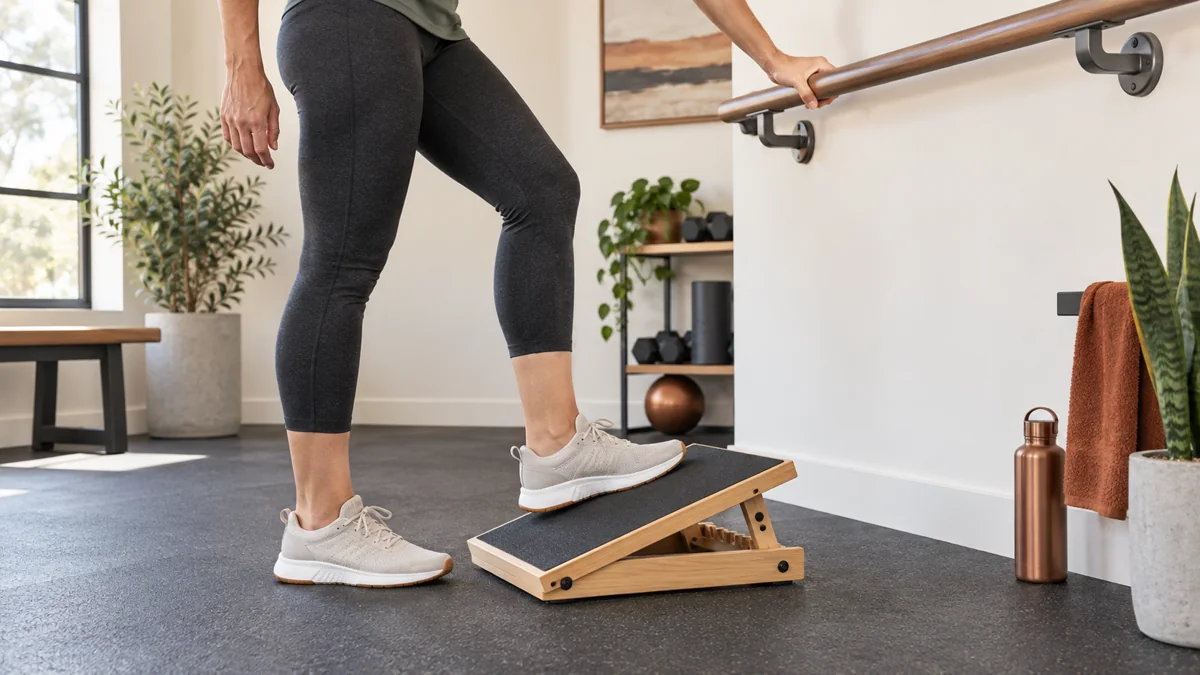
Start With the Right Direction, Angle, and Foot Position
A slant board is simple once you know which way to face. This guide explains how to set it up for calf stretching, ankle mobility, heel-elevated squats, and lower-leg strength.
If you are learning how to use a slant board for the first time, resist the urge to choose the steepest setting. The board should improve your position without forcing range, creating pain, or making you fight for balance. A moderate angle performed well is more useful than an aggressive angle performed poorly.
Which Way Do You Face on a Slant Board?
Board direction depends on the exercise. Think about whether you want the toes elevated or the heels elevated.
Toes Higher Than Heels
Use this direction for straight-knee calf stretches, bent-knee soleus stretches, ankle rocks, and incline calf raises. The position moves the ankle toward dorsiflexion and lengthens the calf complex.
Heels Higher Than Toes
Use this direction for heel-elevated bodyweight squats, goblet squats, cyclist squats, and supported squat holds. Elevating the heels reduces the ankle dorsiflexion required to reach a given squat position.
How to Set Up a Slant Board Safely
Check the Board
Look for cracks, loose hardware, damaged hinges, worn tread, or bent supports. On an adjustable model, make sure the support is fully seated at the same setting across the board.
Choose a Level, Non-Slip Surface
Set the board on a clean, dry floor. Rubber flooring generally provides better traction than a smooth surface. The board should not rock, shift, or lift at an edge when you press on it.
Position It Near Something Stable
Use a wall, stair rail, squat rack, or heavy counter for support. A lightweight chair can slide and is not a dependable anchor unless it is braced securely.
Start With the Lowest Angle
The first setting should create only a manageable change in position. Step off completely before adjusting the board. Never change the angle while standing on it.
Support the Whole Foot
Center the foot on the platform. The heel should not hang beyond the lower edge, and the forefoot should have enough contact to feel secure. If your foot does not fit, use a larger board.
Three Beginner Ways to Use a Slant Board
1. Calf Stretch
Direction: Face uphill.
- Place one foot fully on the board and hold support.
- Keep the knee straight but not locked.
- Shift the hips forward until you feel mild-to-moderate tension in the upper calf.
- Hold 20–30 seconds without bouncing.
- Repeat with the knee slightly bent to emphasize the deeper soleus muscle.
Complete 2–3 comfortable holds per side.
2. Ankle Rocks
Direction: Face uphill.
- Stand with one foot on the board and both hands supported.
- Keep the heel heavy and guide the knee forward over the toes.
- Stop before the heel lifts or the arch collapses inward.
- Return slowly to the starting position.
Perform 8–12 smooth repetitions per side. This should be a controlled motion, not a bounce at end range.
3. Heel-Elevated Squat
Direction: Face downhill.
- Place both heels securely on the incline.
- Set the feet at a comfortable squat width.
- Brace gently and sit down between the hips.
- Let the knees track in the same direction as the toes.
- Stand by pressing through the whole foot.
Begin with 2 sets of 8–12 bodyweight repetitions while holding support if needed.
Once these basics feel consistent, explore the complete guide to 15 slant board exercises for strength and mobility.
What Slant Board Angle Should You Use?
There is no universal best angle. The correct setting depends on the exercise, your current mobility, the board’s dimensions, and your ability to maintain control.
| Experience or goal | Practical starting approach | Signs the angle is too steep |
|---|---|---|
| First-time user | Use the lowest setting with external support. | You cannot place the heel down, balance feels uncertain, or the foot slides. |
| Calf stretching | Choose mild tension that allows normal breathing and no bouncing. | Sharp discomfort, cramping, joint pinching, or forced posture. |
| Ankle mobility | Use an angle that lets the knee move forward while the heel and arch stay controlled. | The heel lifts, arch collapses, or the knee twists inward. |
| Heel-elevated squats | Use the least elevation that helps you reach the intended depth and torso position. | You shift onto the toes, lose balance, or feel unwanted knee or back pain. |
Progress by improving movement quality first. Add repetitions, longer comfortable holds, or a small amount of resistance before assuming you need a steeper board.
A Simple 6-Minute Beginner Routine
- Straight-knee calf stretch: 20 seconds per side.
- Bent-knee calf stretch: 20 seconds per side.
- Supported ankle rocks: 8 repetitions per side.
- Supported squat hold: 10–20 seconds.
- Heel-elevated bodyweight squat: 8 controlled repetitions.
- Rest and repeat once if every movement remains comfortable.
This is an example, not a required prescription. Use fewer exercises or shorter holds when you are new to the board. Mobility drills may fit into a warmup, while loaded squats and calf raises belong in the strength portion of a workout.
Common Slant Board Mistakes
Frequently Asked Questions
How long should you stand on a slant board?
For static calf stretching, a common starting point is 20–30 seconds per position. For mobility drills or strength exercises, use controlled repetitions instead of simply standing on the board.
Can beginners use a slant board?
Yes, provided the board is stable, the angle is manageable, and external support is available. Begin with simple calf stretches, ankle rocks, and supported bodyweight squats.
Should you wear shoes on a slant board?
Use the footwear recommended by the manufacturer and appropriate for the surface. Athletic shoes often provide predictable traction. Barefoot use requires a clean, comfortable surface and sufficient foot control; discontinue it if the tread irritates the skin or the foot slips.
Can you use a slant board every day?
Gentle mobility work may be appropriate frequently for some people, while demanding strength exercises need recovery. Frequency should reflect intensity, symptoms, soreness, and the rest of your training.
Does a slant board improve ankle mobility?
Calf stretching can modestly improve ankle dorsiflexion, and controlled ankle exercises may support flexibility and balance. Results vary, and restricted movement can have causes that an incline board cannot address.
Can a slant board treat Achilles pain or plantar fasciitis?
A slant board is not a diagnosis or guaranteed treatment. Some conditions may benefit from professionally selected stretching or loading, while other injuries can worsen with aggressive dorsiflexion. Persistent pain should be evaluated by a qualified healthcare professional.
Start Low and Learn the Position
The most important part of learning how to use a slant board is matching the direction to the goal: toes uphill for calf and ankle work, heels uphill for squat variations. Use the lowest helpful angle, secure the board, and build control before range or load.
Explore the Slant Boards Hub, compare the best adjustable slant boards, or visit our guides to calf-stretching boards and squat wedges.
Leave a Reply