
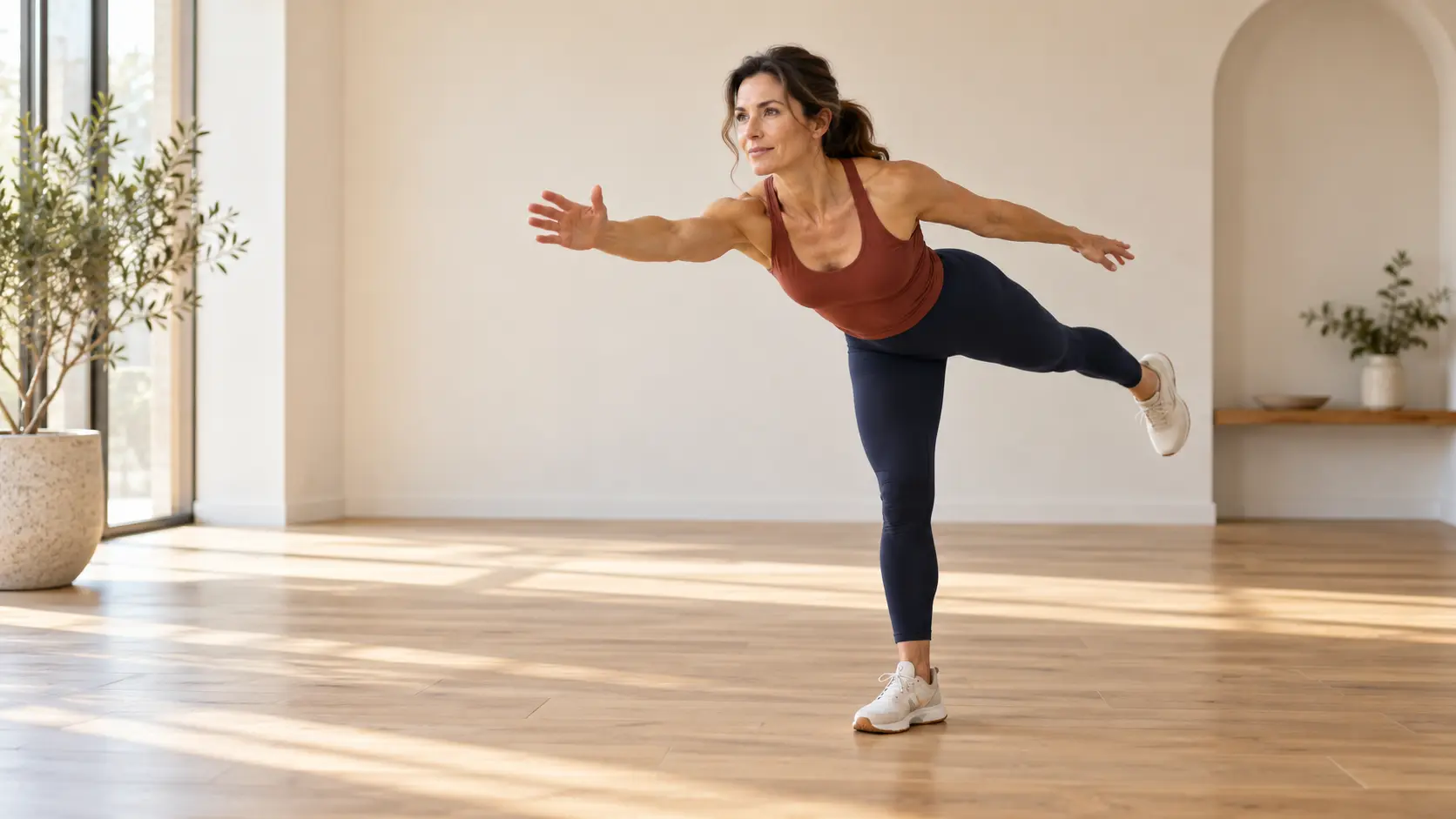
Balance exercises train your body to maintain control while standing still, shifting your weight or moving through space. The right progression can help you develop stability, coordination and confidence without immediately relying on specialized equipment.

What Do Balance Exercises Train?
Balance is not controlled by one muscle. It depends on your nervous system combining information from your eyes, inner ear, joints, muscles and contact with the ground. Your body then makes continual adjustments to keep your center of mass over your base of support.
Effective balance training can challenge several related abilities:
- Static balance: maintaining control without intentionally moving.
- Dynamic balance: maintaining control while stepping, reaching or changing direction.
- Single-leg stability: controlling the hip, knee, ankle and foot while standing on one leg.
- Coordination: organizing multiple joints and body segments during a movement.
- Proprioception: recognizing where your body and joints are positioned without constantly looking at them.
- Reactive control: responding to an unexpected shift without losing your position.
The federal Physical Activity Guidelines include balance work as part of multicomponent physical activity for older adults. However, balance training is useful well beyond one age group. Hikers, runners, field-sport athletes and active adults can all benefit from practicing controlled changes in stance and movement.
If you want a deeper explanation of body-position awareness, visit our guide to proprioception exercises. For ankle-specific limitations, start with these ankle dorsiflexion exercises.
Before You Begin
Practice in an open area on a firm, level surface. A countertop, heavy chair or wall should be within reach whenever you are learning a movement.
Use these basic setup cues:
- Stand tall without locking your knees.
- Keep your breathing relaxed.
- Look at a stable point in front of you.
- Keep your toes relaxed instead of gripping the floor aggressively.
- Use only the amount of hand support you need.
- End the set when your form noticeably deteriorates.
Beginner Balance Exercises
1. Feet-Together Stand
Stand beside a stable support with your feet touching or nearly touching. Distribute your weight evenly across both feet and look straight ahead. Hold the position without leaning into the support.
Start with: 2–3 holds of 20–30 seconds.
2. Controlled Weight Shifts
Stand with your feet approximately hip-width apart. Slowly move your weight toward one foot without lifting the other foot. Return to the center and shift to the opposite side.
Keep your shoulders and pelvis relatively level. The goal is to control the transition rather than move as far as possible.
Start with: 8–10 shifts per side.
3. Tandem Stance
Place one foot directly or nearly directly in front of the other, as though you were standing on a narrow line. Keep most of your weight centered between both feet.
Start with: 2 holds of 20 seconds with each foot forward.
4. Supported Single-Leg Stand
Stand beside a countertop or sturdy chair. Shift your weight onto one leg and lift the opposite foot just above the floor. Keep your standing knee soft and your pelvis level.
Start with: 3 holds of 10–20 seconds per leg.
Once you can complete these exercises with controlled breathing and minimal support, explore our broader guide to single-leg balance.
Intermediate Balance Exercises
5. Heel-to-Toe Walk
Walk forward along an imaginary line, placing the heel of your moving foot close to the toes of your planted foot. Pause briefly after each step before continuing.
Start with: 2–3 passes of 8–10 steps.
6. Clock Reach
Stand primarily on one leg with the other foot lightly touching the floor. Imagine several clock positions around you. Reach the free foot toward one position, return to the center and repeat in another direction.
Start with: 3–5 controlled directions per leg.
7. Step and Hold
Take one controlled step forward and pause before bringing the trailing foot through. Your goal is to stabilize each landing instead of moving quickly.
Start with: 6–8 steps per side.
8. Single-Leg Hinge
Stand on one leg and gently push your hips backward while your torso leans forward. Allow the free leg to extend behind you as a counterbalance. Return to standing by pressing through the planted foot and extending the hip.
Start with: 5–8 repetitions per side.
If you are specifically learning to train on moving equipment, use our separate balance board exercises for beginners. Equipment-based drills belong on that page rather than being mixed into this general exercise progression.
Advanced Balance Exercises
9. Eyes-Closed Stance
Stand beside a stable support in a comfortable stance. Once settled, close your eyes briefly while maintaining your position. Open them immediately if you begin to lose control.
Start with: 3–5 holds of 5–10 seconds.
10. Hop and Stick
Perform a small forward hop and land softly on one foot. Hold the landing for two or three seconds before resetting. Keep the knee tracking over the foot instead of collapsing inward.
Start with: 3–5 controlled landings per side.
11. Multidirectional Reach
Stand on one leg and reach your opposite hand toward several targets in front of, beside and diagonally across your body. Return to a tall position after every reach.
Start with: 4–6 reaches per side.
12. Single-Leg Squat
Stand on one leg in front of a chair or bench. Bend through the hip and knee to lower a short distance, then return to standing. Use a range that allows you to remain controlled.
Start with: 4–6 repetitions per side.
How to Progress Balance Exercises
A harder exercise is not automatically a better exercise. Progress one variable at a time so you can identify which change created the challenge.
You can adjust difficulty by changing:
- Base of support: move from a wide stance to feet together, tandem stance or one leg.
- Hand support: progress from a firm grip to fingertips and then no support.
- Head position: add slow head turns while maintaining control.
- Arm movement: reach in different directions without shifting abruptly.
- Movement speed: slower movement often requires more control than rushing.
- Task complexity: add stepping, hinging, squatting or controlled landing.
- Visual input: reduce visual reliance only after mastering the exercise with your eyes open.
A 15-Minute Balance Workout
Use this routine two or three times per week. Choose the level that allows you to finish with good control rather than selecting exercises solely because they look difficult.
| Exercise | Amount | Rest | Primary focus |
|---|---|---|---|
| Controlled weight shifts | 10 per side | 20 seconds | Weight transfer |
| Tandem stance | 20 seconds per side | 20 seconds | Narrow-base control |
| Single-leg stand | 15–30 seconds per side | 30 seconds | Static stability |
| Heel-to-toe walk | 8–10 steps | 30 seconds | Dynamic balance |
| Clock reach | 4 directions per side | 30 seconds | Multidirectional control |
| Step and hold | 6 per side | 30 seconds | Landing control |
Complete one or two rounds. Beginners can use support throughout. More experienced users can replace one beginner movement with a hinge, multidirectional reach or another advanced variation.
Common Balance-Training Mistakes
Progressing too many variables at once
Standing on one leg, closing your eyes and using an unstable surface simultaneously makes it difficult to identify what you can control. Change one variable at a time.
Holding your breath
Breath-holding often accompanies excessive tension. Continue breathing normally and use only enough muscular effort to organize the movement.
Gripping the floor with your toes
Your foot muscles should participate, but forcefully curling your toes can create unnecessary tension. Think about maintaining broad contact through the heel, base of the big toe and base of the little toe.
Allowing the knee to collapse inward
During single-leg reaches, hinges and squats, aim to keep your knee generally aligned with the middle of your foot. Reduce the range or add support if you cannot maintain that position.
Choosing difficulty over quality
A shorter, controlled hold is more useful than a longer attempt filled with hopping, twisting and repeated grabs for support.
When Should You Use Balance Equipment?
Balance equipment can expand your exercise options, but it is not required for effective balance training. First build control on a stable floor. Equipment can then introduce a different movement pattern or a more specific training goal.
- Balance boards introduce movement beneath the feet.
- Balance-board comparisons can help match the equipment type to your experience.
- Balance and stability balls are useful for core training, supported exercises and half-ball workouts.
- Mobility training may help when limited joint motion prevents you from reaching or squatting comfortably.
Keep equipment-specific exercise variations on their dedicated guides. This makes it easier to select drills based on the equipment you own and your current ability.
Frequently Asked Questions
How often should I perform balance exercises?
Two or three short sessions per week is a practical starting point for many people. You can also practice one or two low-risk exercises more frequently when fatigue does not affect your control.
How long should I hold a balance exercise?
Beginners can start with 10–20 seconds. Increase toward 30–45 seconds only while your position remains controlled. Movement quality matters more than reaching an arbitrary time.
Should I practice balance exercises barefoot?
Barefoot practice can increase sensory feedback from the floor, but it is not mandatory. Use a secure, nonslip surface and choose footwear appropriate for your environment, comfort and medical needs.
Are balance exercises only for older adults?
No. Older adults may use balance training as part of a multicomponent activity program, while athletes and active adults may use it to improve landing control, coordination and movement confidence.
When should I make an exercise harder?
Progress when you can complete the current version with normal breathing, consistent alignment and little or no reliance on hand support. Change only one difficulty variable at a time.
Build Control Before Adding Complexity
The best balance exercise is the one that challenges you without making control impossible. Start with a stable base, narrow your stance gradually, introduce single-leg positions and then add controlled movement. Reduced-vision work and dynamic landings should come later.
That progression gives you room to improve without turning every session into a test. Consistent, controlled practice is more valuable than chasing the most difficult variation.
Leave a Reply