
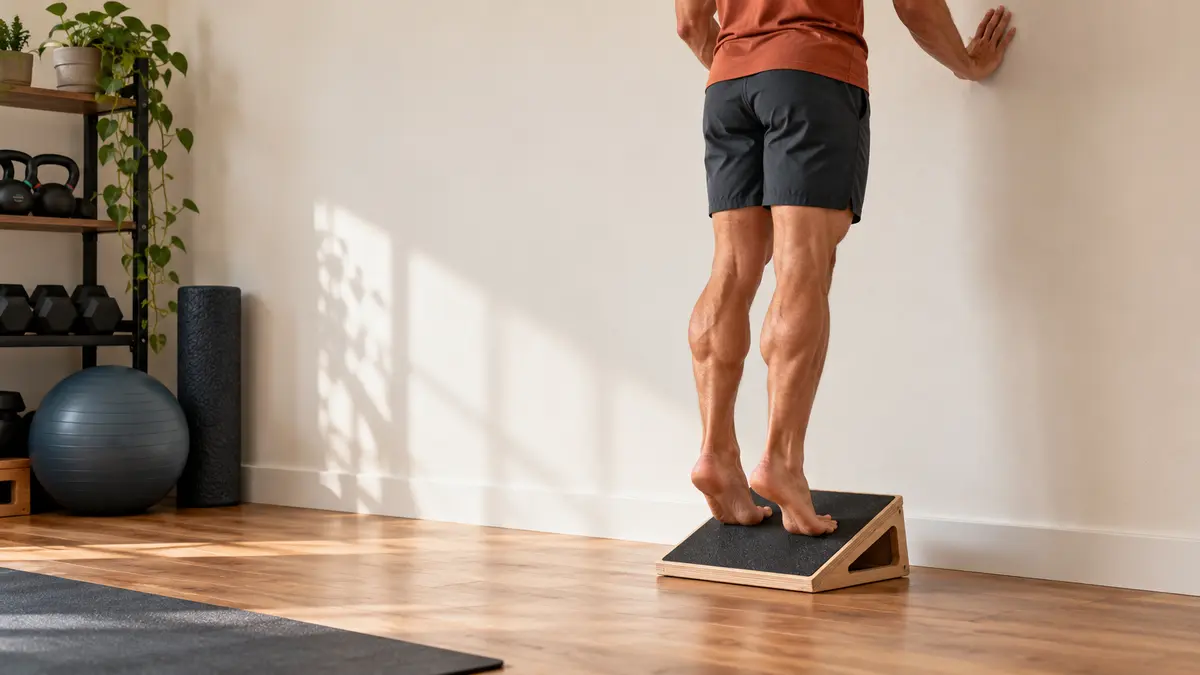
Slant board calf raises let you train plantar-flexion strength while the foot starts on an incline. The setup can increase the available lowering range, but only if the board is stable and your ankle tolerates the position.
How to perform a slant board calf raise
- Place the board on a nonslip surface beside a wall, rail or rack.
- Stand with the balls of the feet supported and heels free to move, if the board is designed for that setup.
- Keep pressure across the big-toe mound and little-toe mound.
- Rise onto the toes without rolling the ankles outward.
- Pause briefly, then lower over two or three seconds.

What muscles do slant board calf raises work?
The gastrocnemius and soleus provide most of the plantar-flexion force, while muscles around the foot and ankle help keep pressure organized. A straight knee generally maintains more gastrocnemius contribution. Bending the knee changes the position of the gastrocnemius and can shift relative emphasis toward the soleus, although no variation fully isolates one muscle.
Research examining heel raises supports using knee position as a programming variable, but muscle activation does not automatically predict long-term growth. Use the variation that matches your goal and that you can perform through a controlled range.
Five useful progressions
1. Supported double-leg
Learn the path and maintain even pressure between feet.
2. Slow eccentric
Rise normally and take three to four seconds to lower.
3. Bent-knee raise
Maintain a shallow knee bend throughout the repetition.
4. Single-leg raise
Use support and reduce range until the path is clean.
5. Weighted raise
Add a vest, dumbbell or machine only after bodyweight control.
Sets and repetitions
| Goal | Starting approach | Key cue |
|---|---|---|
| Technique | 2–3 sets of 6–10 | Pause at the top and lower slowly |
| Endurance | 2–3 sets of 12–20 | Stop when range shortens |
| Strength | 3–4 sets of 6–12 with suitable load | Keep the board and support stable |
These are starting ranges, not prescriptions. Adjust volume to your training history and recovery. The complete slant board exercise library provides other strength and mobility options. Use the slant-board angle guide before increasing the incline.
Common mistakes
- Bouncing out of the bottom position.
- Rolling toward the outer toes.
- Using a board that is too short or not designed for heel raises.
- Increasing angle, load and single-leg difficulty at the same time.
- Continuing through sharp Achilles, heel or forefoot pain.
How board angle affects the exercise
Changing the incline alters the ankle position at the bottom of the repetition. A mild angle is easier to control and provides a sensible starting point. A steeper angle may increase the available lowering range, but only if the heel can travel freely and the forefoot remains securely supported.
Do not assume a stronger stretch means a better strength exercise. If the bottom position causes the arch to collapse or the ankle to roll, reduce the angle or return to a flat step.
Tempo and range of motion
Use a deliberate tempo: about one to two seconds up, a short pause, and two to three seconds down. Lower only through the range you can reverse without bouncing. Over time, try to make the controlled range more consistent before adding repetitions.
A shorter clean repetition is more useful than a deep repetition that shifts pressure onto the outer toes. Film a set from behind if you need to check whether the heel travels straight upward.
A simple twice-weekly plan
On the first day, perform three sets of eight to twelve straight-knee double-leg raises and two sets of bent-knee raises. On the second day, use slow eccentrics or an assisted single-leg variation. Leave at least a day between harder sessions when the calf work is new to you.
Increase only one factor the following week: one or two repetitions, a small amount of load, or a slightly longer range. This makes it easier to identify what your calves and Achilles tendon tolerate.
If adjustability and platform stability are priorities, compare the best adjustable slant boards and the broader best slant boards guide.
Frequently asked questions
Are slant board calf raises better than floor calf raises?
They offer a different starting angle and may allow more lowering range. “Better” depends on the board, your mobility, load and goal.
Should my knees be straight or bent?
Both can be useful. Straight-knee and bent-knee versions change the relative demands across the calf complex.
Can I do weighted calf raises immediately?
First confirm that the board is rated and designed for the exercise. Build stable bodyweight repetitions before adding load.
Research used
- Knee flexion angle and triceps surae activity during heel raises
- EMG analysis of calf exercises
- Foot starting position and calf-raise test outcomes
Health note: This article is for general education and is not a diagnosis or individualized medical advice. Stop if an exercise causes sharp pain, swelling, numbness or instability, and consult a qualified professional when appropriate.
Leave a Reply