
Balance Foundry Exercise Guide
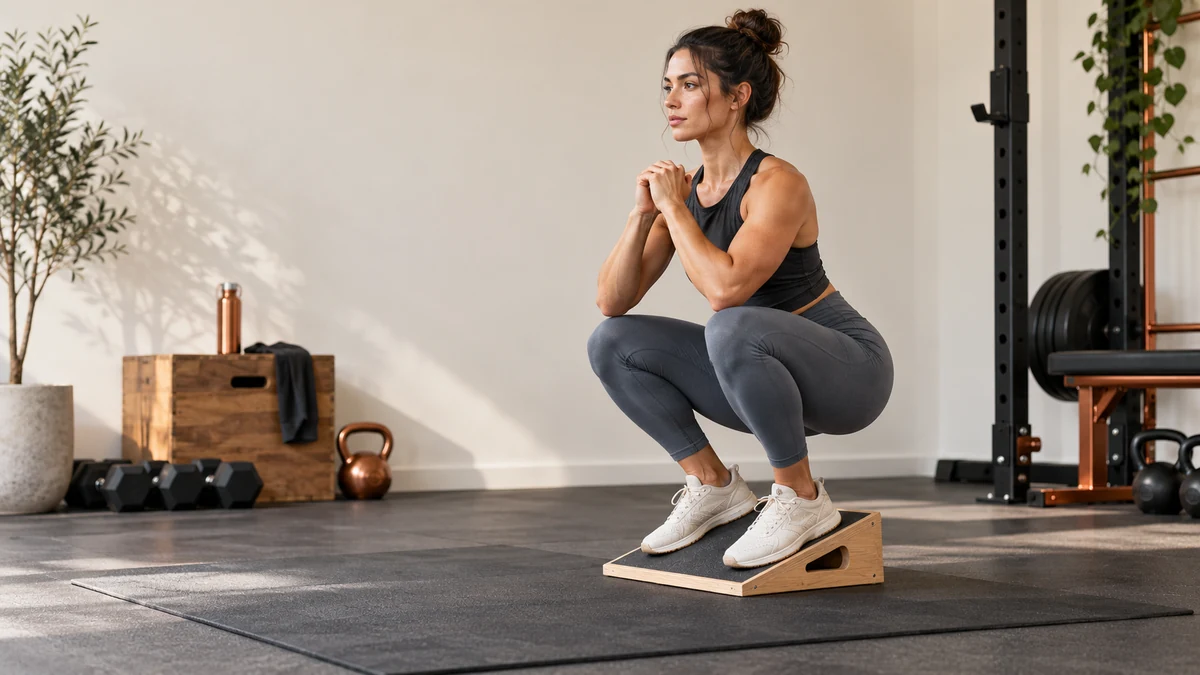
Slant board squats elevate your heels so you can squat with a more upright torso and greater forward knee travel. That small change can make deep squat positions easier to access while placing more emphasis on the quadriceps.
The main slant board squats benefits are improved access to squat depth, a more upright torso position and a strong quadriceps training stimulus. Because the heels are elevated, the ankle does not need as much dorsiflexion as it does during a flat-footed squat. This can make the movement feel more natural for people with long femurs, limited ankle mobility or difficulty staying balanced at the bottom of a squat.
That does not make a slant board squat automatically better than a regular squat. It is a variation with a specific purpose. The board changes your mechanics for the exercise; it does not permanently “fix” ankle mobility or make good technique optional.

What Is a Slant Board Squat?
A slant board squat is a squat performed with the heels elevated above the toes on a stable inclined surface. Your forefoot remains on the board while the incline supports the entire heel. Depending on the board, the angle may be fixed or adjustable.
Heel elevation changes the relationship between the ankle, knee, hip and torso. You can usually allow the knees to move farther forward without needing the same amount of ankle dorsiflexion required by a deep flat-footed squat. The torso can remain more upright, and the knees do more of the work relative to a hip-dominant squat pattern.
This variation is also called a heel-elevated squat. It is similar to squatting in weightlifting shoes or with small heel wedges, but a full-width slant board may provide a broader and more predictable platform. If you are choosing equipment specifically for this exercise, see our guide to the best slant boards for squats.
5 Slant Board Squat Benefits
1. Easier Access to Squat Depth
Some people reach a deeper squat with their heels elevated because the position reduces the ankle range needed to keep the feet planted. This can be useful when a flat-footed squat causes the heels to lift, the torso to fold excessively forward or the body to lose balance.
Depth should still be earned through control. Descend only as far as you can keep your feet secure, knees tracking consistently and trunk braced. A deeper squat is not more valuable if you have to bounce, collapse or shift to one side to reach it.
2. More Upright Torso Position
Heel elevation often lets the knees travel forward while the chest stays more upright. That can make the movement easier to balance and may feel more comfortable for people whose proportions make conventional squats especially hip-dominant.
An upright torso does not mean your back must remain perfectly vertical. A small forward lean is normal. The goal is a stable, coordinated position rather than forcing your chest upward or overextending the lower back.
3. Greater Quadriceps Emphasis
The forward knee travel and upright torso associated with heel-elevated squats generally increase the demand on the knee extensors—the quadriceps. This makes the exercise useful when you want a squat variation that trains the front of the thighs without immediately adding heavy external load.
You should still feel the glutes, adductors and trunk working. “Quad focused” does not mean “quads only.” The body must coordinate several joints and muscle groups to control the descent and stand back up.
4. A Useful Teaching and Assistance Exercise
A stable incline can help beginners experience a controlled squat without fighting for balance. Holding a rail, rack or sturdy countertop provides additional support while learning how the knees, hips and torso move together.
For experienced lifters, slant board squats can work as an accessory exercise after a primary squat or deadlift. The variation allows focused quadriceps work with bodyweight, a goblet load or lighter weights than a traditional barbell squat.
5. Simple, Scalable Progression
You can scale the movement by changing the level of hand support, range of motion, tempo, repetitions or external load. This makes the exercise adaptable without constantly changing equipment.
What Muscles Do Slant Board Squats Work?
Primary Emphasis
- Quadriceps: Extend the knees as you stand and control knee flexion during the descent.
- Gluteus maximus: Extends the hips as you rise from the squat.
- Adductors: Assist hip extension and help control the thighs.
Stabilizing Muscles
- Calves: Help stabilize the lower leg and ankle on the incline.
- Abdominals and spinal erectors: Brace the trunk and maintain posture.
- Foot muscles: Help maintain pressure across the supported foot.
Compared with many flat-footed squat styles, the slant board version usually feels more quadriceps dominant. However, stance width, depth, board angle, load placement and individual anatomy all influence where you feel the exercise.
How to Do Slant Board Squats With Proper Form
Set the Board Securely
Place the slant board on a flat, dry, nonslip surface. Begin with a low incline—roughly 10 to 15 degrees is enough for many beginners. The board should not rock, flex or slide.
Position Your Feet
Stand with your heels toward the low edge and toes toward the high edge. Support the entire heel rather than letting it hang off the board. Use approximately hip- to shoulder-width spacing and turn the toes slightly outward if that feels natural.
Brace Before Descending
Stand tall, take a controlled breath and gently brace your trunk. Keep your ribs stacked over your pelvis rather than flaring the chest or arching the lower back.
Lower Slowly
Bend the knees and hips together. Allow the knees to travel forward in roughly the same direction as the toes. Maintain pressure through the heel, base of the big toe and base of the little toe.
Use the Depth You Can Control
Stop before your heels lose contact, knees collapse inward, pelvis shifts sharply or you feel pain. A brief pause at the bottom can help remove momentum and improve control.
Stand Through the Whole Foot
Push the board away as you extend the knees and hips. Keep the knees tracking with the toes and finish tall without leaning backward.
Recommended Beginner Form
Hold a stable support with one or both hands and use a comfortable range. Perform 6 to 10 slow repetitions, taking approximately two to three seconds to lower. Once you can complete every repetition without pulling yourself up with your arms, reduce the support.
Common Slant Board Squat Mistakes
Starting With Too Much Incline
A steep angle can feel unstable and may place more stress on the knees or forefoot than you are prepared to manage. Start low and increase the angle only if it improves the movement without causing discomfort.
Letting the Knees Collapse Inward
The knees do not need to stay outside the toes, but they should travel in a controlled path generally aligned with them. If the knees repeatedly cave inward, reduce the depth, angle or load.
Leaving Part of the Heel Unsupported
The board should support the entire contact area of the foot. Hanging the heel off the edge changes the movement and may make the position less stable.
Dropping Quickly Into the Bottom
Bouncing into depth hides weak positions and makes it harder to judge whether the setup is appropriate. Use a smooth descent and own the bottom position before standing.
Forcing Painful Range
Muscular effort in the thighs is expected. Sharp knee pain, joint pinching, numbness or instability is not. Shorten the range or stop the exercise rather than trying to push through a warning sign.
Adding Weight Too Soon
External load magnifies whatever technique you already have. First demonstrate consistent foot pressure, knee tracking and trunk control with bodyweight.
Sets, Reps and Progressions
| Goal | Starting Approach | Progression |
|---|---|---|
| Learn the movement | 2 sets of 6–8 supported reps | Use less hand support |
| Build control and endurance | 2–3 sets of 10–15 bodyweight reps | Add a slower lowering phase or pause |
| Build strength | 3–4 sets of 6–10 goblet squats | Add load gradually while preserving form |
| Quadriceps accessory work | 2–4 sets of 8–15 reps after primary lifts | Add reps before adding more weight |
Train the exercise one to three times per week depending on your total lower-body workload and recovery. Beginners may need several days between sessions. Stop each set while you can still complete the next repetition with the same controlled technique.
A Sensible Progression Order
- Supported partial-range squat
- Supported full comfortable-range squat
- Unsupported bodyweight squat
- Tempo squat with a three-second descent
- Paused squat
- Goblet squat
Change one variable at a time. Adding angle, range, repetitions and load in the same session makes it difficult to know which change caused a technique problem or symptom flare.
Slant Board Squats vs. Regular Squats
| Feature | Slant Board Squat | Flat-Footed Squat |
|---|---|---|
| Heel position | Elevated | Level with forefoot |
| Ankle dorsiflexion demand | Usually lower for the same depth | Usually higher |
| Torso position | Often more upright | Varies more with anatomy and squat style |
| Typical emphasis | More knee and quadriceps focused | Can be more evenly shared between knees and hips |
| Best use | Quad training, teaching depth and supported squat practice | General squat strength and everyday movement practice |
Neither variation has to replace the other. You can use flat-footed squats for general movement practice and heel-elevated squats when you want a more upright, quadriceps-focused option.
Frequently Asked Questions
Are slant board squats good for your knees?
They can be a useful way to strengthen the quadriceps and practice controlled knee flexion, but “good” depends on your current tolerance, setup and loading. Start with a low angle and comfortable range. Stop if the exercise causes sharp pain, pinching or instability.
Do slant board squats improve ankle mobility?
They let you squat with less ankle dorsiflexion demand, so they work around limited mobility more than they directly improve it. Use separate calf stretches and controlled knee-over-toe drills if improving ankle range is the goal.
How steep should the slant board be for squats?
Begin around 10 to 15 degrees or the lowest available setting. Increase only if you remain stable, the whole foot is supported and the new angle improves the movement without discomfort.
Should my knees go over my toes?
Forward knee travel is normal in squatting and is expected in this variation. Keep the heels supported and let the knees track in line with the toes. The range should remain controlled and comfortable.
Can I hold dumbbells during slant board squats?
Yes. A single dumbbell held at the chest is a practical first loading option. Master bodyweight repetitions before adding load, and confirm that the board is rated and stable for the combined weight.
Can beginners do slant board squats?
Yes. Beginners should use a low angle, hold a stable support and begin with a partial range. Progress only when balance and knee tracking remain consistent.
Final Takeaway
Slant board squats are a practical heel-elevated squat variation for improving access to depth, maintaining a more upright torso and emphasizing the quadriceps. The best results come from a secure setup, a modest incline and repetitions you can control from top to bottom.
Start with bodyweight, use support when needed and progress one variable at a time. For more exercise ideas, explore our guide to 15 slant board exercises for strength and mobility. If you need equipment, compare our picks for the best slant boards for squats.
Leave a Reply