
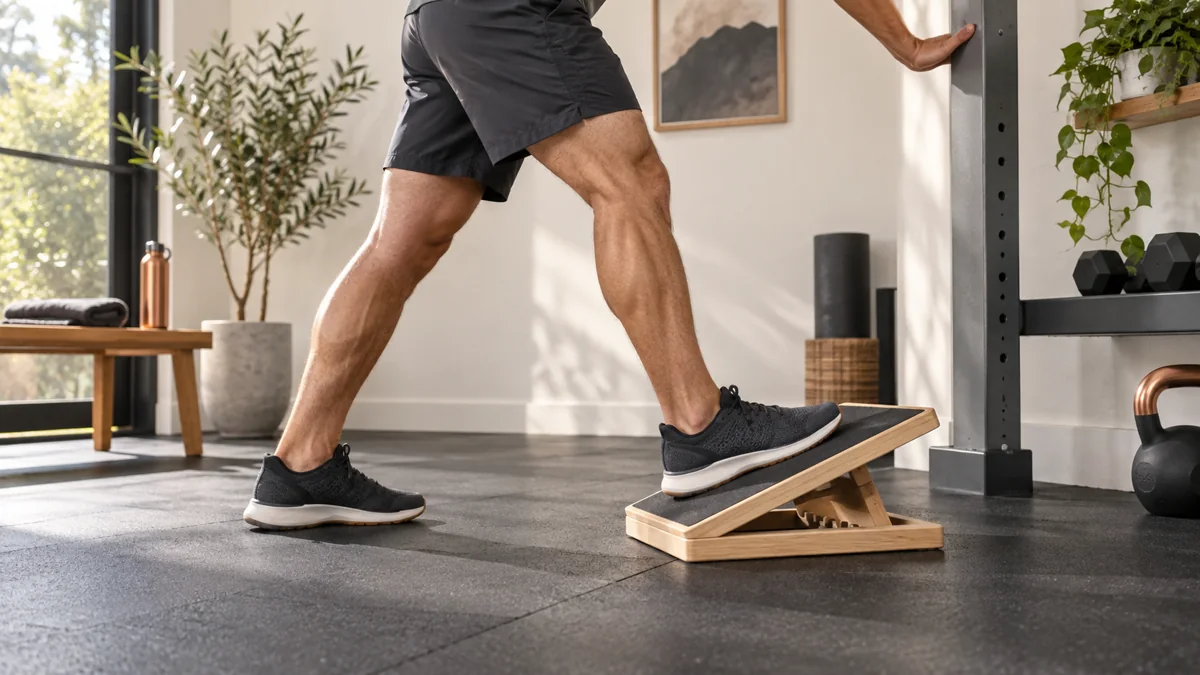
A Better Calf Stretch Starts With a Stable Angle
The right slant board lets you adjust the stretch gradually, keep secure contact underfoot, and focus on controlled ankle movement instead of fighting an unstable platform.
A slant board gives the foot a consistent inclined surface for calf stretching, ankle-mobility drills, and warmups. Compared with improvising on a stair edge or loose plate, a purpose-built board can provide more predictable positioning and a larger contact area.
For most people primarily interested in calf stretching, the Yes4All Professional Wooden Slant Board with Toe Stretcher Bar is our best overall choice. It combines five positions with a raised front bar designed specifically for stretch-focused use. The other recommendations serve buyers who want a larger wooden platform, a lighter portable design, or a simple fixed wedge.
Yes4All Professional Wooden Slant Board
Choose it for five adjustment positions, a wooden platform, an anti-slip surface, and a toe-stretcher bar intended for focused calf work.
Best Calf-Stretching Slant Boards at a Glance
| Product | Best for | Construction | Adjustment | Standout feature | Amazon |
|---|---|---|---|---|---|
| Yes4All Professional Wooden Slant Board | Dedicated calf stretching | Wood | 5 positions | Raised toe-stretcher bar | View |
| StrongTek Extra-Large Wooden Slant Board | Large stable platform | Wood | 5 angles, 15°–35° | Extra-large standing area | View |
| StrongTek Portable Slant Board | Travel and storage | ABS plastic | 5 levels, listed 20°–50° | Approximately 3.7 pounds | View |
| Wolf Squat Wedge Block | Simple fixed setup | Dense EVA | Fixed 15° | Wide 27-inch platform | View |
Product listings, specifications, sellers, and availability can change. Confirm the active Amazon listing before ordering.
How We Chose These Boards
This is a research-based buyer’s guide. Balance Foundry has not physically tested every board listed. We compared current manufacturer and retailer information, incline options, usable platform area, toe support, surface grip, construction, storage, portability, and how well each design fits calf-stretching use. Learn more in our Review Methodology.
We prioritized safe progression over maximum angle. A useful calf-stretching board should provide a manageable starting position, allow controlled increases when appropriate, and remain stable while the user holds a support.
Detailed Slant Board Reviews
1. Yes4All Professional Wooden Slant Board with Toe Bar
The Yes4All stands out because its raised front bar is designed to give the toes a clear contact point during stretch-focused positioning.
The five-position setup gives users room to begin at a lower incline and increase gradually. The anti-slip surface should help keep the shoe planted, while the toe bar can make the board feel more purpose-built for calf stretching than a general squat wedge.
The bar will not suit every movement or foot position, and the wooden construction is less convenient for travel than a compact plastic model. The 500-pound capacity is a retailer/manufacturer listing claim rather than our independent test.
Pros
- Five adjustment positions
- Stretch-specific toe bar
- Anti-slip standing surface
Cons
- Toe bar may limit some exercise positions
- Bulkier than a compact travel board
- Capacity is a listing claim
2. StrongTek Extra-Large Wooden Slant Board
The StrongTek XL is the stronger fit for users who value standing room and want one adjustable board for stretching, mobility drills, and heel-elevated exercise.
Its lower 15-degree setting offers a moderate place to begin, while the five total angles make progressive positioning straightforward. The larger surface can feel more secure for people with bigger feet or those who dislike narrow portable platforms.
This model does not have the Yes4All’s toe bar, and its size and wood construction make it the least travel-friendly option in the group. It makes the most sense as equipment that stays in one home or training area.
Pros
- Five clearly listed angles
- Large standing surface
- Useful for stretching and strength work
Cons
- No dedicated toe bar
- Bulky for travel or frequent storage
- More expensive materials than simple EVA
3. StrongTek Portable Slant Board
The StrongTek Portable is the easiest model here to move between home, office, and gym thanks to its compact ABS construction and listed 3.7-pound weight.
The listing describes five levels across a 20-to-50-degree range. That gives users several choices, but the steepest positions may be unnecessary or inappropriate for many beginners. Start low, maintain control, and increase only when the stretch remains comfortable.
The smaller platform saves space but provides less room underfoot than the XL wooden model. Plastic will also feel different from a rigid wooden surface, particularly near the upper end of the user’s weight range.
Pros
- Lightweight and easy to carry
- Five incline levels
- Compact storage footprint
Cons
- Smaller usable platform
- High settings may be too aggressive
- Plastic feel may not suit every user
4. Wolf Squat Wedge Block
The Wolf Wedge trades adjustability for simplicity: one wide EVA platform, one moderate angle, and no supports or hinges to reposition.
A 15-degree incline is less aggressive than the upper settings on adjustable boards, and the listed 27-inch width provides ample room. The one-piece design is quick to position and useful when several people want a repeatable, moderate stretch without changing hardware.
Its obvious limitation is that it cannot progress through multiple angles. EVA may also compress more than wood or metal, although the listing promotes the material as ultra-dense and gives a tested-capacity claim that buyers should verify on the current page.
Pros
- Moderate 15-degree incline
- Wide platform
- No adjustment mechanism
Cons
- Only one angle
- EVA may compress under load
- Originally designed with squatting in mind
What Does a Slant Board Calf Stretch Target?
Gastrocnemius
This larger, more visible calf muscle crosses the knee and ankle. A calf stretch performed with the knee relatively straight generally emphasizes it more.
Soleus
The soleus sits deeper and does not cross the knee. Gently bending the knee while maintaining heel contact typically shifts more emphasis toward it.
Ankle Dorsiflexion
The position can expose the ankle to controlled dorsiflexion. That does not guarantee a permanent mobility change, but it can be one useful part of a broader mobility routine.
How to Choose a Slant Board for Calf Stretching
Choose a Usable Starting Angle
A board is only useful if you can control the lowest setting. Adjustable designs offer more progression, while a moderate fixed wedge is easier to set up and repeat.
Check the Platform Dimensions
Your heel and enough of the foot should feel secure on the inclined surface. Larger feet generally benefit from a longer, wider platform.
Prioritize Surface and Floor Grip
Look for tread or textured material beneath the foot and non-slip contact points underneath the board. Use the equipment only on a dry, level surface.
Decide Whether You Want a Toe Bar
A raised bar can provide a clear reference point and additional forefoot contact during calf stretching. It may be less convenient for exercises that require moving the foot around the platform.
Consider Where You Will Use It
Wooden boards offer a rigid, furniture-like feel but tend to be heavier. ABS and EVA models are easier to carry and store, although their size and firmness vary.
How to Use a Slant Board for a Calf Stretch
- Place the board on a dry, level, non-slip floor near a wall, rail, or sturdy support.
- Begin with the lowest practical angle.
- Place one foot securely on the incline with the heel supported and toes pointing generally forward.
- Keep the knee straight—but not forcefully locked—to emphasize the gastrocnemius.
- Move the body forward gradually until you feel mild-to-moderate tension in the calf.
- Hold without bouncing and breathe normally.
- Repeat with a small knee bend to shift emphasis toward the soleus.
- Step off before changing the board angle.
Frequently Asked Questions
What angle is best for calf stretching?
There is no single best angle. Many beginners do well with a moderate incline near 10–20 degrees, but comfort depends on ankle mobility, the specific stretch, and injury history. Start lower and progress gradually.
How long should I hold a slant-board calf stretch?
A common approach is a comfortable static hold of roughly 20–30 seconds, repeated several times. Your program may differ based on goals and professional guidance. Avoid bouncing or forcing the end range.
Should my knee be straight or bent?
Both variations can be useful. A straighter knee generally emphasizes the gastrocnemius, while a bent-knee position usually places more emphasis on the soleus.
Can I use a slant board every day?
Gentle mobility work may be appropriate frequently, but daily use is not automatically right for everyone. Adjust intensity and frequency based on recovery, soreness, symptoms, and the rest of your training.
Can a slant board help plantar fasciitis or Achilles pain?
Calf flexibility and ankle function can be relevant to these conditions, but a slant board is not a diagnosis or guaranteed treatment. Pain can have several causes, and aggressive stretching may aggravate some injuries. Seek individualized medical advice.
Is a toe bar necessary?
No. Many people stretch effectively on a plain anti-slip platform. A toe bar is a preference that can provide additional forefoot contact and a more stretch-specific setup.
Our Final Recommendation
Choose the Yes4All Professional Wooden Slant Board for a dedicated calf-stretching setup with five positions and a toe bar. Pick the StrongTek XL for a roomier multi-use platform, the StrongTek Portable for easier transport, or the Wolf Wedge for a simple fixed 15-degree incline.
Continue with our Slant Boards Hub, compare the best adjustable slant boards, or explore our guide to the best slant boards for squats.
Leave a Reply