
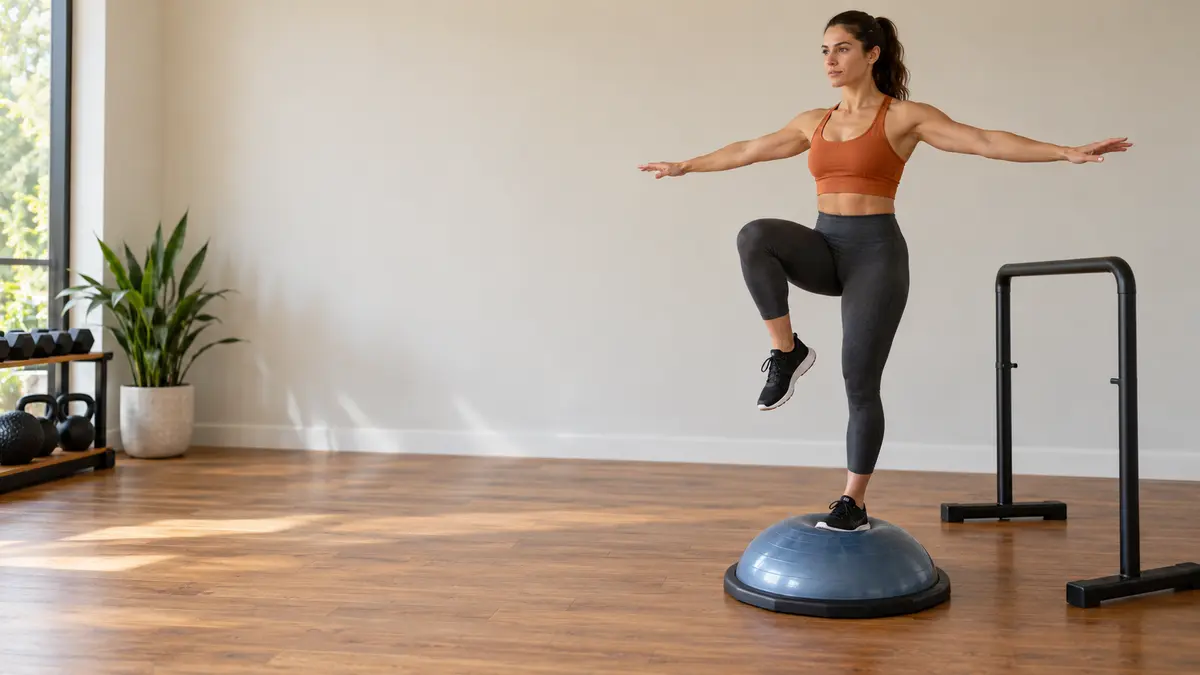
BOSU balance exercises can scale from a supported two-foot stance to demanding single-leg and reactive drills. The dome creates movement in several directions, so progression should come from control—not from trying to make the surface as unstable as possible.
Set up the half-ball trainer
Check that the base sits flat, the dome is evenly inflated and the floor is dry. Firmness changes the feel of the surface, so use the BOSU inflation and firmness guide before training.
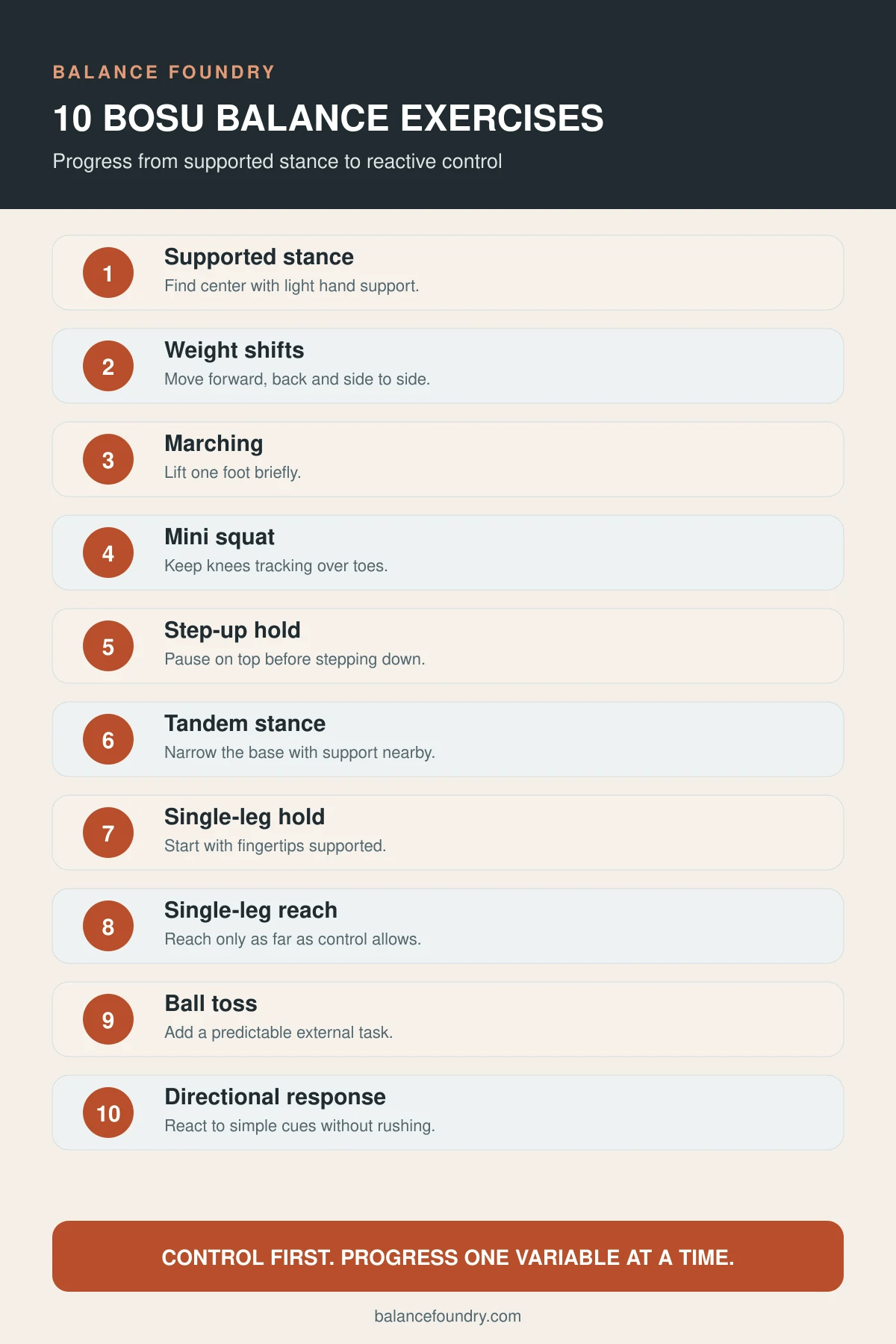
10 BOSU balance exercises
1. Supported two-foot stance
Step onto the dome one foot at a time while holding support. Find a hip-width stance and gradually lighten your grip.
2. Controlled weight shifts
Shift pressure forward, backward and side to side. Keep the movement small enough that your feet stay connected to the dome.
3. Alternating march
Transfer weight and lift one foot a few inches. Pause, replace it and switch sides without rushing.
4. Mini squat
Sit the hips back slightly while the knees track with the toes. Use a shallow depth and keep the torso controlled.
5. Step-up and hold
Step onto the center of the dome, bring the second foot up and pause. Step down under control. Alternate the leading leg.
6. Tandem stance
Place one foot slightly ahead of the other. Narrow the position gradually and keep support close.
7. Supported single-leg hold
Stand near the center with one foot and light fingertip support. Float the other foot only after you feel stable.
8. Single-leg reach
Maintain the stance leg while reaching one hand or the free foot toward a target. Reduce reach distance before compromising alignment.
9. Ball toss
Use a light ball and predictable throws. Start with two feet, then progress to a narrower stance.
10. Directional response drill
Have a partner call simple directions or point to targets. Move deliberately; speed is not useful if it removes control.
A simple progression
| Stage | Exercises | Progress when |
|---|---|---|
| Foundation | Supported stance and weight shifts | You can stay relaxed for 30 seconds |
| Dynamic two-foot | March, squat and step-up | The dome movement stays controlled |
| Narrow base | Tandem and supported single-leg stance | You can correct without hopping off |
| External task | Reach, toss and directional response | Alignment remains organized while attention shifts |
The 20-minute beginner BOSU workout combines several movements into a routine. Read what BOSU training can and cannot do for a balanced view of the evidence.
Dome side or platform side?
A study comparing single-leg stance on both orientations found similar ankle muscle activity between sides in healthy collegiate men. That does not mean the positions feel identical or carry the same setup demands. Platform-side-up work creates a raised rigid platform and should be reserved for users who understand the equipment and can get on and off safely.
If you are comparing equipment, see the best half-ball balance trainers and the guide to half balls versus full stability balls.
How firmness changes the exercise
Dome firmness changes how the trainer responds underfoot. A very firm dome may feel more responsive, while a softer dome allows more deformation. Neither is automatically safer or more effective. Stay within the manufacturer’s inflation guidance and use the same firmness when comparing performance from week to week.
A 15-minute BOSU balance session
Warm up with two minutes of marching and ankle movement on the floor. Complete two 30-second supported stances, eight controlled weight shifts in each direction and two sets of six mini squats. Then perform two step-up holds per side and finish with supported single-leg holds.
At a later session, replace one foundation drill with reaches or a light ball toss. Do not add every advanced variation to the same workout.
How to progress without chasing instability
First reduce your reliance on the support. Next improve hold time or repetition quality. Then narrow the stance or move to one leg. Add reaching, catching or response cues last because these divide attention.
Progress can also mean performing the same drill with less tension. Quieter shoulders, softer toe gripping and smoother corrections show improved organization even when the exercise looks unchanged.
Who should use extra caution?
Start on stable ground or seek professional guidance if you have acute lower-extremity pain, recent surgery, unexplained dizziness, significant sensory loss or a history of falls. Keep the training area clear so stepping off does not create a second hazard.
Frequently asked questions
Can beginners do BOSU balance exercises?
Yes. Start dome-side up with support and a two-foot stance. Avoid advanced single-leg or reactive drills until the foundation is controlled.
Should I wear shoes?
Either shoes or bare feet may be appropriate depending on the dome surface, exercise and your comfort. Avoid socks alone if they slide.
How long should a BOSU balance workout last?
Ten to twenty focused minutes is plenty for many users. Stop when fatigue changes posture or foot control.
Research used
- BOSU balance-training progression trial
- Ankle muscle activation on both BOSU orientations
- Short-term unstable-surface proprioceptive training
Health note: This article is for general education and is not a diagnosis or individualized medical advice. Stop if an exercise causes sharp pain, swelling, numbness or instability, and consult a qualified professional when appropriate.
Leave a Reply