
Balance Foundry Benefits Guide
A BOSU ball can make familiar exercises more demanding by adding controlled instability. Its most defensible benefits involve balance practice, body control, exercise variety and certain forms of core or joint-stabilizer demand—not automatic weight loss, perfect posture or superior strength gains.
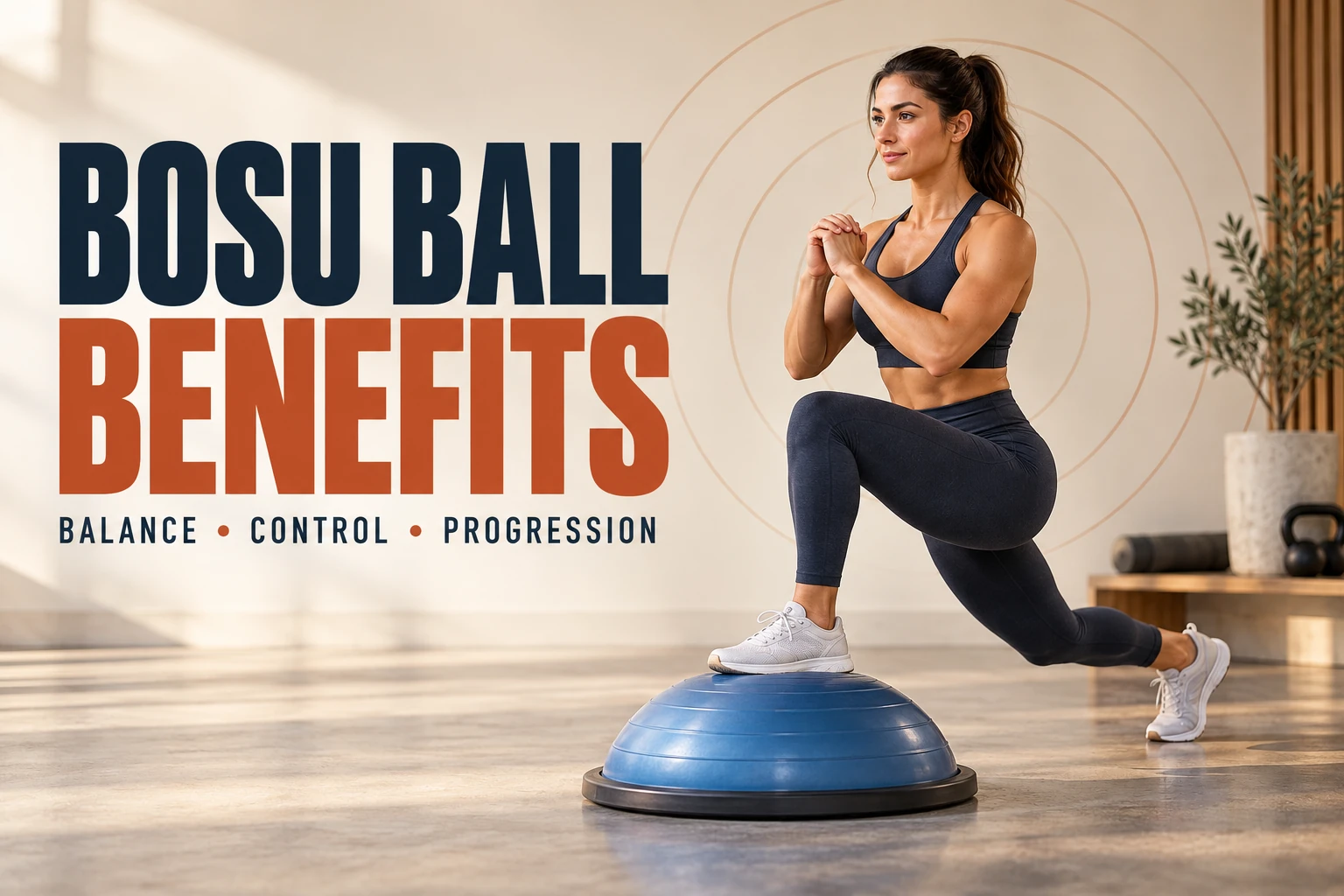
A BOSU ball—more accurately called a half-ball balance trainer—combines an inflatable dome with a rigid platform. That design creates more movement than the floor while remaining more predictable than a fully round stability ball. You can stand, kneel, sit or place your hands on the dome, depending on the exercise.
The challenge is easy to feel, but feeling more wobble does not automatically mean an exercise is more effective. The useful question is not, “Is this harder?” It is, “Does this added instability support the result I want?”

Seven practical BOSU ball benefits
1. It creates a scalable balance challenge
The moving dome gives your body continuous feedback. Small changes at the ankles, knees, hips and trunk help keep your center of mass over the training surface. This makes the BOSU useful for supported stands, weight shifts, step-ups and other drills in which maintaining control is the primary goal.
Balance training has been shown to improve balance performance in a range of populations, although the improvement is often specific to the tasks being practiced. In other words, getting better at a BOSU drill does not guarantee equal improvement in every balance test or real-world activity. That is one reason a good program uses several positions and movement patterns instead of relying on one impressive-looking exercise.
2. It encourages slower, more deliberate movement
An unstable surface gives immediate feedback when you rush, lose foot pressure or allow the body to drift. For many people, that naturally encourages slower repetitions and more attention to alignment.
This can be useful during bodyweight squats, split-stance holds, bridges and controlled reaches. The benefit comes from the focused practice—not from wobbling as much as possible. If the movement becomes too chaotic to repeat with good form, reduce the difficulty or return to the floor.
3. It can increase stabilizer demand in selected exercises
Some exercises performed on unstable surfaces increase activity in muscles that help control the trunk or joints. However, the response depends on the movement, surface, load and person. Research does not support the blanket claim that every exercise activates every muscle more effectively on a BOSU.
For example, a plank with the hands on the dome may require additional control at the shoulders and trunk. A bridge with the feet on the dome may challenge hamstring and pelvic control. Those changes can be useful when they match the exercise goal, but they do not make stable versions obsolete.
4. It adds progression without immediately adding weight
External load is not the only way to progress an exercise. You can also change the base of support, range of motion, tempo, stance or amount of assistance. A BOSU ball offers several of those options.
A supported two-foot balance hold can progress to small weight shifts, a shallow squat, reaching movements or a carefully selected single-leg variation. This creates a useful learning ladder for someone who needs more challenge but is not ready to add speed or heavy resistance.
5. It provides many exercise positions in one compact tool
A half-ball trainer can support standing balance exercises, lower-body strength variations, planks, push-ups, bridges, mountain climbers and mobility work. That versatility is one of its clearest practical advantages for a home gym.
If you are deciding whether this shape fits your training better than a round exercise ball, read our half ball vs. full stability ball comparison. The half ball is generally more practical for standing exercises, while a full stability ball offers more options for rolling, seated and back-supported movements.
6. It can support sport-related balance and control
Athletes may use half-ball exercises to supplement ankle control, landing preparation, trunk stability or coordinated lower-body work. The keyword is supplement. Sport performance still depends on practicing the sport, producing force on stable ground, developing strength and power, and managing workload.
Balance programs can improve postural control, and some broader injury-reduction programs that include balance work have reduced ankle injuries in athletic populations. That does not prove that owning or casually using a BOSU ball prevents injury. The program, frequency, progression, sport and athlete all matter.
7. It can make training more engaging
Adherence matters. If a BOSU ball makes a workout feel more interesting, gives you a clear progression to practice or helps break up a repetitive routine, that is a legitimate benefit. Variety should still have a purpose. Rotate exercises because they train something useful—not simply because they look different.
What half-ball training cannot guarantee
It does not guarantee weight loss
A BOSU workout uses energy, but body-fat loss depends on the larger pattern of nutrition, total activity, training consistency and recovery. The equipment itself has no special fat-burning effect.
It does not automatically fix posture
Posture changes throughout the day and is influenced by habits, workstation setup, movement options, strength, fatigue and comfort. Briefly balancing on a dome does not permanently place the body into a “correct” posture.
It does not guarantee pain relief
Some people enjoy controlled instability work, while others find it uncomfortable or inappropriate. Persistent pain deserves individualized evaluation rather than a one-tool solution.
It does not replace stable strength training
Unstable surfaces commonly reduce the force or power you can produce. When maximal strength, muscle growth or power is the priority, stable exercises usually allow more useful loading.
It does not prevent every injury
Balance work may be one component of a broader program, but no single exercise or device eliminates injury risk. Strength, exposure, technique, fatigue, recovery and previous injury also matter.
It is not appropriate for every exercise
Adding instability to heavy lifts, fast movements or complex skills can reduce quality without adding a meaningful benefit. Use the floor when stability better serves the goal.
Research comparing stable and unstable resistance exercise generally supports this balanced view. Unstable training can improve balance and provide a meaningful coordination challenge, but force and power output are often lower during unstable versions. That makes a BOSU a useful accessory rather than the foundation of a complete strength program.
Dome-side up versus platform-side up
| Orientation | Typical uses | Relative challenge | Best starting point |
|---|---|---|---|
| Dome-side up | Supported standing, squats, step-ups, lunges, bridges and mobility | Usually easier to approach and more predictable | Most beginners should start here near stable support |
| Platform-side up | Planks, push-ups and advanced standing drills when approved by the manufacturer | Often more reactive and less forgiving | Use only after you control simpler dome-up exercises |
Not every half-ball trainer is designed or approved for every orientation. Follow the manufacturer’s instructions for your model, inspect the dome and base, and avoid platform-up standing if the product guidance does not support it.
Firmness also changes the training feel. Before beginning, use our guide to inflating a BOSU ball and adjusting firmness.
When a BOSU ball fits your goals
| Your goal | How useful is a BOSU? | Recommended role |
|---|---|---|
| Improve balance confidence | High | Use supported holds, weight shifts and controlled stepping progressions. |
| Add bodyweight exercise variety | High | Use selected squat, plank, bridge and push-up variations. |
| Build maximal strength | Low as a primary tool | Prioritize stable resistance exercises; use the BOSU only for accessory work. |
| Develop explosive power | Limited | Most power work is better performed on a stable surface where force can be expressed safely. |
| Support sport preparation | Moderate | Choose drills that complement—not imitate—the demands of the sport. |
| Lose weight | Indirect | Use it as one part of a consistent activity and nutrition plan. |
If you want to compare available models, visit our guide to the best half-ball balance trainers for exercise. Experienced athletes considering a firmer performance model can also read our BOSU Elite review.
How to start using a BOSU ball
- Clear the area. Use a level, nonslip surface with enough space to step off safely in any direction.
- Place the dome side up. This is the most practical starting orientation for standing balance work.
- Keep support nearby. Use a wall, rail or sturdy chair until mounting, standing and stepping down feel controlled.
- Begin with a static hold. Practice 15 to 30 seconds with soft knees and steady breathing before adding movement.
- Add small weight shifts. Move gently forward, backward and side to side without letting the edges of the base slam into the floor.
- Progress one variable at a time. Add range, repetitions, arm movement or reduced support—not all of them in the same session.
- Stop before control disappears. Fatigue that creates frantic corrections is a signal to rest or regress the exercise.
How often should you use one?
For general fitness, two or three brief sessions per week can be enough to practice the skill without allowing fatigue to dominate. You might add 5 to 15 minutes of balance or accessory work to an existing workout rather than building every session around the BOSU.
Beginners usually benefit from repeated exposure to a few basic movements. Practice a supported hold, shallow squat, step-up and incline plank until each feels consistent. Then progress the exercise or add a new pattern. Constantly changing drills makes it harder to tell whether your control is actually improving.
Frequently asked questions
Is a BOSU ball good for beginners?
Yes, when beginners start dome-side up, keep stable support nearby and choose simple drills. A half-ball trainer becomes inappropriate when the exercise demands more balance than the person can control.
Does a BOSU ball strengthen your core?
It can increase trunk-control demands during selected planks, bridges, presses and standing exercises. It does not automatically make every exercise a better core exercise, and it should not replace progressive stable strength training.
Can BOSU training improve balance?
It can provide an effective way to practice balance and postural control. Improvements are usually greatest in tasks similar to what you train, so include several stances, directions and movement patterns.
Is standing on the flat side better?
No. Platform-side-up standing is simply more challenging and may not be approved for every model. Dome-side-up work is usually the better starting point and can remain challenging when you add purposeful movement.
Can a BOSU ball replace regular strength training?
No. Unstable exercises commonly limit the force and power you can produce. Use a BOSU for balance, control and selected accessory movements while keeping stable, progressively loaded exercises in your program.
Is a BOSU ball worth buying?
It can be worthwhile if you will regularly use it for balance practice, bodyweight progressions or varied home workouts. It may not be necessary if your priorities are heavy strength training, running, cycling or activities that require little equipment.
The bottom line
The most credible BOSU ball benefits are practical: it creates a scalable balance challenge, adds coordination demands to selected exercises and provides many training positions in one compact tool. It can be especially useful for supported balance practice, controlled bodyweight progressions and accessory work.
What it cannot do is just as important. A BOSU ball does not guarantee weight loss, fix posture, remove pain, prevent injury or outperform stable strength training. Use it when instability supports the goal—and choose the floor when it does not.
Explore more equipment comparisons, workouts and setup help in the Balance Foundry Balance & Stability Balls hub.
Research references
- Behm DG, Muehlbauer T, Kibele A, Granacher U. Effects of strength training using unstable surfaces on strength, power and balance performance across the lifespan. Sports Medicine.
- Behm DG, Colado JC. Instability resistance training for health and performance. International Journal of Sports Physical Therapy.
- Saeterbakken AH, Fimland MS. Muscle force output and electromyographic activity in squats with various unstable surfaces. Journal of Strength and Conditioning Research.
- Zech A, Hübscher M, Vogt L, Banzer W, Hänsel F, Pfeifer K. Balance training programs in athletes: a systematic review. Sports Medicine.
- Al Attar WSA, et al. Injury prevention programs that include balance training exercises reduce ankle injury rates among soccer players. Journal of Physiotherapy.