
Active-Seating Guide
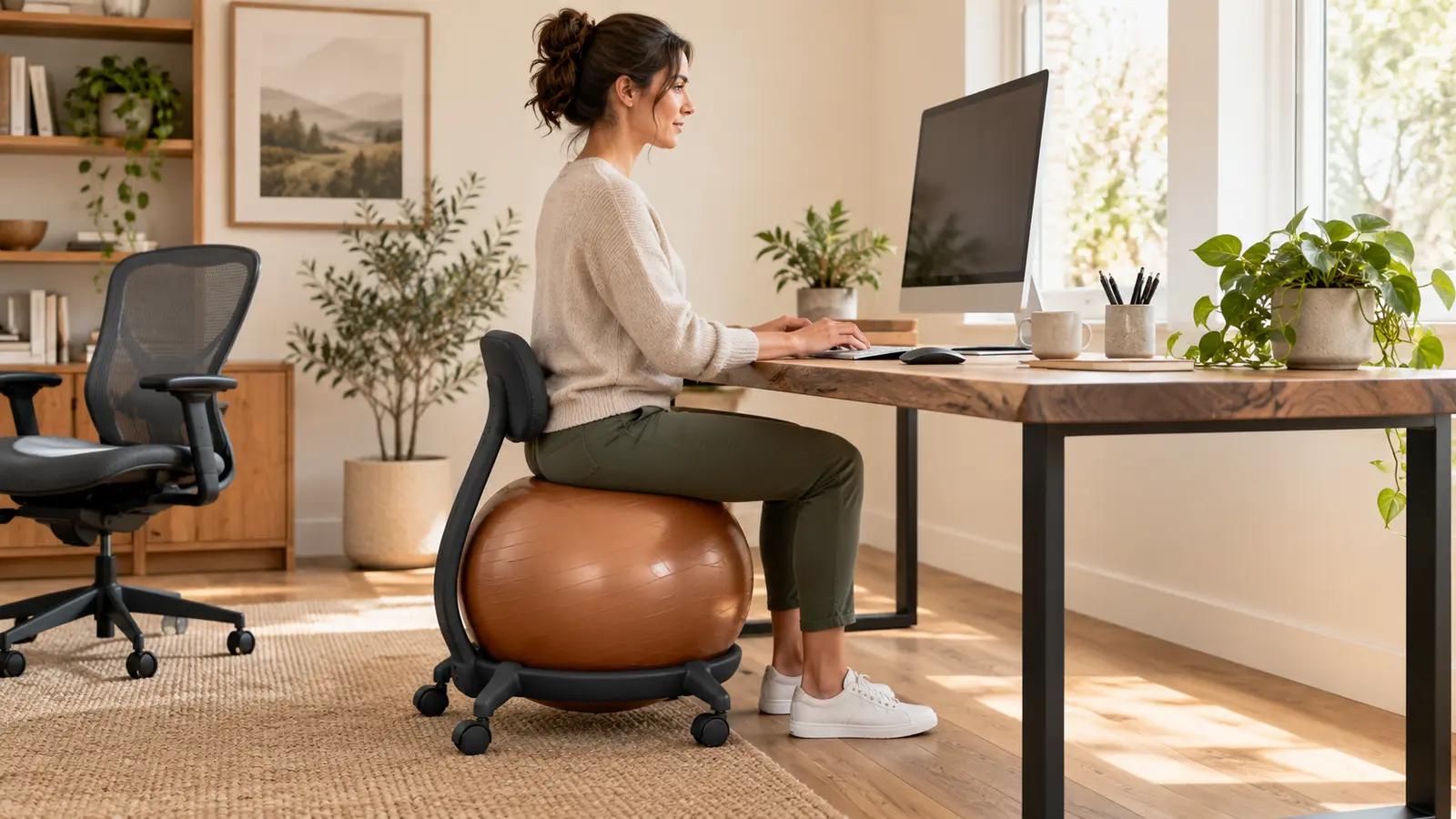
A stability ball office chair can add movement and variety to your workday, but it does not automatically correct posture, strengthen your core or prevent back pain. The most credible use is as an occasional seating option that complements—not replaces—a properly adjusted ergonomic chair and regular movement breaks.
This guide explains the potential benefits, limitations and safety considerations, then compares four chair systems with different amounts of back support, mobility and exercise versatility.
Affiliate disclosure: Balance Foundry may earn a commission from qualifying purchases made through links on this page, at no additional cost to you. Product details, availability and prices can change. Verify current specifications before purchasing.
Should You Use a Stability Ball as a Chair?
For most people, a balance ball office chair is best treated as a secondary seat. It can offer a different sitting experience and encourage small position changes, but it lacks many adjustments found on a conventional task chair.
Research has not consistently shown that prolonged ball sitting meaningfully improves lumbar posture or core-muscle activity. Some studies have reported more discomfort during extended use. That does not make every ball-chair system useless; it means the product should be evaluated as a seating option rather than a medical solution.
Possible Stability Ball Chair Benefits
More Opportunities to Change Position
A ball surface permits small shifts of the pelvis and legs. For someone who otherwise remains motionless for long periods, that variety may make the workday feel less static.
A More Active Sitting Experience
Some users feel more alert on a movable surface. This is a subjective benefit—not proof that the chair builds meaningful core strength—but it may help certain people notice when they have been sitting too long.
Exercise Versatility
A removable ball or ball-and-base system can sometimes be used for mobility work, bridges, wall squats or other exercises away from the desk. A framed chair is generally less versatile than a free ball.
Simple Position Variety
Alternating among a supportive chair, standing and brief ball-chair sessions gives you more positions than relying on one seat all day. The change itself may be more valuable than any single “perfect” posture.
Drawbacks and Safety Considerations
Fatigue Can Degrade Posture
Without adequate back support, the muscles around your trunk and hips may fatigue. When that happens, users often slump, lean on the desk or tuck their feet beneath the ball. Remaining on the chair after control deteriorates defeats the purpose of active sitting.
Limited Ergonomic Adjustment
Many ball chairs do not offer adjustable seat height, seat depth, armrests or lumbar support. If the chair height does not match the desk, you may compensate by elevating your shoulders, reaching forward or positioning your wrists poorly.
Fall and Roll Risk
A free stability ball can roll away during mounting or standing. Bases and frames reduce movement but do not eliminate it. Wheels add convenience yet create another moving component, so verify that the casters or locks behave as intended.
Heat and Surface Comfort
Inflatable PVC is less breathable than many upholstered or mesh seats. Long sessions may feel warm or uncomfortable, especially when the ball is firmly inflated.
No Guaranteed Back-Pain Relief
Back pain has many causes. A ball chair can aggravate symptoms in some users because it removes back support and increases the demands of sitting. Anyone with ongoing pain, balance limitations or a recent injury should discuss the setup with a qualified healthcare professional.
Stability Ball Office Chairs Compared
| Product | Chair style | Listed features | Best for | Main limitation |
|---|---|---|---|---|
| Gaiam Classic Balance Ball Chair | 52 cm ball in wheeled frame with back bar | Pump, frame and ball | Traditional ball-chair experience with a contained frame | Back bar is not equivalent to adjustable lumbar support |
| Champion Sports FitPro | Ball chair with wheels and back support | Hand pump, rolling base and back support | Users prioritizing mobility and a more chair-like frame | Confirm final seat height and caster behavior |
| Gaiam Classic Backless | 52 cm ball in a low backless base | Pump, ball and compact frame | Open active sitting without a back bar | Least support of the framed chair options |
| Trideer Exercise Ball Chair with Bands | Ball with secure base and resistance bands | Base, ball and exercise bands | Users wanting active sitting plus workout versatility | Not as furniture-like as a wheeled office-chair frame |
How these products were assessed: This is a research-based comparison using the supplied listings and publicly described features. It does not claim that every chair was personally tested. We compared chair format, support, movement, exercise versatility and workstation considerations. Read more about how Balance Foundry reviews equipment.
Four Stability Ball Office Chair Options
1. Gaiam Classic Balance Ball Chair
The Gaiam Classic uses a 52 cm anti-burst ball inside a wheeled frame with a back bar. Of these four products, it most closely resembles a conventional rolling desk chair while retaining a ball seat.
The frame helps contain the ball and makes desk positioning more predictable. However, the rear bar should not be mistaken for adjustable lumbar support. Measure the completed chair height against your desk before buying.
- Contained wheeled frame
- 52 cm ball and pump included
- More familiar office-chair format
- Limited ergonomic adjustment
- Back bar offers less support than a task-chair backrest
- Frame reduces exercise versatility
2. Champion Sports FitPro Balance Ball Chair
The Champion Sports FitPro combines a ball seat, rolling base and back support. It is aimed at users who want an active-seating surface without giving up the convenience of wheels.
That mobility makes workstation placement easier, but it also makes caster quality and stability important. Confirm the assembled height and whether the wheel design suits your flooring.
- Wheels and back support
- Hand pump included
- Chair-like office configuration
- Still lacks the adjustability of a quality ergonomic chair
- Moving base may not suit every user
- Requires adequate floor clearance
3. Gaiam Classic Backless Balance Ball Chair
The backless Gaiam model uses a 52 cm ball in a compact frame without the rear support bar. This creates a more open active-seating experience and may fit spaces where a taller frame feels bulky.
The tradeoff is straightforward: there is no back support to use when fatigue sets in. It is better suited to short sitting intervals than uninterrupted desk work.
- Compact backless frame
- 52 cm ball and pump included
- Open movement around the seat
- No back support
- Not intended as an all-day task chair
- Fixed geometry must match the workstation
4. Trideer Exercise Ball Chair with Bands
The Trideer combines a stability ball, retaining base and resistance bands. It is the most exercise-oriented option in this group and can transition from brief desk sitting to stretching or light resistance work.
It does not provide the rolling, furniture-like frame of the Gaiam Classic or Champion chair. Choose it when workout versatility matters more than looking and moving like a standard office chair.
- Base helps limit rolling
- Resistance bands expand exercise options
- More versatile away from the desk
- No backrest or rolling chair frame
- Bands should be inspected before use
- Desk fit depends on the inflated ball and base height
How to Set Up a Stability Ball at Your Desk
Chair and Lower Body
- Keep both feet flat.
- Position your hips level with or slightly above your knees.
- Avoid wrapping your feet around the base.
- Leave enough space to stand safely.
- Follow the chair’s inflation instructions.
Desk and Screen
- Keep your shoulders relaxed.
- Place your elbows near your body.
- Avoid reaching upward to the keyboard.
- Position the monitor near eye level.
- Keep frequently used items within easy reach.
If the fixed chair height does not match your workstation, changing the monitor alone will not solve the problem. You may need a keyboard tray, a different desk height, foot support or a different chair system.
How Long Should You Sit on a Stability Ball Chair?
There is no universal evidence-based duration that fits every person. A conservative approach is to begin with 5–10 minutes, then return to your normal chair. If you remain comfortable and controlled, you can gradually try 15–30-minute periods.
These times are practical starting suggestions, not clinical prescriptions. Stop earlier if you feel fatigue, pressure, pain, numbness, slipping or reduced concentration. The goal is position variety—not accumulating the most time on the ball.
A Simple Workday Rotation
- Use a supportive office chair for focused work.
- Switch to a brief stability ball chair interval.
- Stand, walk or perform a short movement break.
- Return to the supportive chair before fatigue develops.
Who Should Be Especially Cautious?
A stability ball at a desk may be inappropriate for people with significant balance limitations, dizziness, recent surgery, acute pain, lower-extremity weakness or a history of falls. It may also be unsuitable where the floor slopes, the workspace is cramped or sharp furniture edges are nearby.
Ask a qualified clinician for individualized advice if a medical condition influences your seating, balance or pain.
Ball Chair Versus a Regular Stability Ball
A free stability ball offers the most movement and exercise versatility but also the greatest roll risk. A retaining base limits travel. A wheeled frame behaves more like office furniture, yet reduces the freedom that makes a ball useful for floor exercises.
If you need a ball for workouts rather than primarily for sitting, review our best stability balls for exercise and stability ball size chart.
Frequently Asked Questions
Does sitting on a stability ball improve posture?
Not automatically. Research has not consistently found improved lumbar posture during prolonged ball sitting. Posture depends on workstation setup, fatigue, habits and movement throughout the day.
Does a stability ball chair strengthen your core?
It may change how sitting feels, but prolonged sitting has not reliably produced greater trunk-muscle activation than a normal chair. Purposeful exercise is a more direct way to train the core.
Can a stability ball chair help back pain?
It may feel better for some people and worse for others. It should not be presented as a treatment. Persistent or worsening back pain deserves assessment from a qualified healthcare professional.
Is a chair frame safer than a loose ball?
A frame or base can reduce rolling, but it does not eliminate fall risk. Correct assembly, suitable flooring, clear space and controlled mounting still matter.
Can you sit on a balance ball chair all day?
That is generally not the strongest use case. A ball chair lacks many supportive and adjustable features of a good ergonomic chair. Use it as one option in a rotation rather than forcing all-day use.
What size ball chair should I buy?
Follow the complete chair’s sizing instructions, not only a general ball chart. The base or frame changes the final seat height. Confirm that your feet stay flat and your hips sit level with or slightly above your knees.
Final Verdict
A stability ball office chair can provide variety and a more active-feeling seat, but the evidence does not support promises of automatic posture correction, core strengthening or back-pain prevention. The best approach is limited use, careful workstation setup and frequent changes of position.
Among these choices, the Gaiam Classic offers the most conventional framed-chair experience, the Champion FitPro emphasizes rolling mobility, the Gaiam Backless provides a compact open design and the Trideer offers the most exercise versatility.
Leave a Reply