
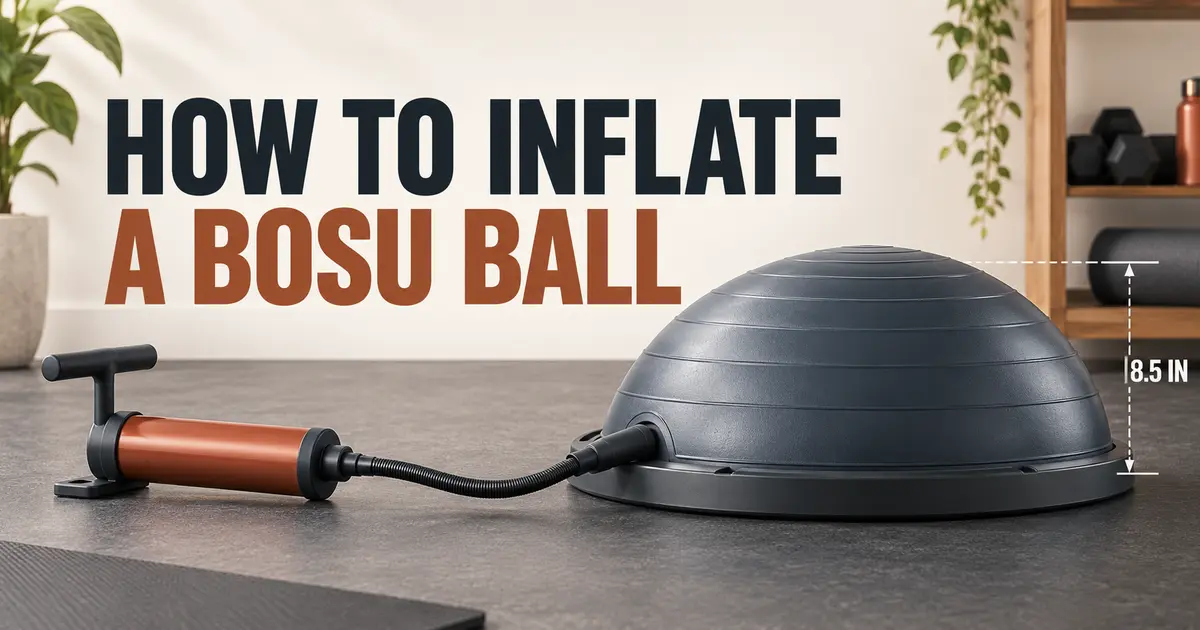
To inflate a BOSU ball, remove the valve plug, insert the correct pump nozzle and add air gradually until the dome measures approximately 8.5 inches from the rigid base. According to BOSU’s current guidance, the dome should not exceed 10 inches and should still give slightly under your weight.
A BOSU ball pump does more than fill an empty dome. It lets you adjust how much the surface gives beneath your hands, knees or feet. Too little air can make the dome collapse excessively. Too much air can exceed the manufacturer’s limit and place unnecessary stress on the material and seams.
The process is simple, but the details matter. The valve should remain clean, the nozzle must fit correctly, and the plug needs to be fully seated after inflation. This guide walks through the process for a BOSU Balance Trainer and provides general guidance for comparable half-ball trainers.

What you need to inflate a BOSU ball
Inspect the dome and base first.
Use the supplied hand or foot pump.
Use a tapered adapter that fits the valve.
Measure from the base to the dome top.
Many BOSU and half-balance-ball packages include a basic manual pump and adapter. A compatible higher-volume hand or foot pump may be easier to use, but avoid forcing an incorrect fitting into the valve.
You will also need the original valve plug and, ideally, a plug-puller tool. Do not use a sharp screwdriver, knife or another object that could damage the plug, valve or dome.
How to inflate a BOSU ball step by step
Inspect the dome, base and valve
Place the trainer on a clean floor with the dome facing up. Look for cracks, cuts, damaged seams, separation between the dome and base, or damage around the valve opening. Do not inflate or use a trainer with visible structural damage.
Wipe dust away from the valve so debris is not pushed inside while the pump nozzle is inserted.
Remove the valve plug
Use the supplied plug puller to lift the plug straight out. Work carefully rather than twisting aggressively. Put the plug somewhere clean and within reach because you will need to replace it immediately after removing the pump nozzle.
Connect the correct pump nozzle
Attach the compatible tapered nozzle or adapter to the hose. Insert it securely enough to limit escaping air, but do not force an oversized adapter into the valve.
A conventional sports-ball needle is different from the wider nozzle commonly used for a half-ball balance trainer. Use only the fitting specified for your model.
Inflate the dome gradually
Pump with smooth, even strokes. Pause periodically to check the dome’s shape and height. The surface should rise evenly rather than bulging sharply in one area.
Do not wait until the dome feels extremely hard before measuring it. It is easier to add a small amount of air than to correct significant overinflation.
Measure the dome height
Place a ruler or tape measure vertically beside the trainer. Measure from the top surface of the rigid base to the highest point of the dome—not from the floor.
BOSU currently recommends inflating its Balance Trainer to approximately 8.5 inches high and states that the dome should not exceed 10 inches. Comparable trainers may specify another measurement.
Remove the nozzle and replace the plug
Keep the plug ready in one hand. Pull the nozzle from the valve and immediately press the plug into place. A brief release of air is normal, but working promptly limits air loss.
Press the plug until it is securely and evenly seated. It should not sit loosely or protrude in a way that could catch during use.
Perform a final check
Set the trainer on its intended exercise surface. Confirm that the base sits flat, the plug remains secure and the dome gives slightly when you press it or carefully apply body weight.
Begin with a supported exercise beside a wall before moving into an entire workout.
How high should a BOSU ball be inflated?
| Measurement | Guidance | Why it matters |
|---|---|---|
| Recommended BOSU dome height | Approximately 8.5 inches | Provides a repeatable starting point for inflation. |
| Maximum BOSU dome height | Do not exceed 10 inches | Helps avoid overinflation and unnecessary material stress. |
| Where to measure | From the top of the rigid base to the dome’s highest point | Measuring from the floor adds the base thickness and gives an incorrect reading. |
| Final feel | The dome should give slightly under weight | A dome that feels rigid with almost no give may be overinflated. |
Do not rely on tire-style PSI assumptions. BOSU’s public guidance uses dome height and feel rather than a universal pressure number. Actual internal pressure can vary with temperature, altitude, product design and measurement equipment.
How to adjust BOSU ball firmness
To make the dome firmer
- Remove the plug carefully.
- Insert the compatible pump nozzle.
- Add a small amount of air.
- Measure the dome again.
- Replace the plug and test the surface.
A firmer dome has less give under pressure. Never exceed the height limit to achieve a harder feel.
To make the dome softer
- Use the plug puller to remove the plug.
- Release only a short burst of air.
- Replace the plug securely.
- Test the dome and remeasure it.
- Repeat in small increments if needed.
A softer dome has more give and allows the body to sink farther into the surface.
Firmness changes how the trainer feels, but it does not create a simple universal scale from “easy” to “hard.” A softer dome may feel more forgiving during kneeling or lying exercises while creating different foot and ankle demands during standing.
A firmer dome may feel more responsive but less cushioned. Test the setting with a basic supported exercise before progressing.
Common BOSU inflation problems
The dome loses air immediately after pumping
Some air will escape while switching from the nozzle to the plug. Keep the plug ready and insert it promptly. If substantial air continues escaping after the plug is installed, remove it, inspect it for dirt or damage and reinstall it evenly.
The pump nozzle does not fit
Do not force it. Confirm that you have the tapered adapter intended for the trainer rather than a needle for a basketball or soccer ball. Replacement pump kits often include several fittings, but only use one that fits without damaging the valve.
The dome looks uneven
Stop inflating and place the base flat on the floor. Confirm that the dome and base are not damaged or separated. A distorted or damaged trainer should not be used.
The dome feels too hard
Measure its height. If it is overinflated or provides almost no give, release air in short increments and retest. Never exceed the manufacturer’s maximum height.
The dome feels too soft
Check for an improperly seated plug or a slow leak. If the trainer is intact, add air gradually until it reaches the recommended height and desired amount of give.
The trainer repeatedly loses air
A small change over a long period can occur with inflatable equipment and environmental temperature changes. Rapid or repeated air loss may indicate a damaged plug, valve, seam or dome. Stop using the trainer until the cause is identified.
Can you use an electric pump?
A low-pressure electric pump may work when the manufacturer permits it and the correct adapter is available. Electric pumps can add air much faster than a manual BOSU ball pump, making it easier to overshoot the target height.
If you use one, add air in short bursts and measure frequently. Do not use a high-pressure shop compressor or gas-station air line. High-volume or high-pressure equipment can overinflate the dome before you have time to react.
Care, temperature and storage
- Store the trainer away from sharp objects, heaters and prolonged direct sunlight.
- Keep the dome and valve clean and dry.
- Do not place heavy or sharp equipment on the inflated dome.
- Recheck firmness after major temperature changes.
- Inspect the base, dome, seams and plug before each workout.
- Use the plug puller rather than a sharp improvised tool.
Air contracts in colder conditions and expands when warmed. A trainer moved from a cold garage into a warm room may feel different after it reaches room temperature. Allow it to acclimate before making a large firmness adjustment.
Using the trainer after inflation
Start with the dome side up and place the balance trainer near a stable support. Try gentle hand pressure, a supported two-foot stance or another simple movement before beginning your regular routine.
For a guided first session, use our 20-minute BOSU ball workout for beginners . If you are still selecting equipment, compare the best balance balls for exercise .
Frequently asked questions
How much should I inflate a BOSU ball?
BOSU recommends a dome height of approximately 8.5 inches, measured from the top of the rigid base to the highest point of the dome. The company states that the dome should not exceed 10 inches and should give slightly under weight.
What type of pump does a BOSU ball use?
A BOSU ball commonly uses a manual hand or foot pump with a compatible tapered nozzle. Use the pump and adapter supplied with your model whenever possible. Do not assume a sports-ball needle is appropriate.
Can I inflate a BOSU ball with a bicycle pump?
A bicycle pump may work only with a compatible low-pressure adapter. The adapter must fit the valve without being forced. Add air slowly and monitor the dome height because bicycle pumps may deliver air differently from the included pump.
Should a BOSU ball be hard or soft?
It should feel supportive while giving slightly under your weight. Adjust the feel in small increments without exceeding the manufacturer’s specified height.
Does a firmer BOSU ball make exercises harder?
Not in every case. Firmness changes surface response and the amount of give. The effect depends on the exercise, body position and user. Choose a setting that allows controlled technique.
Why does my BOSU ball keep deflating?
Check whether the plug is clean, undamaged and fully seated. Continued rapid air loss may indicate damage to the plug, valve, seam or dome. Stop using the trainer if you cannot identify and correct the problem safely.
Final inflation checklist
- The dome, base, seam and valve show no visible damage.
- The dome measures approximately 8.5 inches for a BOSU Balance Trainer.
- The dome does not exceed the 10-inch maximum.
- The plug is clean and fully seated.
- The rigid base sits flat without rocking or sliding.
- The dome gives slightly when weight is applied.
- A supported test movement feels controlled.
Leave a Reply