
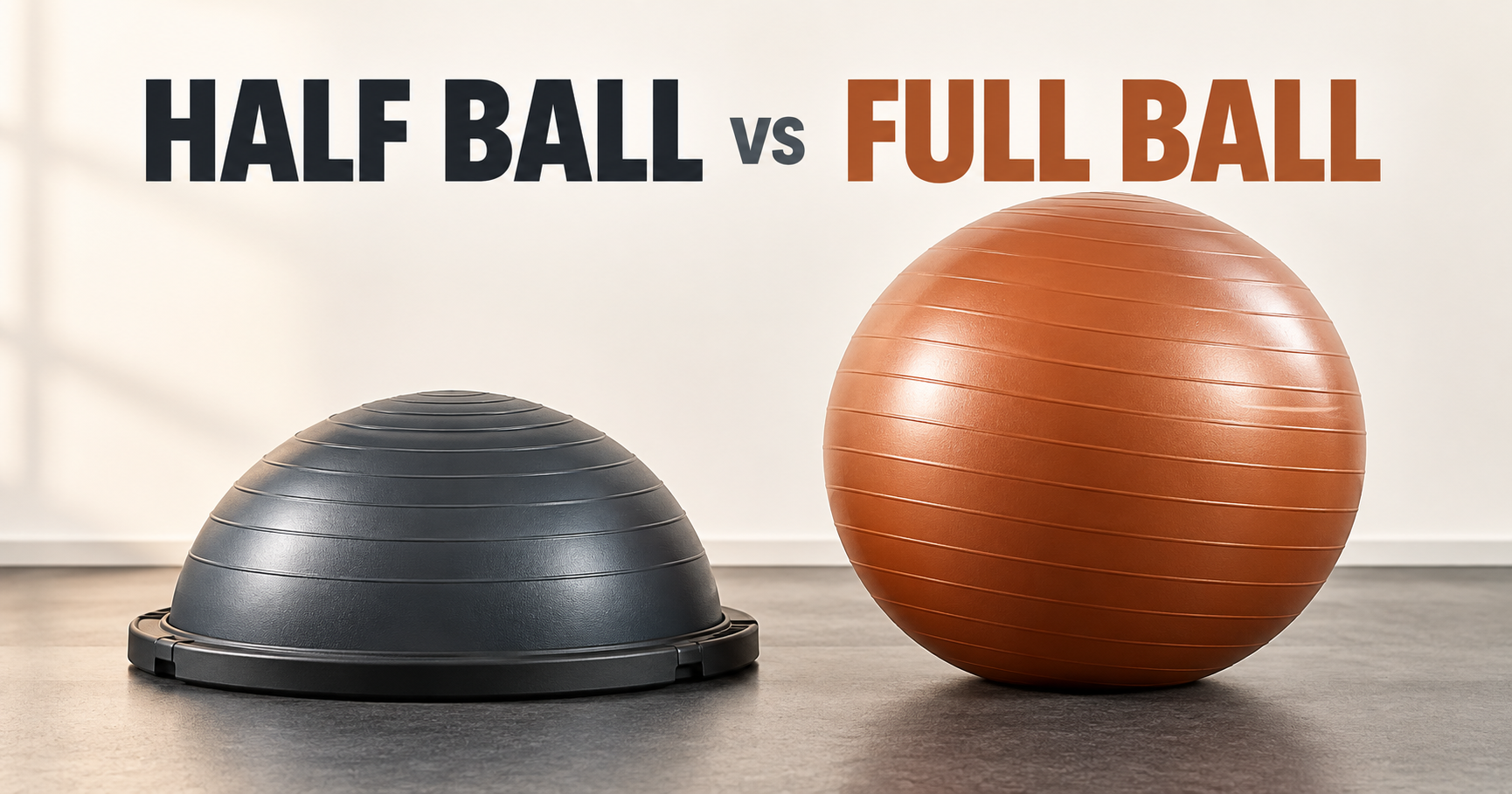
The main difference between a half ball and a full ball is how each one moves. A half-ball balance trainer has an inflatable dome secured to a rigid base, making it useful for standing balance and supported strength exercises. A full stability ball rolls in every direction and is better suited to seated, lying and rolling exercises.
Comparing a half ball vs full ball can be confusing because retailers use names such as balance ball, BOSU ball, exercise ball, yoga ball and stability ball interchangeably. The tools may both be inflatable, but their construction changes how they behave and which exercises they perform best.
Half ball vs full ball: key differences
Half-ball balance trainer
An inflatable dome is permanently attached to a wide, rigid platform. With the dome facing up, the platform stays against the floor while the user stands, kneels, sits or presses on the flexible surface.
- Stable contact with the floor
- Suitable for standing exercises
- Easy to step on and off
- Useful for balance and lower-body drills
- Usually requires more floor space for storage
Full stability ball
A fully round inflatable ball has no flat base. It can roll in any direction, allowing it to support the back, legs or torso while also creating movement beneath the body.
- Rolls freely in every direction
- Useful for seated and lying exercises
- Provides a larger curved support surface
- Available in different sizes based on user height
- Can roll away when not secured
| Feature | Half ball | Full ball |
|---|---|---|
| Construction | Inflatable dome attached to a rigid base | Fully round inflatable ball |
| Movement | Dome compresses and shifts while the base stays planted | Ball can roll in every direction |
| Best-known use | Standing balance and supported strength exercises | Core, seated, rolling and back-supported exercises |
| Common sizes | Often approximately 23 to 26 inches across | Commonly 45, 55, 65 or 75 centimeters |
| Beginner setup | Dome side up near a wall or rail | Use open floor space and prevent unintended rolling |
| Storage | Rigid base prevents compact folding | Bulky when inflated but lighter and easier to move |
| Typical limitation | Less useful for exercises that need a rolling surface | Not intended as a standing platform |
What is a half ball used for?
A half exercise ball is most useful when you want some instability without allowing the equipment to roll freely across the floor. The rigid platform creates a defined footprint, while the dome responds to shifts in pressure.
Standing balance practice
The dome can challenge your ability to control your feet, ankles, knees, hips and trunk during supported holds, marching and weight shifts. Beginners can position the trainer beside a wall and gradually use less hand support as control improves.
Lower-body exercises
Squats, split-stance holds, step-ups and carefully selected lunges can be performed with one or both feet interacting with the dome. The unstable surface generally reduces how much external load you can handle, so the tool is better for coordination and controlled accessory work than maximum-strength training.
Planks and push-ups
The dome provides an elevated surface for the hands or forearms. This makes it possible to adjust the angle of a plank or push-up while asking the upper body and trunk to keep the trainer steady.
Mobility and supported movement
The dome can serve as a raised support for kneeling stretches, ankle movement drills and controlled transitions. Its usefulness depends on the exercise and the user’s ability to get on and off the floor safely.
Potential benefits of a half ball
- Provides a controlled way to practice balance
- Allows standing and stepping exercises that do not fit a rolling ball
- Adds variety to bodyweight strength sessions
- Can be used for upper-body, lower-body and core exercises
- Offers an obvious progression from wall support to less support
The half ball is not automatically superior to a stable floor. Stable exercises usually allow more force production and heavier loading. Use the balance trainer when instability supports the goal—not simply to make every movement harder.
Try the beginner BOSU workoutWhat is a full stability ball used for?
A full ball supports and rolls with the body. That rolling ability is its defining feature. It can increase the movement range of certain exercises, support the spine or legs, and create resistance by moving the ball toward or away from the body.
Seated exercises
A correctly sized stability ball can provide a moving seated surface for posture drills, pelvic movement and light exercises. Sitting on a ball is still sitting, however, and should not be treated as a complete strength or posture program.
Core and trunk exercises
Common options include stability-ball crunches, rollouts, stir-the-pot variations and planks with the forearms or feet supported. Because the ball rolls, these movements can create a longer lever or a changing support point.
Hamstring curls and bridges
Placing the heels on the ball allows the user to combine a bridge with a rolling leg curl. This trains hip extension and knee flexion while the trunk works to limit unwanted movement.
Back-supported strength exercises
The curved ball can support the upper back during light pressing, fly and rotation exercises. The setup requires control and clear space because the ball can move as body position or loading changes.
Stretching and mobility
A full ball can support the body during gentle chest, shoulder, hip and back movements. Its large curved surface can make it useful for supported mobility exercises when the user can safely control the ball.
Potential benefits of a full ball
- Supports seated, supine, prone and back-supported positions
- Allows rolling movements that a half ball cannot provide
- Offers multiple sizes for different users and exercises
- Can expand the range of bodyweight core exercises
- Works well for mobility and supported floor routines
Which ball is better for your goal?
| Your primary goal | Better starting choice | Why |
|---|---|---|
| Standing balance practice | Half ball | The rigid base creates a contained platform for supported standing drills. |
| Beginner core exercises | Either | A half ball works well for elevated planks; a full ball supports seated and lying movements. |
| Hamstring curls | Full ball | The ball must roll toward and away from the body. |
| Squats and step-ups | Half ball | The fixed base is designed for standing contact. |
| Back-supported dumbbell exercises | Full ball | The larger round surface supports the upper back. |
| Small-space storage | Depends | A half ball does not roll away, but its rigid base remains bulky. A full ball is bulky while inflated. |
| General mobility | Either | The best choice depends on whether you need a raised fixed support or a rolling curved surface. |
| Athletic balance drills | Half ball | It accommodates standing, stepping and split-stance exercises. |
Exercises you can do with each ball
Half-ball exercise ideas
- Supported balance hold
- Supported march
- Shallow squat
- Split-stance hold
- Controlled step-up
- Incline push-up
- Forearm plank
- Glute bridge with feet on the dome
- Mountain climber
- Kneeling mobility drill
Full-ball exercise ideas
- Seated pelvic tilt
- Stability-ball crunch
- Wall squat with the ball
- Glute bridge
- Hamstring curl
- Forearm rollout
- Stability-ball plank
- Prone back extension
- Supported dumbbell press
- Gentle chest or back stretch
Can one ball replace the other?
Only for some exercises. Both can support planks, bridges and certain core movements, but the training experience is not identical. A half ball cannot roll through a hamstring curl the way a full ball can. A full ball should not be treated like a fixed standing platform.
If you have room for both, they complement each other. The half ball covers standing balance and fixed-base exercises, while the full ball covers rolling and body-support applications. If you want only one, choose it based on the movements you will perform most often.
Safety and setup differences
Half-ball safety
- Begin dome-side up and keep a wall or rail within reach.
- Place the rigid base on a clean, level, nonslip surface.
- Step onto the center slowly instead of jumping onto the dome.
- Use platform-side-up positions only when permitted by the manufacturer.
- Stop the set when you can no longer control the feet, knees or trunk.
Full-ball safety
- Select the correct diameter for your height and planned exercises.
- Keep the floor clear so the ball cannot roll into furniture or equipment.
- Use the ball away from sharp objects and rough surfaces.
- Follow the manufacturer’s inflation and weight-limit instructions.
- Learn how to get on and off the ball before adding resistance.
Inspect either type for leaks, damaged seams, loose plugs or base damage before use. If you have a history of falls, recent surgery, vertigo or a condition that affects balance, seek individualized guidance before using unstable equipment.
Half ball vs full ball for beginners
A half ball may feel more approachable for standing training because its base does not roll across the floor. That does not mean standing on it is easy. Use a wall and begin with two-foot holds or small weight shifts.
A full ball may be easier for floor-based exercises because it can support a large portion of the body. Its tendency to roll still requires careful positioning. Beginners should start with exercises in which multiple body parts remain in contact with the floor.
In either case, select a familiar exercise and introduce only a small amount of instability. Increasing difficulty gradually is more productive than choosing a complex movement simply because it looks challenging.
Frequently asked questions
Is a BOSU ball a half ball?
Yes. A BOSU Balance Trainer is a branded half-ball trainer with an inflatable dome attached to a rigid platform. “BOSU ball” is commonly used as a general search term, although BOSU is a brand name.
Is a full exercise ball the same as a stability ball?
Usually, yes. Exercise ball, stability ball, Swiss ball and yoga ball are frequently used for the same general type of fully round inflatable ball. Product construction and intended use can still vary.
Which ball is better for core exercises?
Both can train the core. A half ball is particularly useful for elevated planks and exercises that need a fixed base. A full ball allows rolling exercises, longer levers and back-supported movements. Exercise choice and execution matter more than the label on the equipment.
Which is better for balance?
A half ball is generally more practical for standing balance drills. A full ball creates substantial instability but is not intended to be used as a standing platform. It is better suited to seated, kneeling or supported exercises.
Can I use either ball as a desk chair?
A full stability ball can be used as a temporary sitting surface, but sitting on it does not replace regular movement, an appropriate workstation setup or strength training. A half ball is not designed to function as a conventional desk chair.
Do I need both?
No. Buy the tool that matches the exercises you expect to perform. Owning both expands your options, but neither is essential for building strength, balance or mobility.
Final verdict
In the half ball vs full ball comparison, the right answer comes down to movement. The fixed base of a half ball makes it the stronger choice for standing balance, stepping and supported strength exercises. The rolling surface of a full stability ball makes it better for seated work, hamstring curls, back-supported movements and exercises that use the ball’s movement.
Choose the tool that fits your actual workout—not the one with the longest list of theoretical uses. Beginners can make meaningful progress with either option when they start with support, use controlled ranges and increase the challenge gradually.
Compare half-ball trainers Start the beginner workout
Leave a Reply