
Full-Round Stability Ball Workout
Stability ball exercises can train your legs, glutes, chest, back and core while adding a balance challenge to familiar movements. The best place to begin is not the hardest variation—it is the version you can control with steady breathing and consistent alignment.
This guide includes 15 exercises ranging from beginner-friendly wall squats and seated marches to more demanding knee tucks and feet-elevated push-ups. You can practice the movements individually or use the sample workout near the end of the article.
Training note: This article provides general fitness education and is not individualized medical advice. If you are pregnant, recovering from an injury, managing a balance disorder or unsure whether unstable-surface exercise is appropriate, consult a qualified healthcare or fitness professional.

Before You Begin
Use a properly inflated, full-round stability ball on a clean, nonslip surface. Clear enough space that a small roll will not carry you into furniture, steps or sharp objects. Beginners can position the ball near a wall for added confidence.
Ball size matters. As a general starting point, a 55 cm ball often suits users around 5 feet to 5 feet 5 inches, a 65 cm ball often suits users around 5 feet 6 inches to 5 feet 11 inches, and a 75 cm ball often suits users around 6 feet to 6 feet 3 inches. Body proportions and the exercise also matter, so follow the manufacturer’s size chart.
15 Stability Ball Exercises
Complete each repetition slowly. Exhale through the difficult portion of the movement and avoid holding your breath.
Stability Ball Wall Squat
Works: Quadriceps, glutes and hamstrings
- Place the ball between your mid-back and a wall.
- Walk your feet slightly forward and set them about hip- to shoulder-width apart.
- Bend your knees and let the ball roll along your back as you descend.
- Stop at a comfortable depth, then press through your whole foot to stand.
Form cue: Keep your knees tracking in the same direction as your toes.
Beginner target: 8–12 repetitions.
Stability Ball Hamstring Curl
Works: Hamstrings, glutes and trunk
- Lie on your back with your heels and lower calves on the ball.
- Brace your trunk and lift your hips.
- Pull your heels toward your glutes while keeping your hips elevated.
- Slowly extend your legs and lower your hips when the set is complete.
Modification: Practice the bridge hold without curling the ball.
Target: 6–12 controlled repetitions.
Stability Ball Glute Bridge
Works: Glutes, hamstrings and core
- Lie on your back with your lower legs supported on the ball.
- Gently brace your abdomen and press your legs into the ball.
- Lift your hips until your shoulders, hips and knees form a long line.
- Pause without arching your lower back, then lower slowly.
Form cue: Finish by squeezing your glutes, not by flaring your ribs.
Beginner target: 8–15 repetitions.
Stability Ball Crunch
Works: Abdominals
- Sit on the ball and walk your feet forward until your lower and mid-back are supported.
- Keep your feet flat and knees bent.
- Place your hands across your chest or lightly behind your head.
- Bring your ribs toward your pelvis, pause and lower with control.
Form cue: Keep your neck relaxed and avoid pulling on your head.
Beginner target: 8–15 repetitions.
Stability Ball Forearm Rollout
Works: Abdominals, lats and shoulders
- Kneel with your forearms on the ball and your elbows below your shoulders.
- Brace your glutes and abdomen.
- Allow the ball to roll forward as your arms move away from your body.
- Stop before your lower back arches, then pull the ball back.
Modification: Use a short range and keep your hips slightly behind your knees.
Target: 6–10 repetitions.
Incline Plank on a Stability Ball
Works: Core, chest and shoulders
- Place the ball against a wall to reduce movement if needed.
- Set your hands or forearms on the upper portion of the ball.
- Walk your feet back until your body forms a straight line.
- Brace your trunk and hold without letting your hips sag.
Modification: Use a wall-supported ball and a more upright body angle.
Beginner target: 15–30 seconds.
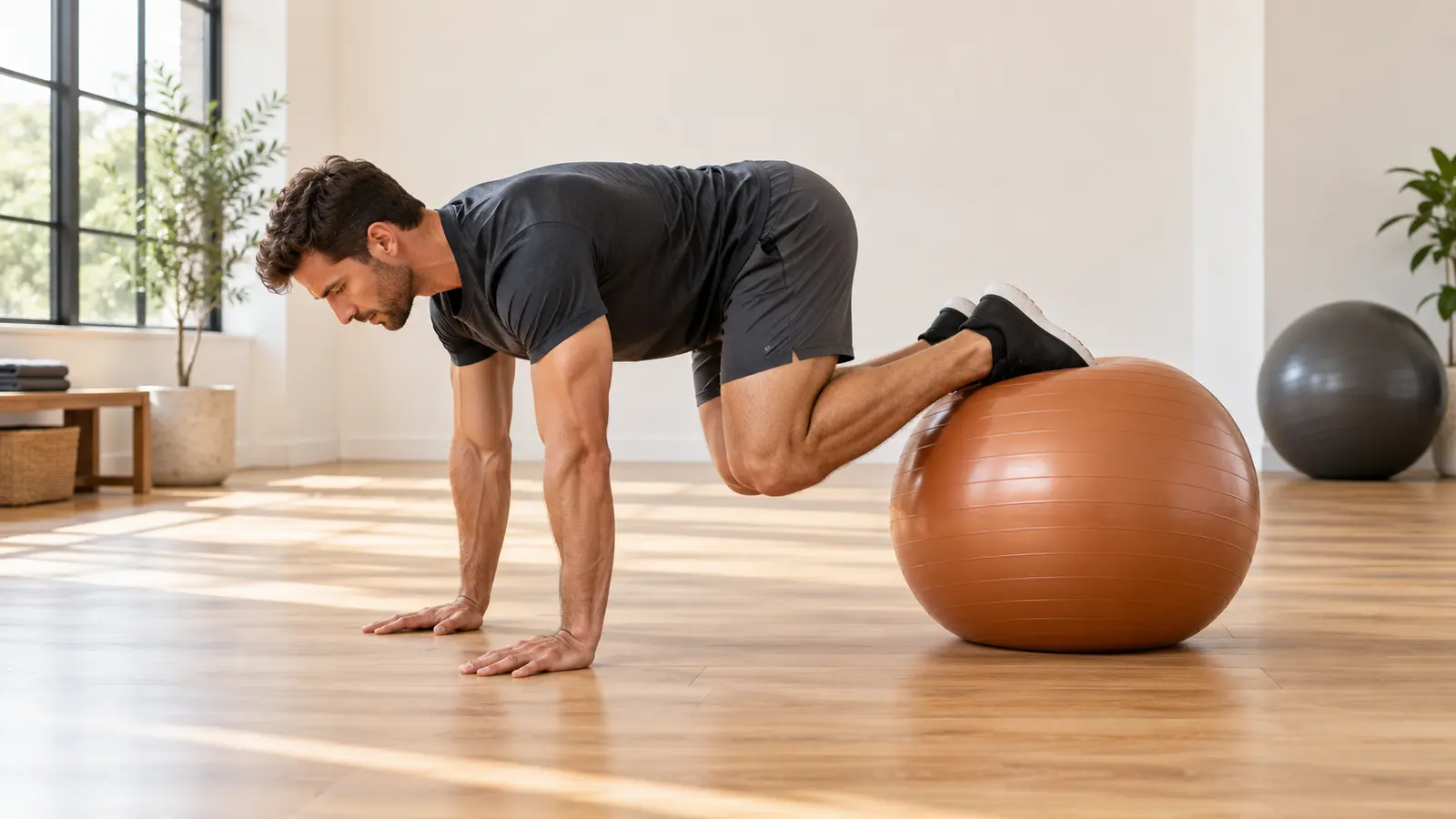
Stability Ball Knee Tuck
Works: Abdominals, hip flexors and shoulders
- Begin in a high plank with your shins on the ball.
- Keep your shoulders stacked over your hands.
- Pull your knees toward your chest, allowing the ball to roll forward.
- Extend your legs slowly without letting your back sag.
Modification: Hold the starting plank or begin with the ball closer to your knees.
Target: 5–10 repetitions.
Stability Ball Back Extension
Works: Spinal erectors, glutes and upper back
- Kneel or stand with your hips and abdomen supported by the ball.
- Anchor your feet against a wall if needed.
- Begin with your torso angled over the ball.
- Lift until your body reaches a neutral line, then lower slowly.
Form cue: Stop at neutral rather than hyperextending your lower back.
Beginner target: 8–12 repetitions.
Stability Ball Chest Press
Works: Chest, triceps, shoulders and glutes
- Sit on the ball holding light dumbbells, then walk forward until your head and upper back are supported.
- Lift your hips into a bridge and place your feet firmly on the floor.
- Press the weights over your chest without banging them together.
- Lower until your elbows reach a comfortable position.
Modification: Learn the dumbbell press on the floor or a bench before adding the ball.
Target: 8–12 repetitions with a manageable weight.
Seated Stability Ball March
Works: Deep core, hip flexors and postural muscles
- Sit tall near the center of the ball with your feet flat and wide enough for control.
- Brace gently without holding your breath.
- Lift one foot a small distance from the floor.
- Set it down quietly and alternate sides.
Modification: Keep your fingertips on a stable counter or wall.
Beginner target: 6–10 lifts per side.
Stability Ball Dead Bug
Works: Abdominals and hip control
- Lie on your back and hold the ball between your hands and bent knees.
- Press gently into the ball to create tension.
- Extend the opposite arm and leg without letting your lower back lift.
- Return to the center and alternate sides.
Modification: Move one limb at a time or reduce the range.
Target: 5–8 repetitions per side.
Feet-Elevated Stability Ball Push-Up
Works: Chest, triceps, shoulders and core
- Begin in a high plank with your shins supported on the ball.
- Keep your body rigid and hands slightly wider than shoulder-width.
- Bend your elbows and lower your chest toward the floor.
- Press back up without letting your hips drop or rotate.
Modification: Use a floor, wall or bench push-up first. Moving the ball closer to your knees generally improves control.
Target: 5–10 repetitions.
Stability Ball Reverse Hyper
Works: Glutes, hamstrings and lower-back stabilizers
- Lie facedown with your hips supported on the ball and hands firmly on the floor.
- Begin with your toes touching the floor.
- Squeeze your glutes and lift your legs until they align with your torso.
- Lower slowly without swinging.
Form cue: Lift through your hips and stop before your lower back compresses.
Target: 6–12 repetitions.
Stability Ball Adductor Squeeze
Works: Inner thighs and deep core
- Lie on your back with your knees bent and feet flat.
- Place a small exercise ball between your knees. If using a large stability ball, position it where you can squeeze safely without forcing your hips wide.
- Exhale and apply gentle, even pressure.
- Hold briefly, then release without letting the ball drop.
Form cue: Use moderate pressure. This is not a maximum-effort crush.
Target: 8–12 squeezes with 2–3-second holds.
Supported Stability Ball Mobility Roll
Works: Shoulders, upper back and hips through a gentle range
- Kneel in front of the ball with your hands resting on top.
- Sit your hips back while rolling the ball forward.
- Allow your chest to lower between your arms without forcing the shoulders.
- Pause, breathe and return to the starting position.
Modification: Perform the movement standing with the ball on a table or against a wall.
Target: 5–8 slow repetitions or 3–5 relaxed breaths.
A Full-Body Stability Ball Workout
You do not need to perform all 15 movements in one session. This balanced routine uses eight exercises and should take roughly 25–35 minutes, depending on your rest periods.
| Exercise | Sets | Repetitions or time | Rest |
|---|---|---|---|
| Wall squat | 2–3 | 8–12 | 45–60 seconds |
| Chest press | 2–3 | 8–12 | 60 seconds |
| Glute bridge | 2–3 | 10–15 | 45 seconds |
| Seated march | 2 | 8 per side | 30 seconds |
| Hamstring curl | 2–3 | 6–12 | 45–60 seconds |
| Forearm rollout | 2 | 6–10 | 45 seconds |
| Back extension | 2 | 8–12 | 45 seconds |
| Supported mobility roll | 1–2 | 5–8 slow repetitions | As needed |
Beginners can complete one or two sets and skip any exercise that feels unstable. More experienced users can substitute knee tucks, feet-elevated push-ups or reverse hypers after mastering the easier movement patterns.
How to Progress Stability Ball Workouts
Make an Exercise Easier
- Place the ball against a wall.
- Widen your stance.
- Shorten the range of motion.
- Use a stable support.
- Reduce the load or hold time.
- Choose the floor-based version.
Make an Exercise Harder
- Narrow your base gradually.
- Increase repetitions before adding load.
- Slow the lowering phase.
- Add a brief pause.
- Move farther from the ball’s center of support.
- Progress only one variable at a time.
Instability is a tool, not the goal. If adding movement makes your technique deteriorate, return to the previous variation. Stable exercises may be the better choice when your main objective is lifting heavier loads or producing maximum force.
Common Stability Ball Exercise Mistakes
Using the Wrong Size Ball
A ball that is too large or too small can change your joint angles and make the exercise setup awkward. Check the manufacturer’s chart rather than choosing by color or assuming one size fits everyone.
Progressing Before You Can Hold Position
A shaky plank is not automatically more effective. Build control with the ball supported by a wall or practice a stable floor variation first.
Holding Your Breath
Breathe continuously. Exhaling during the hardest portion of an exercise often helps maintain trunk tension without unnecessary straining.
Using Momentum
Fast repetitions can hide poor control and cause the ball to move unexpectedly. Use a deliberate tempo and finish each repetition before beginning the next.
Ignoring the Training Area
Remove sharp objects, inspect the ball and avoid slick flooring. Leave enough open space to dismount safely if you lose your position.
Choosing a Ball for These Exercises
Look for the correct diameter, a textured nonslip surface, clear inflation directions and a design intended for exercise. Anti-burst does not mean puncture-proof. It generally describes how the ball is intended to deflate after certain types of damage.
If you still need equipment, compare our best stability balls for exercise. If you are deciding between a round ball and a dome-shaped trainer, see our half ball versus full ball comparison.
Frequently Asked Questions
Are stability ball exercises good for beginners?
Yes, provided the exercise matches the person’s current ability. Wall squats, supported bridges, seated marches and mobility rolls are more approachable starting points than knee tucks or feet-elevated push-ups.
Can a stability ball workout train the whole body?
Yes. A balanced session can include squat, bridge, hamstring, pushing, trunk-stability and mobility movements. The ball does not replace every piece of strength equipment, but it can support a useful full-body routine.
How often should I do stability ball exercises?
Two nonconsecutive sessions per week is a reasonable starting point for a full-body, strength-focused routine. Your training frequency should reflect your experience, total workload and recovery.
Do stability ball exercises burn belly fat?
No exercise selectively removes fat from one area. Stability ball exercises can strengthen and train your trunk, while changes in body fat depend on your broader activity, nutrition and energy balance.
Is a stability ball the same as a Swiss ball?
Usually, yes. Stability ball, Swiss ball, exercise ball and yoga ball commonly describe the same large, inflatable round ball.
Should I use a stability ball as a desk chair?
It is better viewed as an occasional seating option than an automatic posture solution. Alternate positions, take regular movement breaks and use a supportive chair when you become fatigued.
Build Control Before Complexity
The most productive stability ball workouts are built on repeatable positions. Begin with wall squats, bridges, seated marches and supported mobility. Add curls, rollouts and loaded presses once you can keep the ball controlled. Save knee tucks, feet-elevated push-ups and reverse hypers for the point when the foundational versions feel steady.
Leave a Reply