
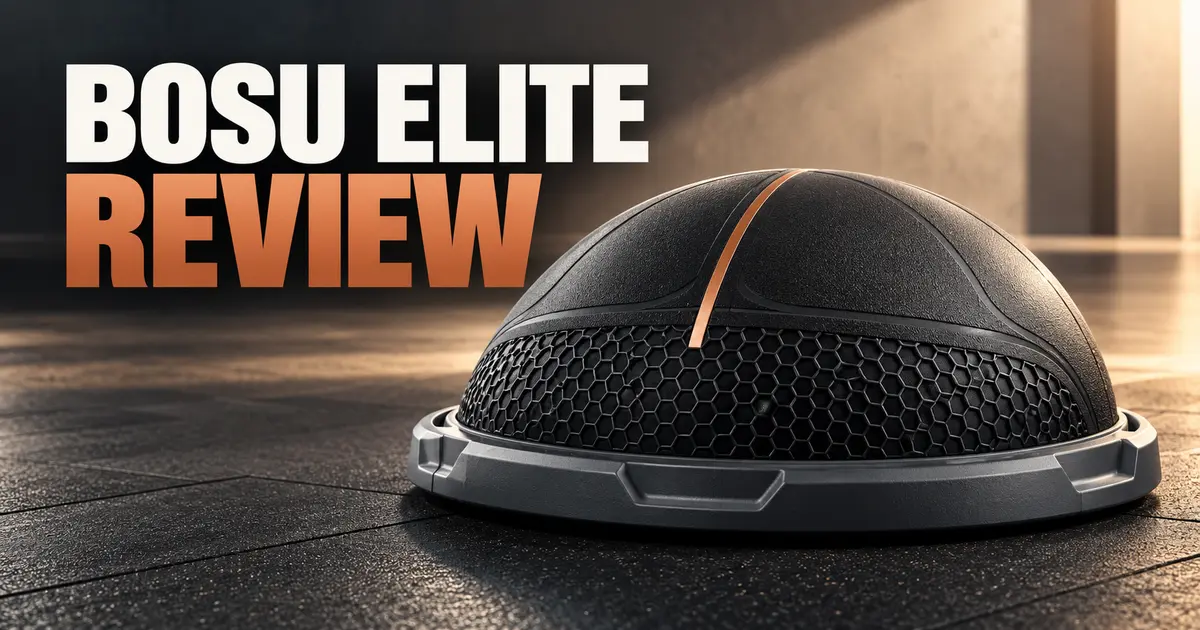

The BOSU Elite is best for experienced exercisers, athletes and coaches who want a firmer, resistance-focused balance trainer. Its high-density Reactive Dome, reinforced platform and marked Power Zone distinguish it from the softer, general-purpose BOSU models. Beginners can use it, but most casual home users do not need its specialized feel.
BOSU Elite review: quick verdict
The BOSU Elite is a thoughtfully differentiated performance model rather than a cosmetic upgrade. Its denser dome is designed to push back more firmly when compressed, while the Power Line and textured Power Zone provide repeatable placement cues for hands and feet.
That makes it most useful when a training plan specifically uses force application, dynamic isometrics, loaded positions or athletic movement drills.
Buy it if: you already use balance trainers, want a firmer resistance-focused dome and will take advantage of the placement markings.
Skip it if: you primarily want gentle balance practice, general mobility or an affordable first half-ball trainer.
What is the BOSU Elite?
The BOSU Elite by WeckMethod is a performance-oriented half-ball trainer with a high-density dome attached to a reinforced rigid platform. It retains the familiar BOSU shape but shifts the emphasis from general instability toward resistance, feedback and repeatable positioning.
BOSU’s current product description explicitly distinguishes the Elite from the Original Balance Trainer: the Elite focuses more heavily on resistance training. WeckMethod describes the denser dome as a surface that stores and returns force when compressed. That idea drives the product’s design and the exercise programming associated with it.
The Elite can still support familiar exercises such as squats, push-ups, planks and balance holds. The difference is that its firmer surface and placement markings are designed for more intentional loading rather than simply making the surface wobble.
BOSU Elite specifications
| Specification | BOSU Elite | What it means |
|---|---|---|
| Platform diameter | 25 inches according to the owner’s manual | A full-size training footprint for standing, kneeling and upper-body exercises. |
| Recommended height | Approximately 8.5 inches | The Elite manual warns not to exceed 8.5 inches of inflation. |
| Dome | High-density Reactive Dome | Firmer resistance and feedback than a standard general-purpose dome. |
| Platform | Reinforced rigid base with recessed handles | Supports turning, carrying and approved exercises with the platform facing up. |
| Surface cues | Power Line and honeycomb Power Zone | Visible and tactile reference points for hand and foot placement. |
| Included items | Listings commonly identify a pump and owner’s manual | Confirm the current Amazon package before purchasing. |
| Weight limit | Published sources conflict | The older owner’s manual lists 400 pounds, while some current sellers list different limits. Verify the live listing and documentation supplied with the unit. |
| Warranty | Often listed as two years | Confirm current coverage, seller authorization and terms before ordering. |
Key BOSU Elite features
High-density Reactive Dome
The dome is the most important difference between the BOSU Elite and the company’s general-purpose trainers. It is designed to feel denser and resist compression more strongly. BOSU describes this surface as a Reactive Dome, while WeckMethod discusses dynamic elastic resistance and force return.
In practical terms, the surface should feel less soft and yielding than a standard BOSU dome. That can be useful for forceful presses, athletic stance work and exercises in which you intentionally drive into the dome. It may be less comfortable for someone who mainly wants gentle kneeling, stretching or introductory balance work.
Power Zone
The Power Zone is the honeycomb-textured section of the dome. It provides a tactile target that can help users feel whether their foot or hand is contacting the intended portion of the surface.
This does not automatically correct technique. It gives the coach or user a repeatable reference point. The value increases when an exercise program specifies where and how to apply pressure.
Power Line
The marked Power Line runs across the dome and includes reference points for positioning. It can make stance width, hand placement and repeated setup more consistent.
Coaches may find this particularly useful when teaching several athletes or repeating the same drill over multiple sessions.
Reinforced platform
The rigid base is designed for demanding use and includes recessed handles. The trainer can be used dome-side up or, for approved exercises, platform-side up. Platform-up training presents a greater fall risk and should be introduced cautiously.
Honeycomb grip and visual cueing
The textured grip and visible markings make the Elite look more technical than the standard blue BOSU. More importantly, they create touch and sight cues that can help with consistent placement.
Those features are most valuable to users who follow structured programming rather than selecting random balance exercises.
How the BOSU Elite fits into training
Resistance-focused training
The Elite’s primary purpose is not simply to maximize wobble. BOSU positions it as a resistance-focused tool. Pressing into the firmer dome during a squat, push-up, split stance or isometric hold changes the feedback compared with a softer surface.
That does not mean it replaces barbells, dumbbells or stable resistance exercises. Stable surfaces remain more appropriate for many maximum-strength and muscle-building goals.
The Elite is better viewed as a supplemental tool for force direction, coordination, stance work and dynamic tension.
Speed and athletic drills
Athletes may use the Power Line and Power Zone to repeat foot-placement and force-application drills. The firmer dome may provide faster feedback when pushing into or away from the surface.
Exercise selection still needs to match the athlete, sport and training phase.
Balance work
The Elite can train balance, but it is not necessarily the best first purchase for someone whose only goal is basic stability practice. Its dense dome and performance programming are the reasons to choose it.
A standard BOSU or less specialized half-ball trainer may be more approachable for general balance work.
Core training
Planks, push-ups, mountain climbers, bridges and resisted isometric positions can all use the Elite. The dome’s firmness may make it easier to press forcefully into the marked zones while maintaining a specific setup.
BOSU Elite exercise ideas
Good starting exercises
- Supported two-foot stance
- Power Zone weight shifts
- Shallow squat with wall support
- Incline push-up
- Forearm plank
- Glute bridge with feet on the dome
More advanced applications
- Dynamic isometric squat press
- Loaded goblet squat to the dome
- Athletic stance and force-direction drills
- Explosive hand-release push-up variations
- Split-stance power holds
- Platform-up plank variations
Advanced does not simply mean faster. A slower isometric press into the Power Zone can be demanding when the user applies force intentionally and maintains position.
Begin with the dome side up and become familiar with the surface before trying platform-up exercises.
What we like about the BOSU Elite
- Clear product purpose: It targets resistance and athletic training rather than being another general balance dome.
- Useful placement cues: The Power Line and Power Zone support repeatable hand and foot positions.
- Firmer training surface: The high-density dome is designed for stronger compression and feedback.
- Full-body versatility: It supports standing, kneeling, supine, prone and upper-body exercises.
- Coach-friendly layout: Numbered and textured targets can simplify cueing during structured training.
- Reinforced construction: The base and dome are designed around more demanding performance use.
Potential drawbacks
- Specialized for many home users: Beginners may not use the resistance-focused features enough to justify this model.
- Firmer feel: Users wanting a softer surface for mobility or gentle exercise may prefer another trainer.
- Higher purchase price: The Elite normally sits toward the premium end of the half-ball category.
- Bulky storage: The rigid 25-inch platform does not fold or roll away.
- Learning curve: The Power Line and Power Zone become more valuable when the user understands their programming.
- Conflicting published weight limits: Buyers need to verify the current model documentation.
BOSU Elite vs Original and NexGen models
| Feature | BOSU Elite | Standard or NexGen BOSU |
|---|---|---|
| Primary emphasis | Resistance, force application and performance training | General balance, strength, cardio, mobility and home fitness |
| Dome feel | High-density and firmer | More conventional balance-trainer response |
| Placement system | Power Line and honeycomb Power Zone | NexGen models use quadrants and surface markings; other models vary |
| Best user | Experienced exerciser, athlete or coach | Beginner through experienced general fitness user |
| Mobility and gentle use | Usable, but not its main advantage | Often the more natural fit |
| Value | Strong when its specialized resistance features are used | Stronger for broad, general-purpose training |
If you want one half-ball trainer for mixed family workouts, beginner balance, mobility and general exercise, the NexGen or standard BOSU models may be the more practical purchase.
If you specifically want a denser dome for performance programming and repeatable force-placement cues, the Elite has a meaningful advantage.
Who should buy the BOSU Elite?
The BOSU Elite is a good fit for:
- Athletes incorporating stance, power and force-direction drills
- Experienced users who find a standard BOSU dome too soft
- Coaches who value consistent visual and tactile placement cues
- Home-gym owners who want a premium performance-oriented trainer
- Users following WeckMethod or BOSU Elite-specific programming
Consider another model if:
- You are completely new to unstable-surface exercise
- Your main priorities are gentle balance, stretching or mobility
- You want the most affordable half-ball trainer
- You will not use the Power Zone, Power Line or firmer dome
- You need compact equipment that can be stored in a small cabinet
Setup, inflation and safety
The BOSU Elite owner’s manual specifies an inflated height of approximately 8.5 inches and warns against exceeding that measurement. This differs from the broader maximum guidance published for some other BOSU models, so follow the Elite-specific manual packaged with your unit.
Set the trainer on a level, nonslip surface with enough space to step off in any direction. Become comfortable stepping onto and off the dome before progressing.
The manual recommends using a wall or stable surface for support when beginners acclimate to the dynamic surface.
Platform-side-up exercises increase fall risk. Use them only after mastering appropriate dome-side-up movements, and follow the manufacturer’s safety instructions.
For general inflation guidance, see how to inflate a BOSU ball and adjust firmness .
Frequently asked questions
Is the BOSU Elite worth it?
It is worth considering for athletes, coaches and experienced users who will use the firmer dome and placement markings. A general fitness user may receive better value from a standard or NexGen BOSU.
What makes the BOSU Elite different?
Its defining features are the high-density Reactive Dome, reinforced platform, marked Power Line and honeycomb Power Zone. BOSU positions it more toward resistance training than general instability training.
Is the BOSU Elite harder than a regular BOSU?
It feels different because the dome is denser and pushes back more firmly. Whether an exercise is harder depends on the movement, setup and user. It is not automatically more unstable in every position.
Can beginners use the BOSU Elite?
Yes, provided they begin dome-side up near a stable support. However, beginners who do not need its resistance-focused features may find a general-purpose trainer more economical and approachable.
How high should the BOSU Elite be inflated?
The Elite owner’s manual shows an 8.5-inch height and warns not to exceed 8.5 inches. Measure from the platform to the top of the dome and follow the current manual supplied with the product.
Can the BOSU Elite be used platform side up?
The product supports approved exercises in either orientation, but platform-side-up use increases fall risk. Become familiar with the trainer dome-side up first and follow the manual.
What is included with the BOSU Elite?
Current listings commonly identify a pump and owner’s manual. Package contents can change, so verify the live Amazon offer before purchasing.
Final verdict: should you buy the BOSU Elite?
The BOSU Elite is one of the more purposeful premium half-ball trainers available. The high-density dome, reinforced base and placement markings all support the same idea: applying force into a repeatable position rather than adding instability for its own sake.
That makes it a compelling choice for the right buyer. Athletes, experienced exercisers and coaches can use features that a general-purpose trainer does not emphasize.
Beginners and casual home users should be honest about whether those features will change their training. If not, a standard BOSU or another quality balance ball may deliver better value.
Bottom line: Buy the BOSU Elite for its firmer resistance and performance-oriented cueing—not simply because it is the premium model.
View the BOSU Elite on Amazon Compare more balance balls
Leave a Reply